From 8/2/2007 to 10/1/2007 (almost 20 years ago today) I worked at Hanford in eastern Washington State. On weekends I drove over to Seattle to visit my daughter!
Hanford is a nuclear site operated by the Department of Energy (DOE). Every two years each DOE site is charged with hiring an outside engineering firm to analyze the operation of the site. I was working for an engineering firm Project Time and Cost (PT&C). Our job was to analyze all of their operations and determine if they had enough staff and equipment to do their assigned task. Most of the sites I analyzed did not have enough of either. Unfortunately Musk cut more from some!
Some of the most significant DOE nuclear sites include:
Hanford Site I spent time there – Produced plutonium for the Manhattan Project and Cold War; now one of the world’s largest environmental cleanup projects.
Savannah River Site I spent time there– Produced materials for nuclear weapons; now focuses on cleanup, tritium, and waste management.
Idaho National Laboratory – Nuclear reactor research and waste management.
Oak Ridge Reservation I spent time there– Includes multiple facilities involved in uranium enrichment, research, and national security.
Los Alamos National Laboratory – Nuclear weapons design and stockpile stewardship.
Lawrence Livermore National Laboratory – Nuclear weapons research and high-performance computing.
Pantex Plant – Assembly and disassembly of U.S. nuclear warheads.
Y-12 National Security Complex – Uranium processing and storage.
Kansas City National Security Campus – Manufactures non-nuclear components for nuclear weapons.
Nevada National Security Sites I spent time there– Former nuclear test site, now used for national security research.
In order for me to get access to secure areas of the DOE operations I had obtained a “Q” clearance. Most of my coworkers had a “M” clearance but PT&C decided to spend the money and time (it took two years) for me to get all the way from M to the Q clearance. My neighbors asked me “Were those really the FBI that came around asking about you?’
It is funny that the Qanon people follow someone that claimed he had a Q clearance. I do not believe that a person who advanced to a Q clearance would risk his clearance.
A central figure in the origins of QAnon was the anonymous online poster known simply as “Q.”
The name “Q” refers to Q clearance, a real U.S. Department of Energy security clearance. A Q clearance grants access to highly classified information related to nuclear weapons and nuclear materials. It is roughly comparable in sensitivity to a Top Secret clearance in other parts of the federal government, though the systems are administered differently.
QAnon began in October 2017 when someone posting as “Q” on the imageboard 4chan (and later 8kun) claimed to have a Q clearance and therefore access to highly classified government information. The posts, called “Q drops,” consisted of cryptic messages, questions, and predictions. Followers tried to decode these messages, believing they revealed hidden events and plans.
It’s important to note that:
There is no verified evidence that the person or people behind “Q” actually held a Q clearance.
The identity of “Q” has never been conclusively established.
Numerous journalists and researchers have investigated Q’s identity, but no single conclusion has been universally accepted.
So, while QAnon followers generally accepted the claim that “Q” possessed a Q clearance, that claim itself has never been substantiated.
To show how important my Q clearance was, there are reportedly only four people who have the top clearance: the quote “R” clearance. One is given to the President (even though he is not usually informed as to what is going on) and there are three employees who have attained that clearance. Each of the three are not allowed to be sick! If they want to take an over the counter pill for anything, they need to inform the DOE doctor. If the doctor thinks that the medicine would at all impare them, they will be placed on leave. Those with the R clearance are the only ones privy to where all of our nuclear material is and what all of the nuclear program is doing. I became friends with the guy in Hanford who has an R clearance and he allowed me to go places at the site where no one else has been before. Very interesting indeed.
At another site I gave a presentation to the top R clearance person from Washington DC to push for more money and more equipment because the site was going backward!
Each time I was assigned to a DOE site I spent time driving all over the site to get the lay of the land. PT&C supplied the car and gas, so off I went. In addition at the Nevada site I rented an airplane and pilot to see the site from the air! All of the sites are heavily guarded and the public is not allowed. So, I could drive everywhere with no traffic and only was stopped a few times by security, but I had my badges and was not detained.
Jump to today.
I was watching a program on TV that is called “Where on Earth?” on the “Space and Beyond” channel.
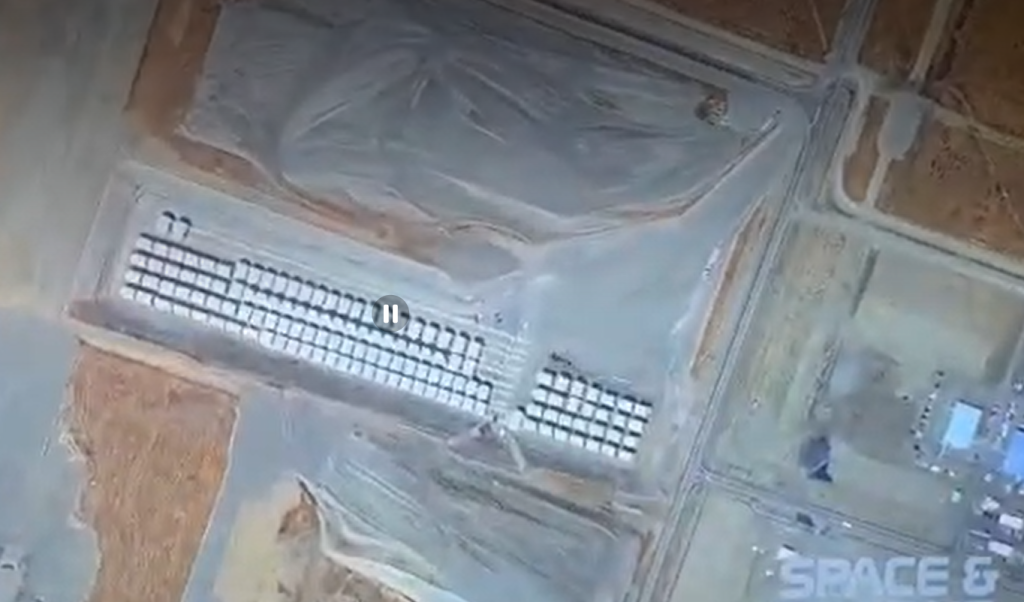
Where on Earth? is a documentary-style program that explores unusual places, mysterious structures, satellite imagery, archaeology, and scientific discoveries. Episodes often ask questions like “What is this strange object?” or “Why does this place look so unusual from space?” and then explain the science or history behind it. Below is the interesting photo from Google Earth for this episode: What are those strange white dots they asked?
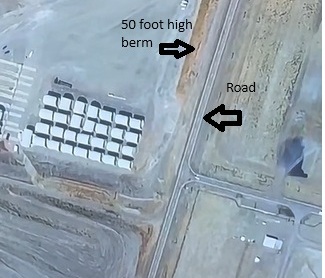
Storage area at the Hanford Site where defueled reactor compartments from retired U.S. Navy nuclear submarines and cruisers are stored.
Here’s what those objects are:
- When a U.S. nuclear-powered submarine is retired, the entire reactor compartment—the middle section containing the nuclear reactor—is cut out of the submarine. (The bow and stern are then welded to a new nuclear reactor!)
- The spent nuclear fuel is removed first at Puget Sound Naval Shipyard.
- The empty but still radioactive reactor compartment is then sealed with thick steel bulkheads on both ends, creating a large cylindrical package.
- That package, typically about 30–40 feet (9–12 m) in diameter and 100 feet (30 m) or more in length, is transported by barge up the Columbia River and then overland to Hanford.
- At Hanford, the compartments are placed in engineered trenches and eventually covered for long-term disposal.
From directly overhead, the rounded ends of these huge cylinders can make them look like rows of giant white capsules.
The program is referring to the Reactor Compartment Disposal Facility, which has received reactor compartments from:
- Los Angeles-class submarines,
- Ohio-class submarines ,
- Earlier submarine classes, and
- Several nuclear-powered cruisers.
This is one of the few places in the world specifically designed for the long-term disposal of these massive reactor compartments.