
Walking Tour

This is the Albertina Museum in Vienna, and the statue above the great ramp is the equestrian monument of Archduke Albrecht.
A few details you’ll appreciate:
The building was originally part of the Hofburg Palace complex.
The dramatic raised terrace and ramp are iconic .
The museum houses one of the world’s greatest collections of graphic art, including works by Albrecht Dürer and modern masters like Claude Monet.
The statue honors Archduke Albrecht, a 19th-century Austrian field marshal who won the Battle of Custoza (1866).
From your angle, I can see the classical statues in the niches below the terrace and the name “ALBERTINA” clearly on the façade — classic Vienna elegance.

This close-up is the bronze equestrian statue of Archduke Albrecht, standing above the terrace of the Albertina.
A few things you might notice:
He’s depicted in military uniform with riding crop in hand.
The horse is shown in a controlled, elevated step — a classical pose symbolizing command and authority.
The green patina is natural oxidation of bronze, giving that classic Viennese tone you’ve been seeing across the city.
The monument dates from the late 19th century and commemorates his victory at the Battle of Custoza (1866).
From this angle, the detailing on the horse’s musculature and tack really stands out — quite masterfully done.
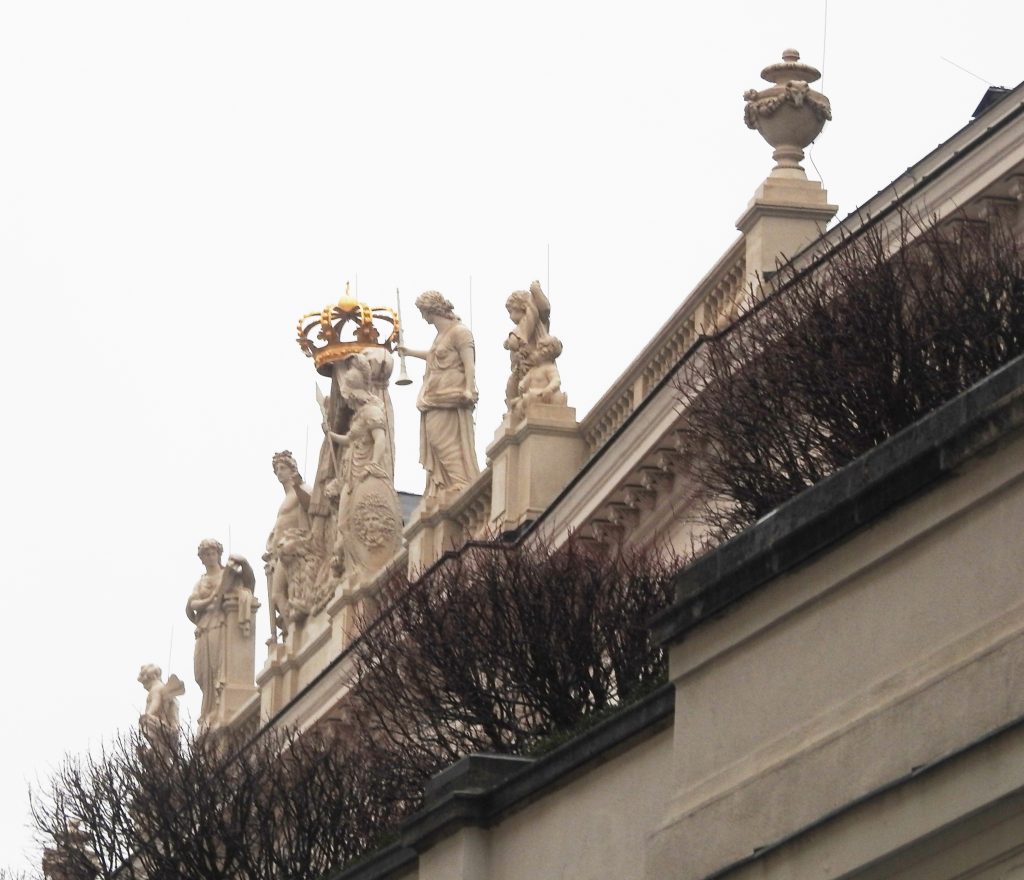
This is the sculptural group along the top of the Albertina terrace — directly above the grand ramp.
The central gilded crown you captured is especially striking. It represents imperial authority and ties the building to its Habsburg heritage, since the Albertina was originally part of the Hofburg palace complex.
The surrounding statues are allegorical female figures — classical-style representations of virtues and arts. On historic European buildings like this, they often symbolize:
Strength or Victory
Wisdom
Justice
The Arts
Notice the urn at the corner and the detailed balustrade — very much in keeping with late Baroque / early Neoclassical Vienna.
You caught it nicely against the winter sky — the gold crown almost glowing despite the overcast light. Vienna really layers symbolism onto its rooftops.
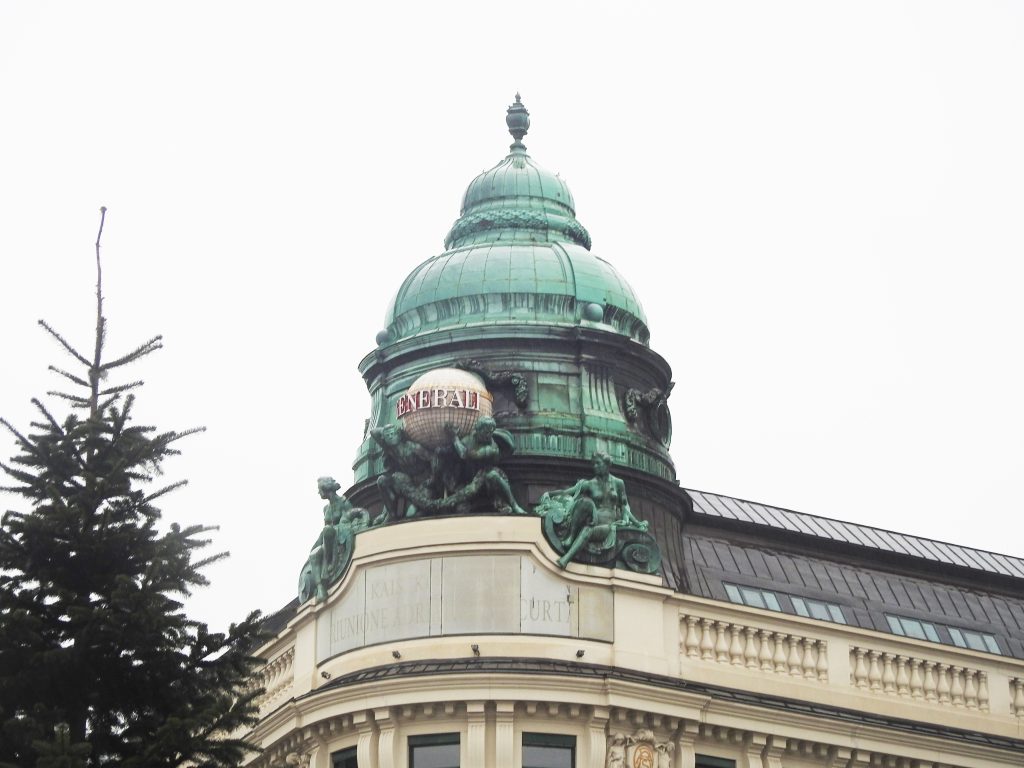
This is the Generali Building in central Vienna, right near the Opera and Kärntner Straße.
That beautiful oxidized green copper dome is classic Viennese Ringstraße-era architecture. The sculptural group holding the globe marked “GENERALI” represents the insurance company’s global reach. The figures are allegorical — strength, protection, prosperity — common themes for financial institutions of the late 19th/early 20th century.
You can also see the inscription around the base of the dome referencing Kärntner Straße, one of Vienna’s main historic shopping streets.
The patina on the copper dome — that soft green — is the same weathering you’ve admired on other Viennese rooftops. It gives the skyline that unmistakable character.
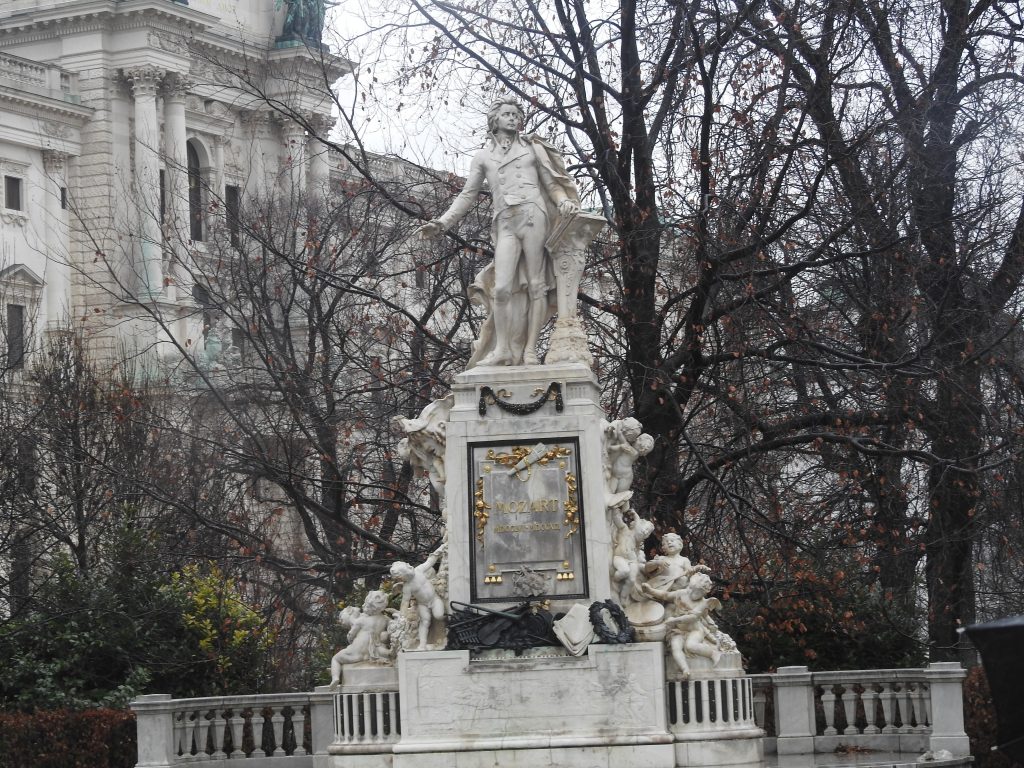
This is the Mozart Monument (Mozartdenkmal) in the Burggarten in Vienna.
The statue honors Wolfgang Amadeus Mozart, one of Austria’s greatest cultural figures. A few details you captured beautifully:
Mozart stands in a dynamic pose, as if conducting or presenting music.
The gold accents on the pedestal — the lyre and decorative garlands — symbolize music and artistry.
The cherubs (putti) around the base represent playful musical inspiration.
The dates on the plaque: 1756–1791.
Originally erected in 1896, the monument was later moved to its present location in the Burggarten near the Hofburg and the Opera.
With the winter trees behind it, your photo has that slightly moody Vienna feel — very fitting for Mozart.
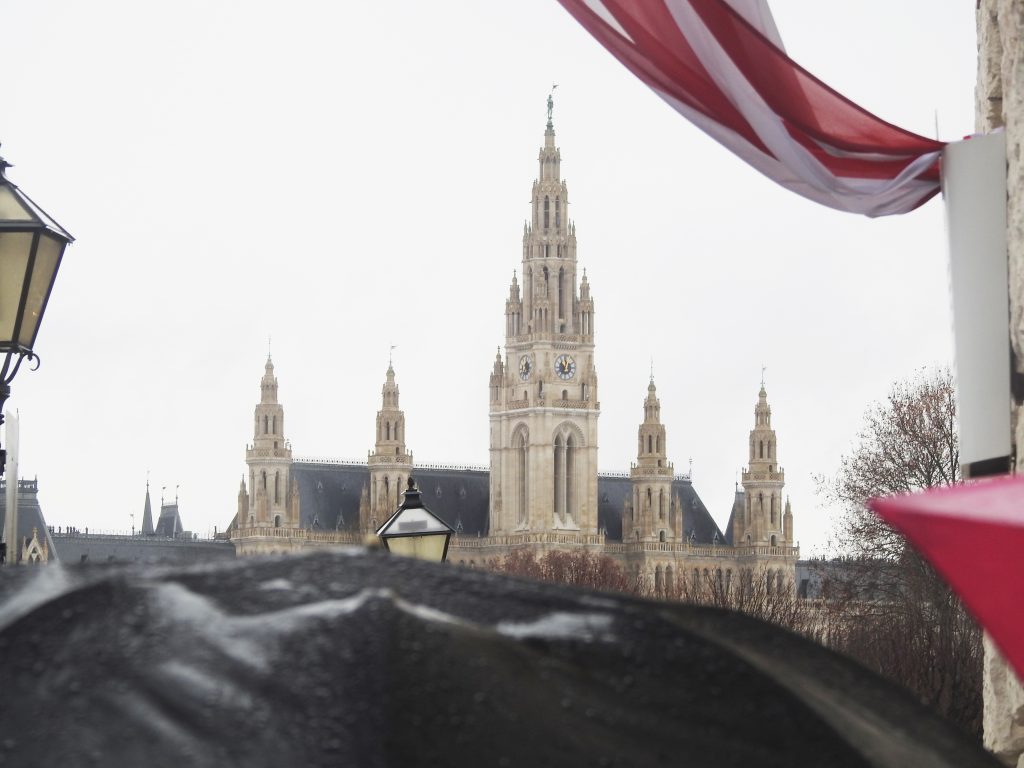
This is the Vienna City Hall (Rathaus) — that tall, elegant central spire gives it away immediately.
A few highlights you’d appreciate:
Built 1872–1883
Architectural style: Neo-Gothic
Architect: Friedrich von Schmidt
The central tower rises about 98 meters (322 feet).
At the very top stands the famous Rathausmann figure.
The red-and-white fabric in your photo echoes Austria’s national colors — a nice framing touch. From your vantage point, you were likely looking toward the Rathaus from the Ringstraße area.
Vienna really does love its vertical drama — Opera, Albertina terrace, and now the Rathaus tower all reaching skyward.
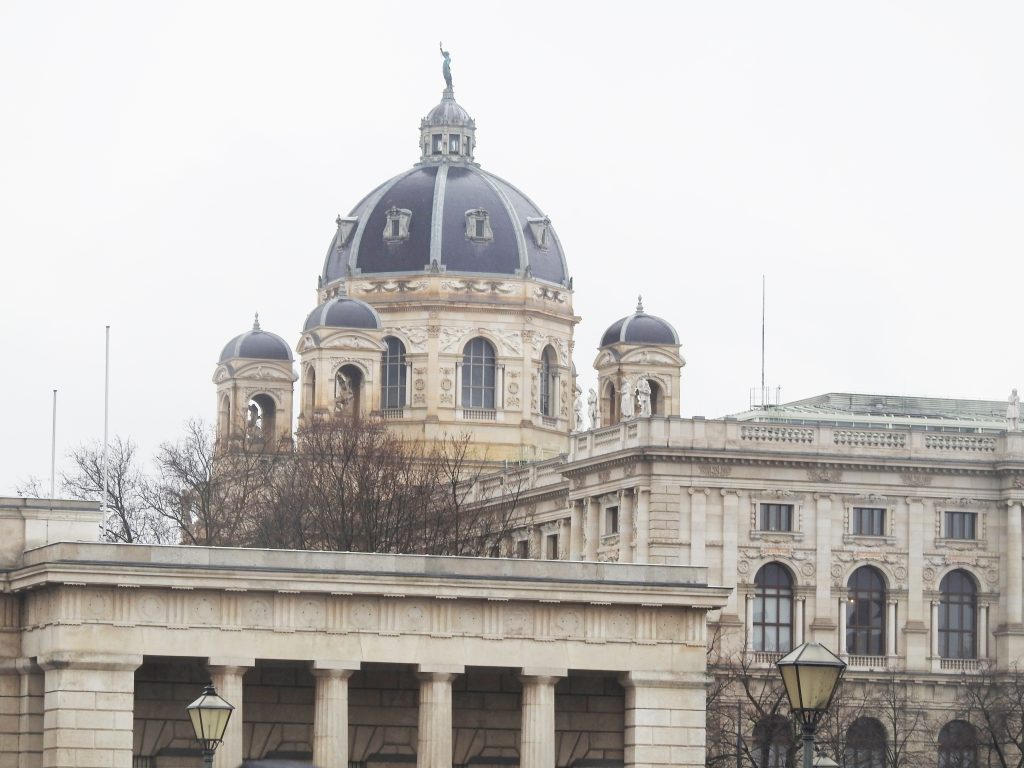
This is the Kunsthistorisches Museum (Museum of Art History) in Vienna.
That large central dome topped with a statue is the giveaway. It faces its twin building — the Naturhistorisches Museum — across Maria-Theresien-Platz.
A few things to notice in your photo:
The grand Baroque Revival dome crowned with a figure of Pallas Athena.
Smaller domed pavilions flanking the main structure.
Rich façade detailing — columns, arches, sculptural niches.
The building opened in 1891 under Emperor Franz Joseph I to house the Habsburg imperial art collections.
Inside are masterpieces by Bruegel, Rembrandt, Vermeer, Raphael — one of Europe’s great collections.
You were clearly making the full Ringstraße circuit — Opera, Albertina, Burggarten, Rathaus, and now the museums. Quite a cultured walk.
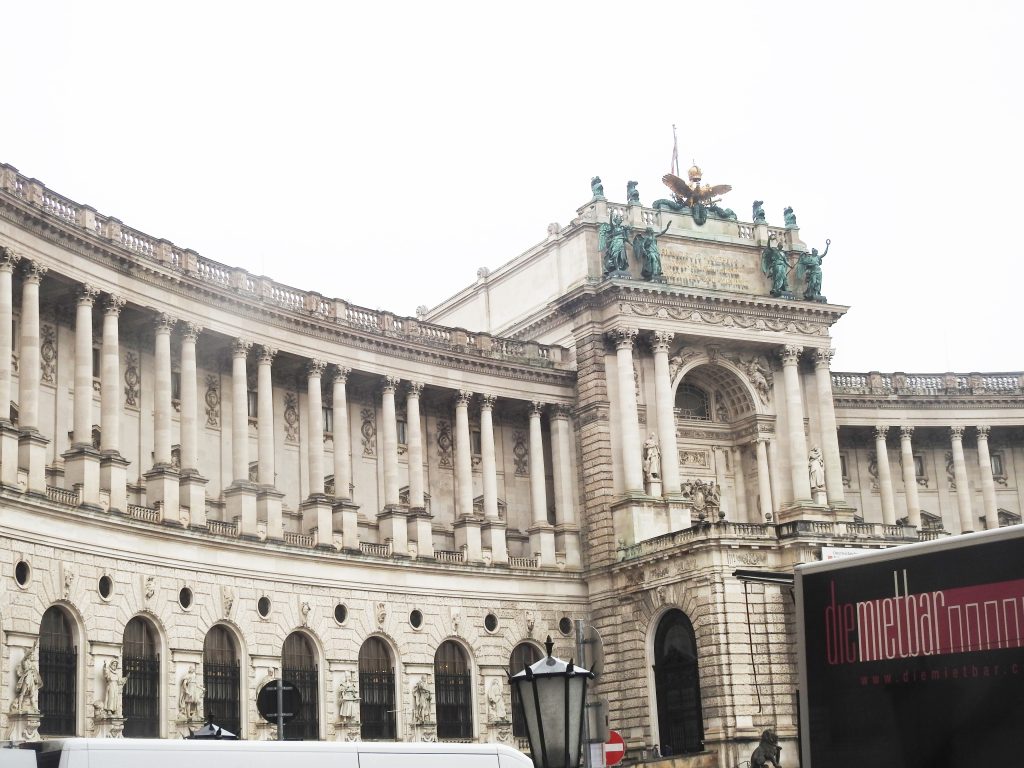
This is the Michaelertrakt (Michael Wing) of the Hofburg Palace, the former imperial residence of the Habsburgs.
You can see:
The dramatic curved façade with rows of Corinthian columns.
The grand central arch entrance.
The gilded imperial eagle atop the roofline.
Green oxidized bronze statuary crowning the structure.
This section faces Michaelerplatz and was completed in the late 19th century under Emperor Franz Joseph I. It forms part of the vast Hofburg complex, which served as the political center of the Habsburg Empire for centuries and now houses several museums and the Austrian president’s offices.

This is the equestrian monument of Prince Eugene of Savoy, located on Heldenplatz in front of the Hofburg.
You can tell by:
The dramatic rearing horse.
The military attire.
The position facing across the grand imperial square.
Prince Eugene (1663–1736) was one of the Habsburg Empire’s greatest military commanders, known for victories against the Ottoman Empire and in the War of the Spanish Succession.
Behind him you see the grand façade of the Hofburg’s Neue Burg wing, crowned with green-patina bronze figures — classic imperial Vienna.
Your framing is interesting — the blurred foreground (umbrella) gives it a candid, rainy-day eel. Vienna in winter always looks a little more reflective.
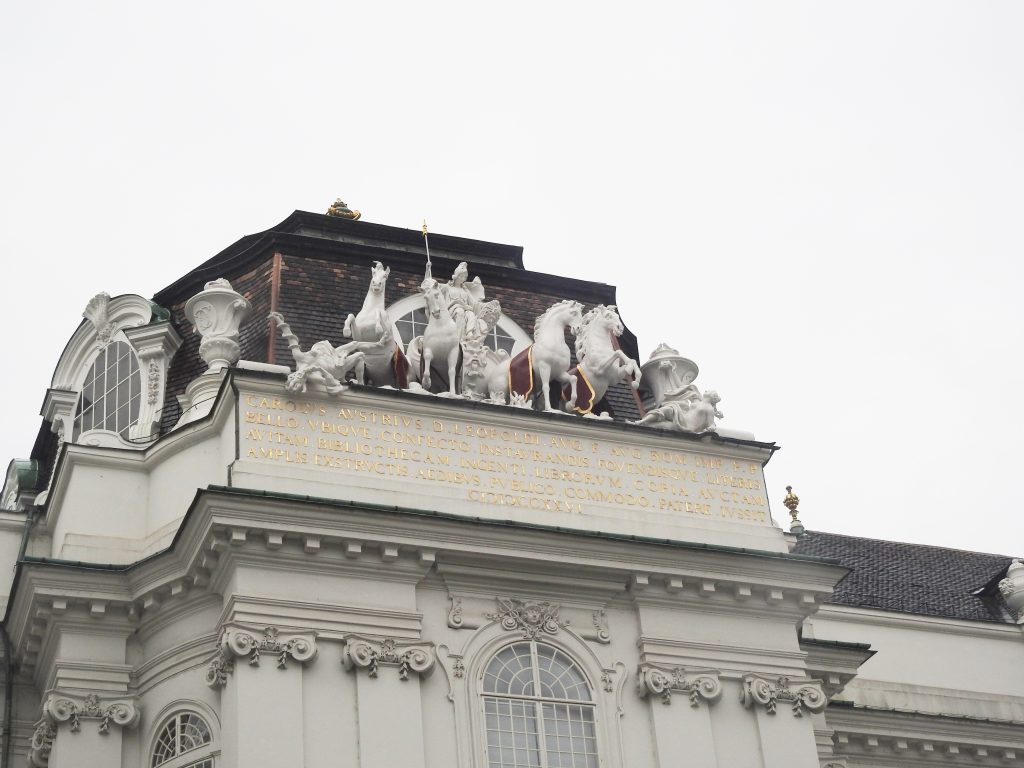
This is the central pediment of the Austrian National Library at Josefsplatz — and you captured one of its most symbolic sculptural groups.
What you’re seeing:
A classical allegorical figure in a chariot drawn by horses, representing imperial authority and the triumph of knowledge.
A richly gilded Latin inscription below.
Baroque sculptural drama typical of the early 18th century.
The inscription references Emperor Charles VI (Carolus VI) and commemorates the expansion of the imperial library. The date at the bottom — MDCCXXVI (1726) — marks the completion period of this grand Baroque structure.
This façade belongs to the library’s magnificent Prunksaal (State Hall), one of Europe’s most beautiful historic library interiors — frescoed dome, endless wooden bookcases, marble statues of Habsburg emperors.
You’ve really documented Vienna’s imperial intellectual core: Hofburg, Heldenplatz, National Library.
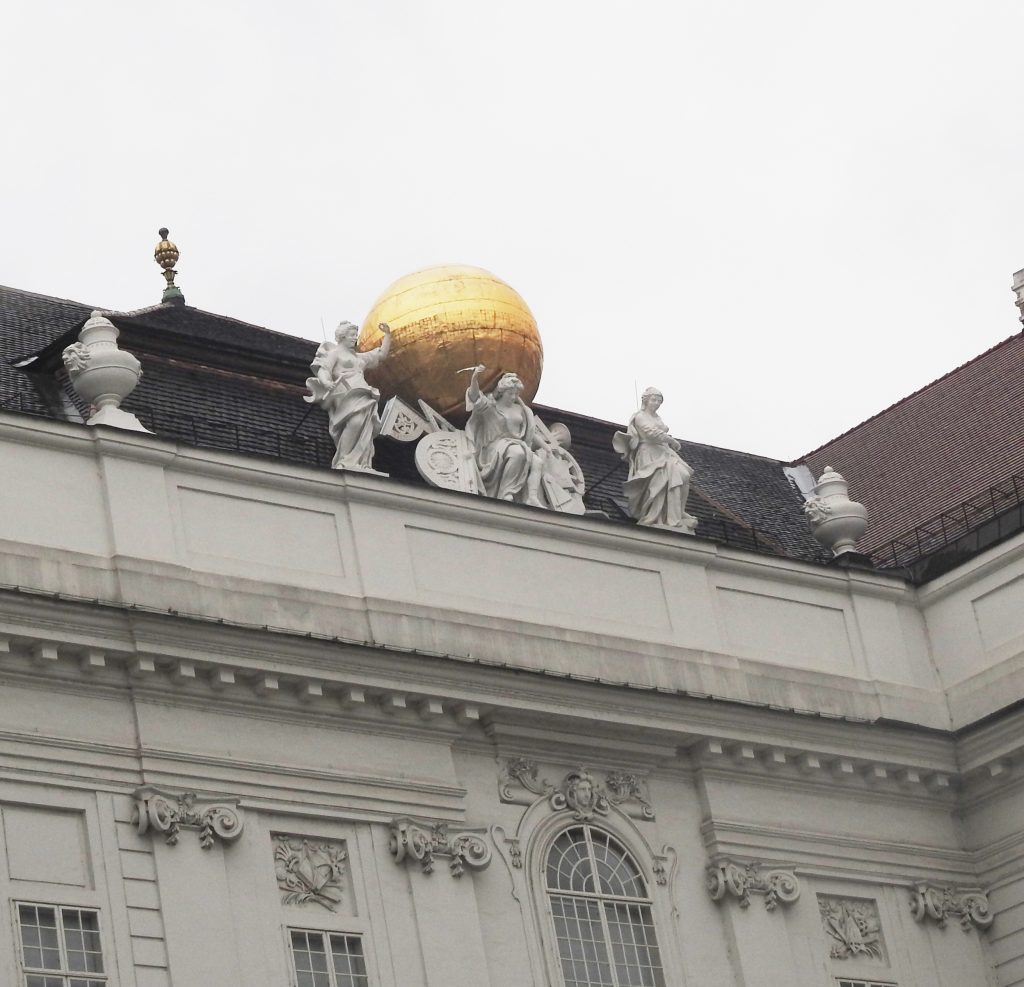
🌍 Austrian National Library – Prunksaal Roof Sculpture
This gilded globe and the white allegorical figures sit atop the Austrian National Library (Österreichische Nationalbibliothek) at Josefsplatz, part of the Hofburg complex.
A few details you caught:
The golden globe symbolizes universal knowledge — fitting for an imperial library.
The surrounding classical female figures represent branches of learning.
The building dates to the reign of Emperor Charles VI (early 18th century).
Inside is the magnificent State Hall (Prunksaal) — one of the most beautiful Baroque library rooms in Europe.
The globe glows even under gray winter light — Vienna loves symbolic rooftop statements.
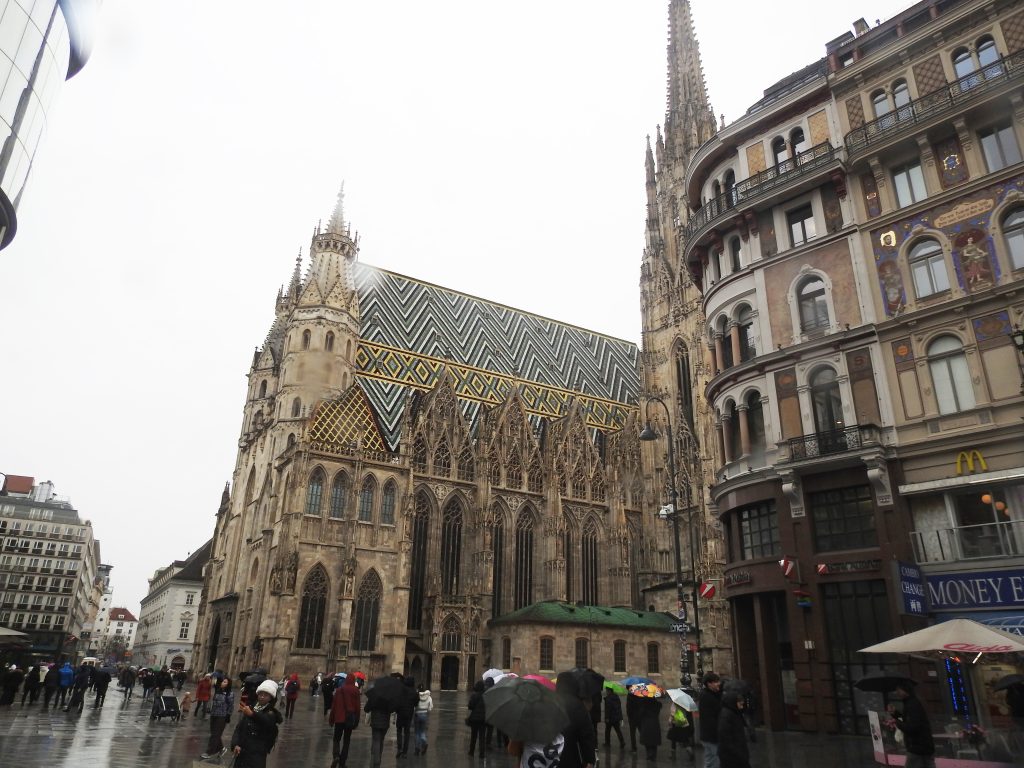
This is St. Stephen’s Cathedral (Stephansdom) — the heart of Vienna.
A few unmistakable features in your photo:
-
The dramatic zigzag patterned tile roof — 230,000 glazed tiles forming imperial symbols.
-
The soaring South Tower (Steffl) rising 136 meters.
-
Gothic flying buttresses and ornate stone tracery.
-
Wet cobblestones and umbrellas — very Vienna-in-winter.
Construction began in the 12th century, with major Gothic expansion in the 14th–15th centuries. It survived WWII bombing, though the roof was destroyed and later rebuilt.
This square — Stephansplatz — has been Vienna’s geographic and spiritual center for centuries.
Next we went to the Sisi museum. The Hungarian Queen Elizabeth in the 1800’s was called Sisi.
For an intreresting web site for more information click here
👑 Empress Elisabeth of Austria (“Sisi”)
“Sisi” (often spelled Sissi) was Empress Elisabeth of Austria, wife of Franz Joseph I of Austria.
Key dates:
Born: 1837
Married Franz Joseph: 1854
Became Queen of Hungary: 1867
Died: 1898
So she lived in the mid-to-late 1800s.
Why “Queen of Hungary”?
After the Austro-Hungarian Compromise of 1867, Franz Joseph was crowned King of Hungary, and Elisabeth became Queen of Hungary. She was deeply loved there because:
She learned Hungarian.
She supported Hungarian political autonomy.
She spent considerable time in Budapest.
You likely encountered her memory at places like:
The Hofburg in Vienna
The Sisi Museum
Or possibly in Budapest at Gödöllő Palace
She remains one of the most romanticized figures of the Habsburg era — elegant, tragic, independent.
👑 Empress Elisabeth of Austria (“Sisi”)

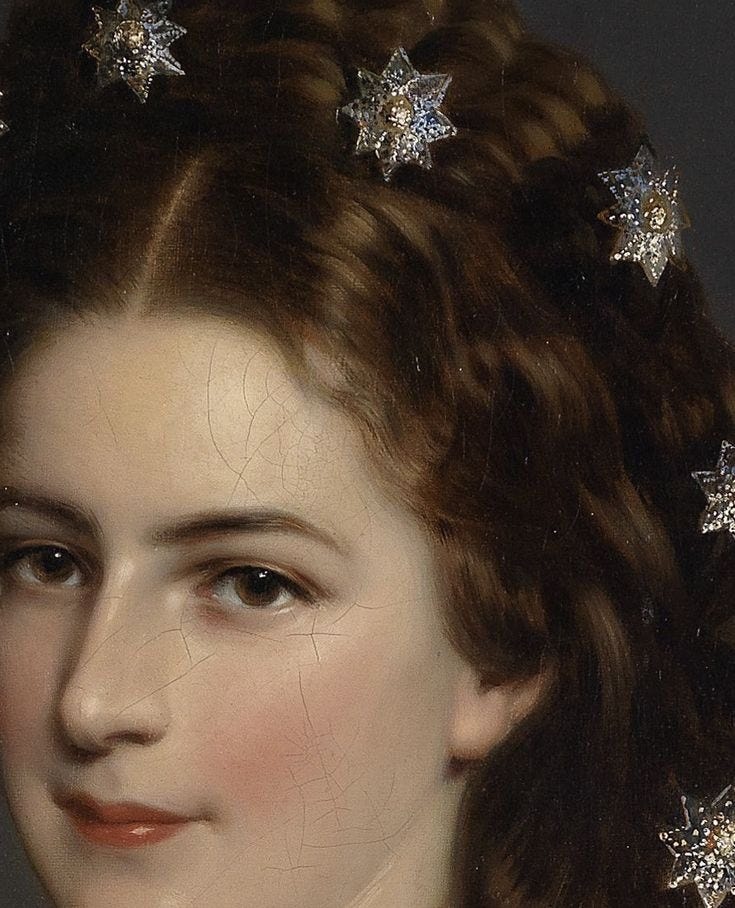

Most famous likeness
The iconic portrait by Franz Xaver Winterhalter shows her with:
-
Flowing dark hair
-
Diamond stars woven into her hair
-
Bare shoulders and white gown
That image shaped the romantic legend of “Sisi.”
Statues
You’ll find statues of her in:
-
Vienna (Volksgarten)
-
Budapest (near the Elisabeth Bridge and Gödöllő Palace)
She was widely admired for her beauty and grace — and her image became almost mythic during her lifetime.
Sisi did not like staying in one place very long. She was restless, independent, and often avoided rigid court life in Vienna.
Here’s where she spent much of her time:
🏰 Vienna – Hofburg Palace
Her official imperial residence.
But she disliked the strict court protocol there and tried to escape whenever possible.
🌿 Hungary – Gödöllő Palace
This became her favorite residence after 1867.
She loved Hungary, learned the language, and felt more at ease there. Hungarians adored her.
🌊 Greece – Achilleion Palace
She had this palace built in the 1890s.
It reflects her fascination with Greek mythology, especially Achilles. She spent extended periods there.
🌴 Madeira & Mediterranean travel
She traveled frequently for health reasons (lung concerns and general restlessness), often wintering in warmer climates like Madeira and the Mediterranean coast.
🇨🇭 Switzerland
She was assassinated in Geneva in 1898 by an Italian anarchist while traveling incognito — she preferred anonymity when abroad.
In short:
She spent her life moving between Vienna (duty), Hungary (comfort), Greece (escape), and constant travel.
She was more of a wandering empress than a settled queen.
📍 Geneva — September 10, 1898
Sisi was in Geneva traveling incognito (as she often did). She was walking along the lakeside toward a steamship on Lake Geneva when she was attacked by an Italian anarchist, Luigi Lucheni.
What happened
-
Lucheni stabbed her in the chest with a thin, sharpened file.
-
Because she wore a tight corset, the wound was not immediately obvious.
-
She thought she had simply been struck or pushed.
-
She boarded the boat as planned.
Shortly after departure, she fainted.
The boat turned back to shore when it became clear something was seriously wrong. She was carried back to the hotel, where it was discovered the blade had pierced her heart.
She died about an hour later.
I only took one photo, but 9 videos here in the Palace in Vienna, an amazing place to see the actual rooms she lived in while here in the Hofburg Palace! She was a fitness buff and it showed!
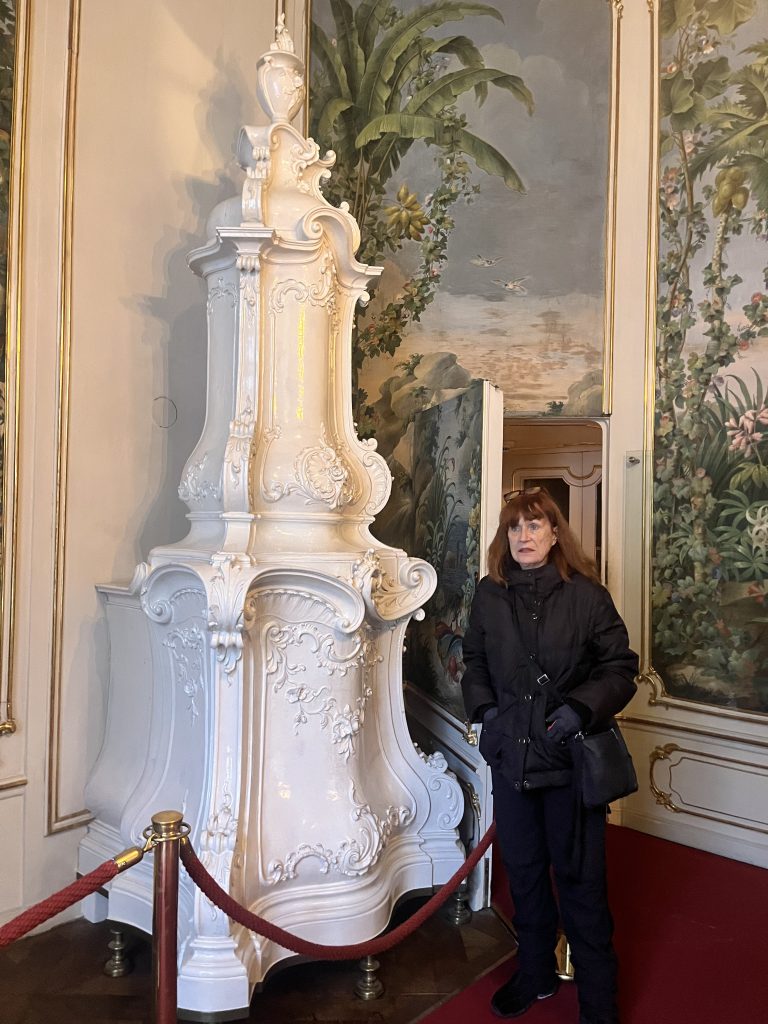
The tall white ceramic structure was the way they heated the rooms, it was fed from the other side. A huge heater!
One of the beautifully preserved imperial rooms inside the Hofburg Palace, in the Sisi Museum or Imperial Apartments section.
The tall white structure beside Eileen is a Rococo ceramic stove (Kachelofen) — a highly decorative 18th-century heating stove. These were common in Austrian palaces:
Made of glazed ceramic to retain heat
Highly ornate with scrollwork and floral relief
Fueled from a rear service passage so servants could tend the fire without disturbing the room
The wall panels behind Eileen look like painted chinoiserie or pastoral murals, very much in the late Baroque / Rococo style — tropical foliage, birds, soft landscape scenes. That decorative taste fits the 1700s–early 1800s imperial aesthetic.
As this was in the Sisi section, it’s interesting because Elisabeth (“Sisi”) actually preferred lighter, more athletic and modern spaces later in life — she disliked the heavy ceremonial atmosphere of court rooms like these.
The red rope barrier suggests this is part of the official museum route.
When I was working in New Orleans I investigated the home of a soccer star. He had a tub just like this one but it was all brass.
Toilets do not function any differently today as they did 200 years ago.
The core idea (unchanged)
Water sits in a bowl.
Waste drops into water.
A flush sends it through a pipe.
A curved trap holds water to block sewer gases.
That S-trap principle was refined in the late 1700s. The basic gravity + water seal concept hasn’t changed dramatically in 200 years.
This one most likely had a servent supply the water though.
Heat for the bathroom.
Another room.
After the visit to Sisi’spalace we went to the hotel, then in the evening went towhere they had their Ferris Wheel!
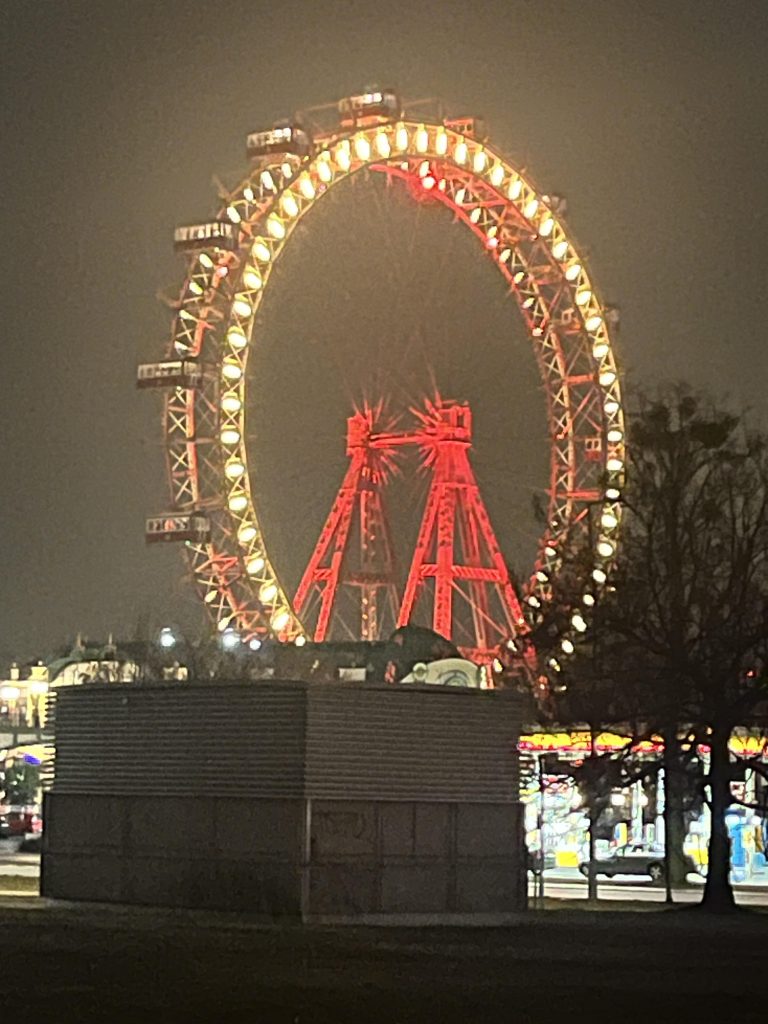
NOTE: It is Wien in Vienna, it was fun to walk around and see all the venues they had, even though it was closed except for a few things.
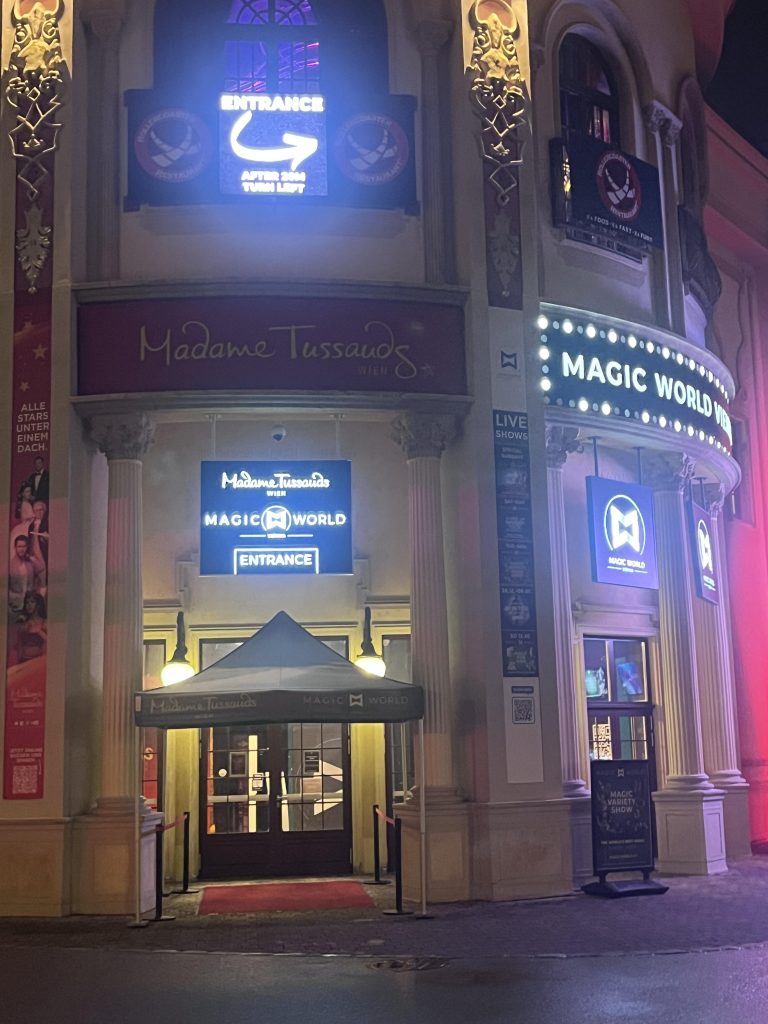
One of the about 50 venues!