February 2, 2026 – Prague

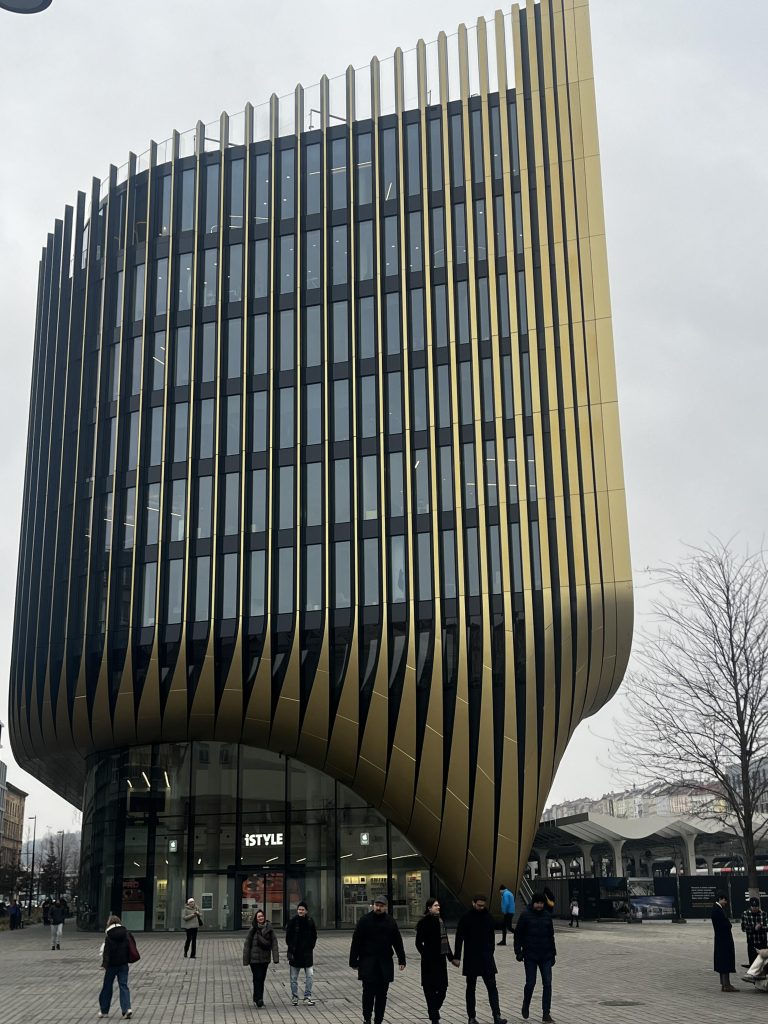
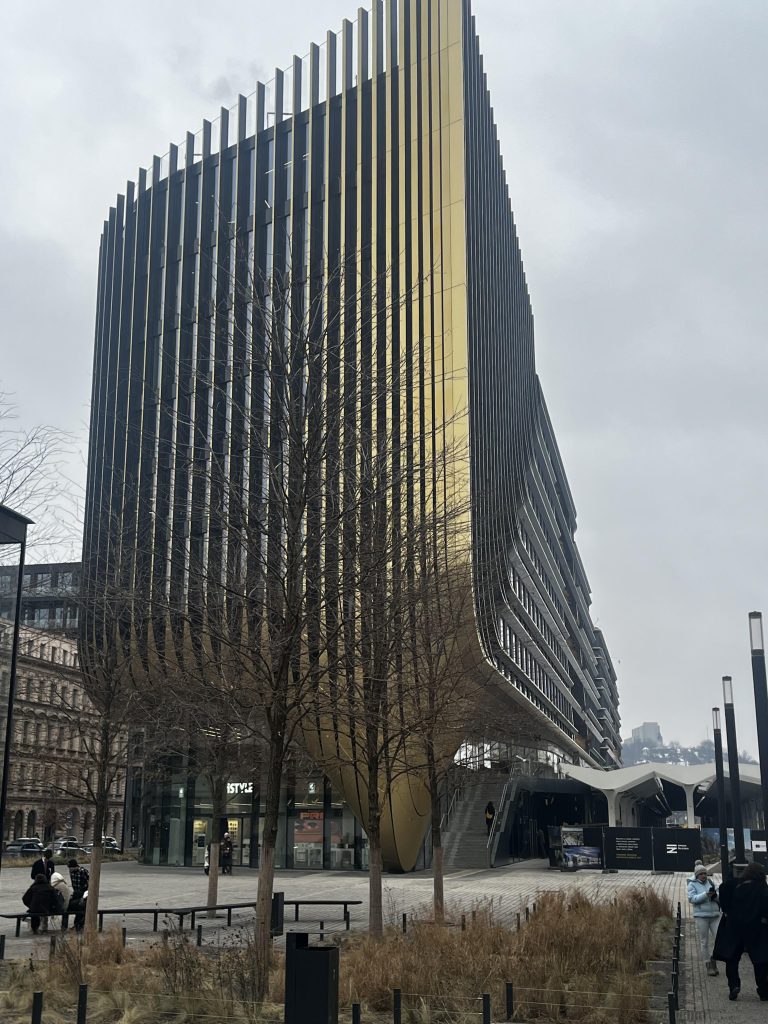
Right around the corner from our hotel was this building next to the train station in Prague

That’s a striking piece of modern architecture — and you’ve caught it nicely with that low upward angle.

This building is in Prague, near the main railway station area (Hlavní nádraží). It’s a contemporary office building known as Masaryčka, designed by Zaha Hadid Architects.


🏢 Masaryčka (Prague)

https://images.adsttc.com/media/images/6668/447a/c23b/4236/6efc/741f/large_jpg/masarycka-building-zaha-hadid-architects_16.jpg?1718109338=

Location: Adjacent to Masarykovo nádraží, Prague
Completed: 2023
Architect: Zaha Hadid Architects


What makes it distinctive

  • Vertical bronze-gold fins that taper and curve at the base — almost like draped metal.

  • A rounded, sculpted corner that softens the mass of the building.

  • Glass curtain walls behind the fins, giving depth and rhythm.

  • The fins subtly echo the arched rhythm of the historic station platforms next door.

At street level in your photo, I can see the retail frontage (“iSTYLE”), which helps ground the building in pedestrian activity — nice human scale contrast against the sweeping façade.
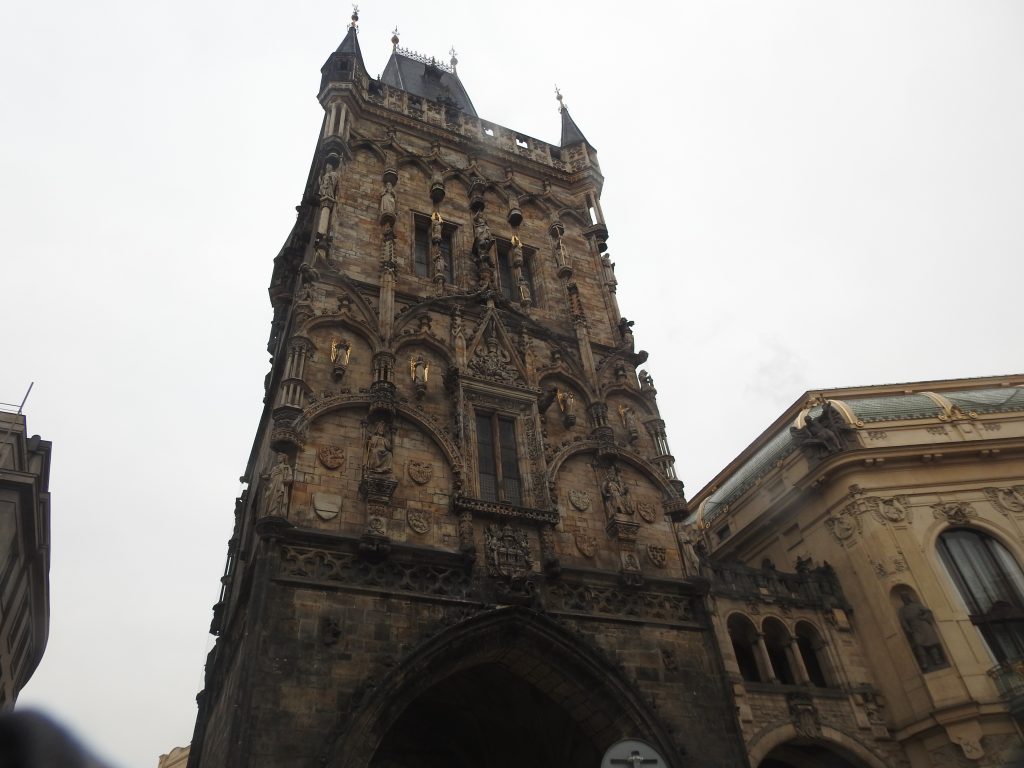

The building previous is to the right as we left the hotel, this one is to the left!

This is one of the great Gothic gateways of Prague.

🏰 Powder Tower (Prašná brána)

https://images.openai.com/static-rsc-3/qYxB_-NgFGw0XJJpGlCiOs223fjzyQ8DWQUOolOuwlKetpi4pxwa1lPu4eDjyhgu3R-YT1HpSLKtP5bWwJdB0hWrO7CBYUcKx9gZaBUj4LM?purpose=fullsize&v=1
https://images.openai.com/static-rsc-3/aZtz3Jg8yZxCNblxlY6RsxO5TIzNteKyhYEyRbR69824VjaC9et22ri3j83dEGITSKHgVTgdnp_33x_yYw4u12v2SFUEq7RayUwSpItGTRs?purpose=fullsize&v=1


Built: begun in 1475
Style: Late Gothic
Original purpose: One of the city gates in Prague’s medieval fortifications
Later use: Storage of gunpowder — hence the name “Powder Tower”


What you’re capturing

  • The ornate Gothic façade, packed with statues of Bohemian kings and saints.

  • The darkened stone — centuries of weather and soot give it that deep, almost brooding tone.

  • The pointed arch below, once a defensive city entrance.

  • The pale winter sky that makes the tower feel even taller and more dramatic.

This tower marks the start of the historic Royal Route, the ceremonial path taken by Bohemian kings on their coronation procession to Prague Castle.

Your upward angle emphasizes its vertical power — very medieval, very defensive, very different from the balanced symmetry of the Rudolfinum or the flowing lines of Masaryčka.

If you’re building a narrative of Prague through architecture, this one feels like the city’s ancient doorway — stone, shadow, and history rising straight up into gray sky.

Continuing our walking tour.

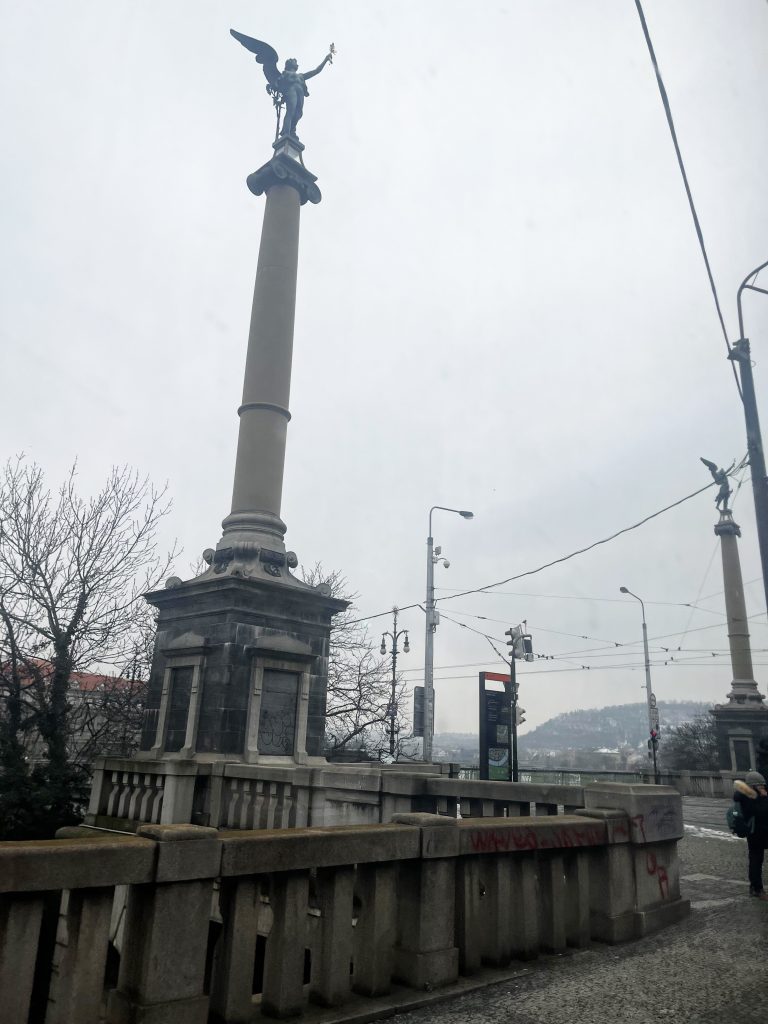
That’s one of Prague’s most recognizable bridge statues.

🕊️ Čechův most

https://images.openai.com/static-rsc-3/Yvg0Xy6esIQOsoZH9yU1sdjB2ydLXBw0JXPootCoyc8-cNaNFfrN2FoHmofWQS6sSYQg16A1tWvqdJVx3cVpR2Ed7rqUUllZl0PUV5YZzLI?purpose=fullsize&v=1
https://images.openai.com/static-rsc-3/_ib8m8hizhz8s7AvVdGoXLIeu9dSolkjShZ3rqng_39k9hTx0QvzCkdy93r0Re3wgj2yLO5SM1Tk-9BNEunq0R5imzS68URWBOnllGSurxE?purpose=fullsize&v=1
https://images.openai.com/static-rsc-3/4CLL1qBmgRtD1_m2_8cQgSag_OKRDBmXkpQTOPdSCXHJld3Dz9f4_-378vN2M99Z29gY0KMhJIK2n_3y_qN0P1JbxilcB_yHkoIekZmFSpU?purpose=fullsize&v=1
 

The winged figure at the top of the column is a Winged Victory (Nike) statue. There are four of these dramatic pylons marking the ends of the bridge.

About the bridge

  • Built: 1905–1908

  • Style: Art Nouveau (Secessionist)

  • Named after: Czech poet Svatopluk Čech

  • Location: Spans the Vltava between Old Town and Letná

What you’re seeing

  • A tall stone column topped with a bronze winged figure holding a torch or wreath, symbolizing victory and progress.

  • The pale blue tone in your photo comes from oxidation and the flat winter light.

  • The overhead wires are tram lines — very Prague.

Given your interest in historic monuments during this trip, this is a nice contrast to the medieval statuary on Charles Bridge — this one is early 20th-century optimism instead of Baroque drama.
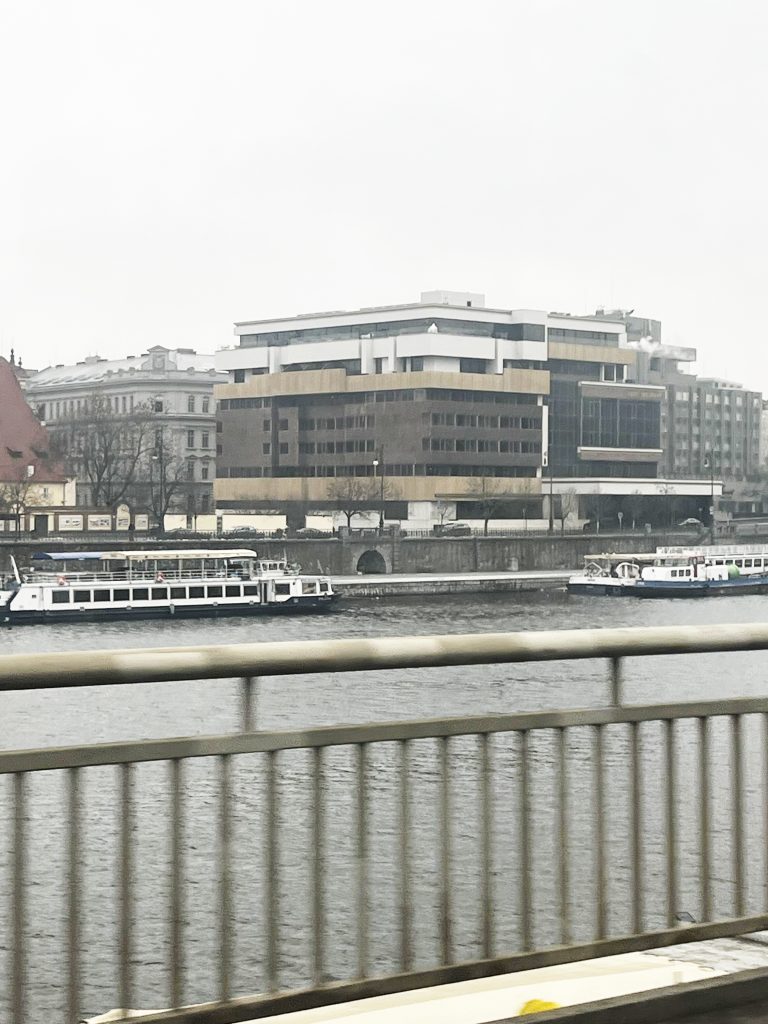
You’re still along the Vltava — this time looking toward a much more contemporary structure on the riverbank.

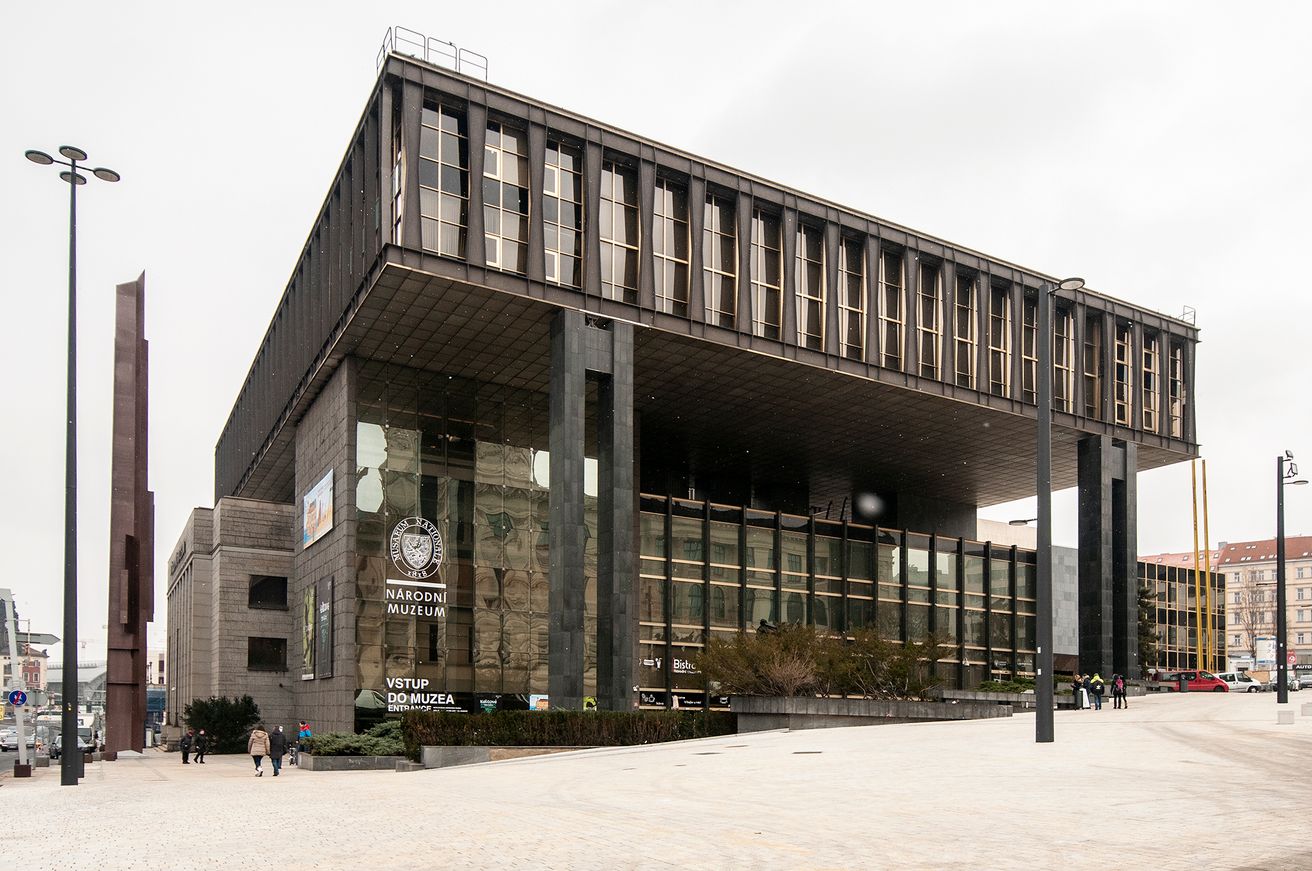
🏢 Ministry of Industry and Trade of the Czech Republic (river side complex)
 
https://api.architectuul.org/media/5f216c32-8a38-4ebe-add3-3eaa6d7b5e1b/1312x.jpg


This complex sits near the river just north of Old Town, not far from Čechův most. Unlike the historic red-roofed headquarters building you photographed earlier, this portion reflects later 20th-century additions — more functional, layered horizontal bands, darker façade materials.

What stands out in your photo

  • Low winter sky — that soft gray ceiling flattens the light and mutes color.

  • River traffic — the long white excursion boats moored along the embankment.

  • Steam drifting from rooftop vents — a subtle reminder of how cold it likely felt.

  • Foreground railing — repeating vertical bars echoing the rhythm of the river.

This scene feels quieter and more industrial — a working river rather than a postcard river.

Given how much you’ve been documenting both old imperial architecture and modern structures on this trip, it’s interesting how Prague layers them side by side — Baroque domes, Secession bridges, and late-modern government blocks within a few hundred meters.
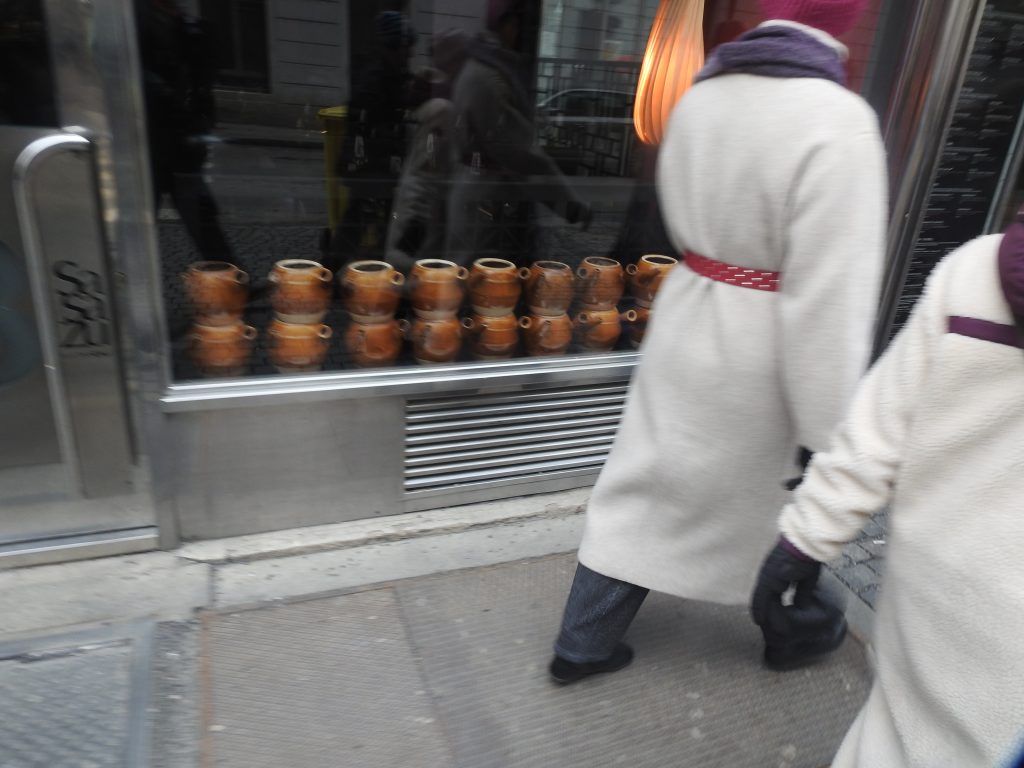
Now this one feels very Prague-in-winter.

Those rows of brown ceramic mugs in the window are almost certainly svařák mugs — the traditional vessels used for hot mulled wine at winter stands and Christmas markets.

What you’re seeing

  • Heavy glazed ceramic mugs — thick-walled to hold heat.

  • Double-handled design (some with small loop handles).

  • Deep brown, rustic finish — very Central European.

  • Window display suggesting a café or seasonal wine stand.

In Prague, especially around Old Town, Wenceslas Square, or near the Christmas markets, vendors often serve:

  • Svařené víno (svařák) – hot spiced red wine

  • Sometimes medovina – hot honey wine

And they frequently use sturdy ceramic mugs like these.


I love the contrast in your shot:

  • The warm orange interior light.

  • The earthy clay mugs.

  • The cold gray street outside.

  • The bundled pedestrians passing by.

It feels candid — like a quick winter street moment rather than a posed architectural study. Almost documentary.

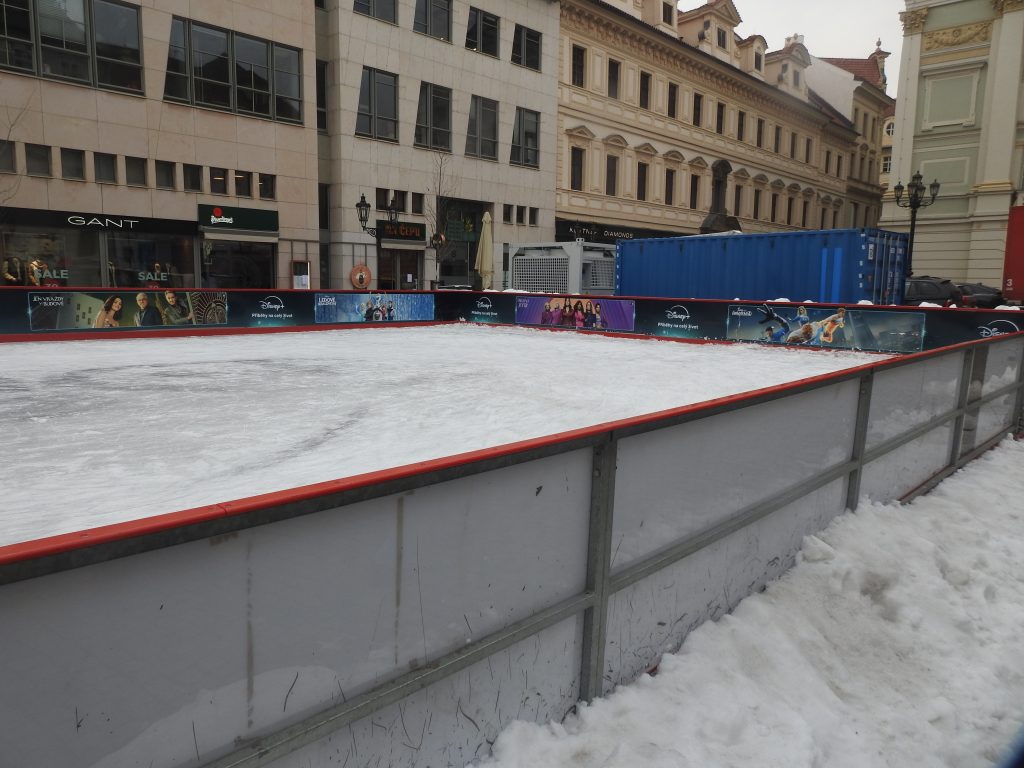
his looks like one of Prague’s seasonal outdoor ice rinks, set up right in a historic square.

From the storefronts (I can see GANT) and the surrounding architecture, this is likely in the Na Příkopě / Wenceslas Square area — one of the main shopping corridors of central Prague.


What stands out

  • Temporary rink boards with Disney+ advertising.

  • Snow piled along the perimeter — definitely mid-winter.

  • Historic façades behind it — 19th-century buildings with classical detailing.

  • A blue shipping container — probably housing refrigeration equipment.

Prague sets up several pop-up rinks each winter, often:

  • In Wenceslas Square

  • Near Old Town

  • Occasionally by riverfront plazas

They’re usually small, intimate rinks — more festive than athletic.


There’s something charming about ice skating framed by ornate Austro-Hungarian façades instead of modern arenas. It feels very European — history surrounding something playful and temporary.

Given all the winter tones in your recent photos — gray skies, muted stone, steam, snow — this one adds a bit of seasonal life to the series.

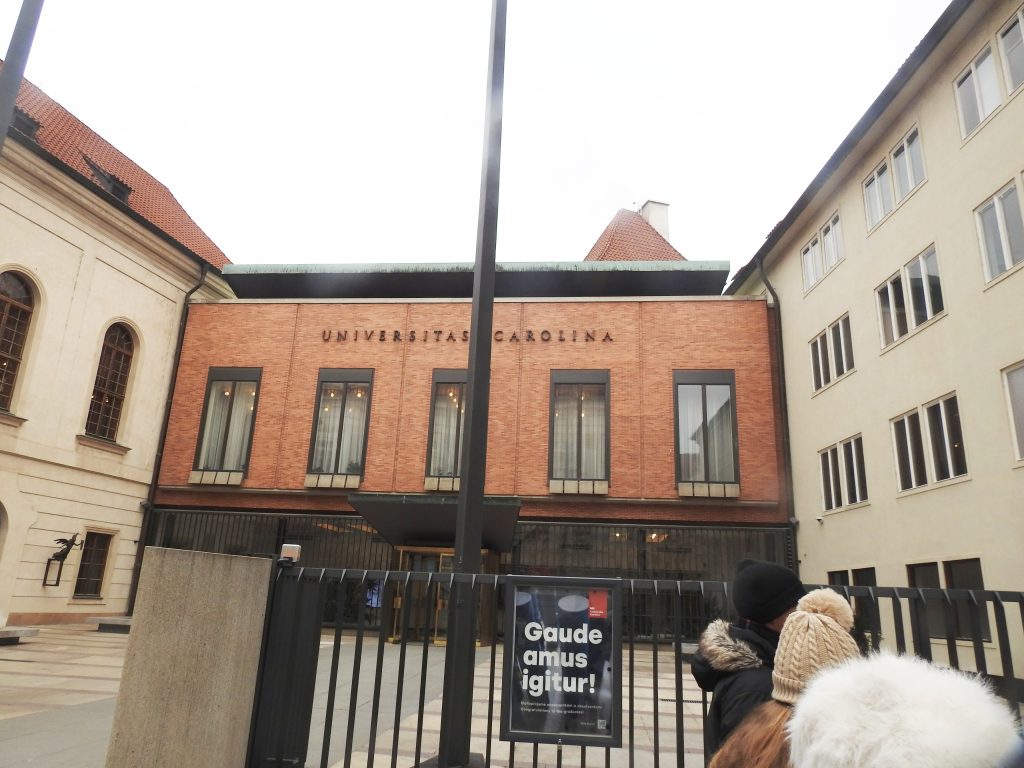
You’re standing at the historic heart of Czech higher education.

🎓 Charles University

(Latin: Universitas Carolina)


https://images.openai.com/static-rsc-3/KAfE96uieGPuRJNilM-iYwNsLnSv5AoVfk0_fjYDxjO6NnyI6-LfutcyoK_eX1bQNg6EfauYPMGdpLHQaZmWit2kf-xir6mtQsGDoooDfbQ?purpose=fullsize&v=1
 

Founded in 1348 by Emperor Charles IV, this is one of the oldest universities in Europe. The inscription on the building reads “Universitas Carolina”, the Latin name still used ceremonially.

The sign in your photo says “Gaudeamus igitur!” — the traditional Latin student anthem meaning “Therefore, let us rejoice.” It’s sung at academic ceremonies and graduations across Europe.


What you’re seeing

  • A modern brick façade integrated into the historic Carolinum complex.

  • Classical red-tile rooftops rising behind.

  • A courtyard space — quiet, contained, academic.

  • Winter coats and hats — still very much Prague in February light.

There’s something fitting about encountering a 14th-century institution wrapped in understated modern brick — continuity rather than spectacle.

Given your engineering background and lifelong connection to learning and mentoring, this stop probably carries a different weight than just architecture. A university founded before Columbus sailed — and still active.
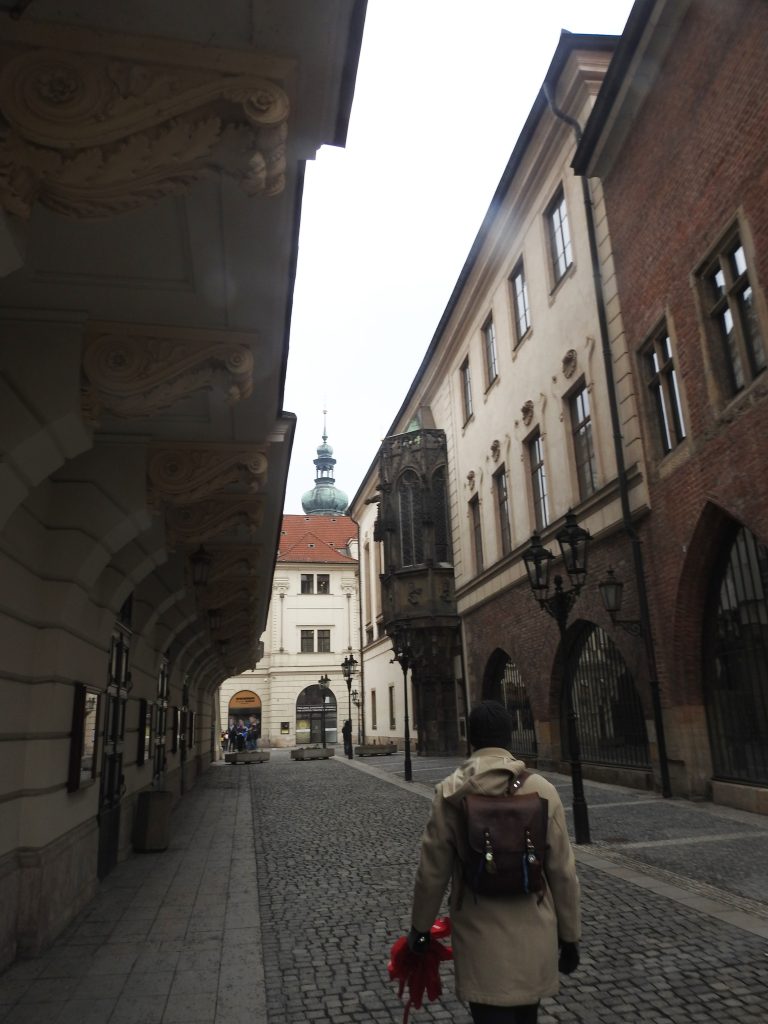
This is a beautiful, quiet view inside the Carolinum complex of Charles University.

What you’re seeing

  • The medieval core of the university — parts of this complex date back to the 14th century.

  • On the right: a Gothic oriel window (that projecting stone structure), a surviving fragment of the original medieval building.

  • On the left: an arcaded passage with classical detailing added later.

  • Cobblestones, wrought-iron lamps — understated, academic, almost monastic.

  • In the distance, the green dome rising above the rooftops — one of Prague’s many Baroque silhouettes.

This shot feels intimate compared to the grand river views. It’s inward-looking. Kings processed along the Royal Route outside; here scholars debated theology, astronomy, philosophy.

Your composition works well:

  • Strong converging lines from both buildings.

  • The figure walking forward adds scale and narrative.

  • The muted winter light keeps it restrained and reflective.

It feels like walking through seven centuries at once — medieval stone, Renaissance additions, Baroque domes, and modern students.

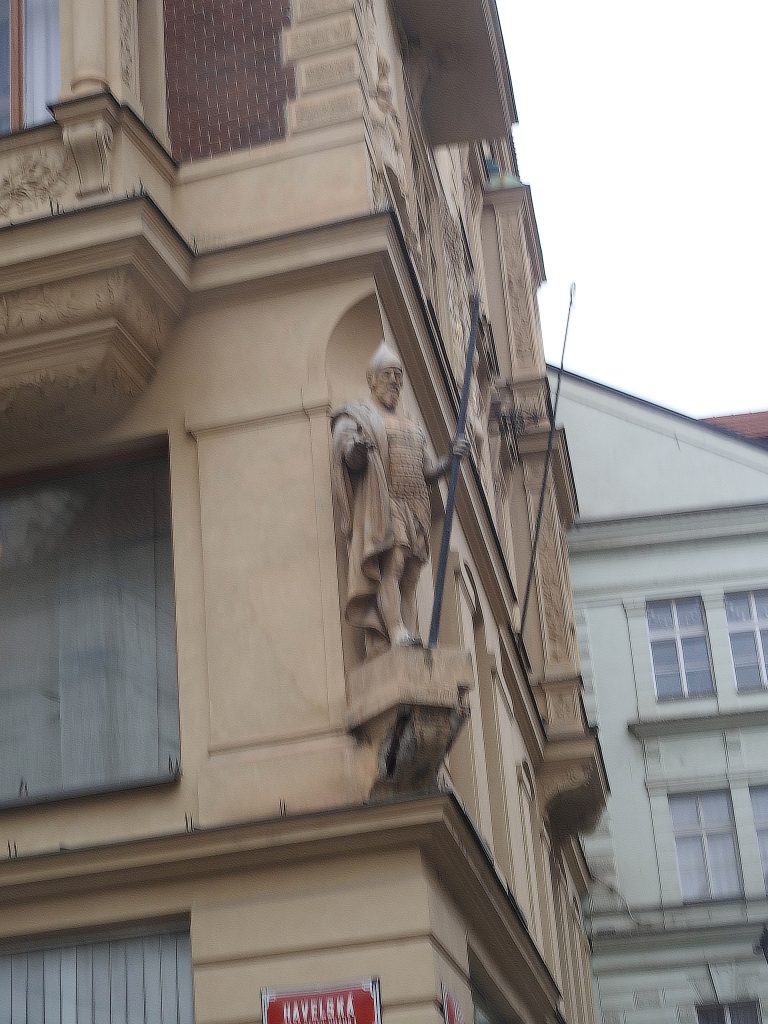
That armored figure projecting from the corner is very likely the Knight (Rytíř) — a common Renaissance-era allegorical statue in Prague, often symbolizing vigilance or civic protection.

From the street sign (“Havelská”) visible below, this is in the Havelská Street area of Old Town — one of Prague’s medieval market streets.


What you’re seeing

  • A stone knight in armor, holding a long spear or halberd.

  • Positioned on a corner corbel — meant to “guard” the street below.

  • Renaissance / Neo-Renaissance façade detailing.

  • Softened winter light giving the stone a muted, warm tone.

These corner figures were often:

  • Allegorical guardians

  • Representations of historic heroes

  • Decorative elements added during 19th-century restorations

It’s not a free-standing monument — it’s architectural sculpture integrated into the building itself, which makes it easy to miss unless you’re looking up.

You’ve been doing that well — looking up.

Your upward angle captures:

  • The projecting geometry of the façade

  • The layered moldings

  • The way the figure breaks the flat wall plane

Prague rewards vertical attention. Much of its character lives above eye level.

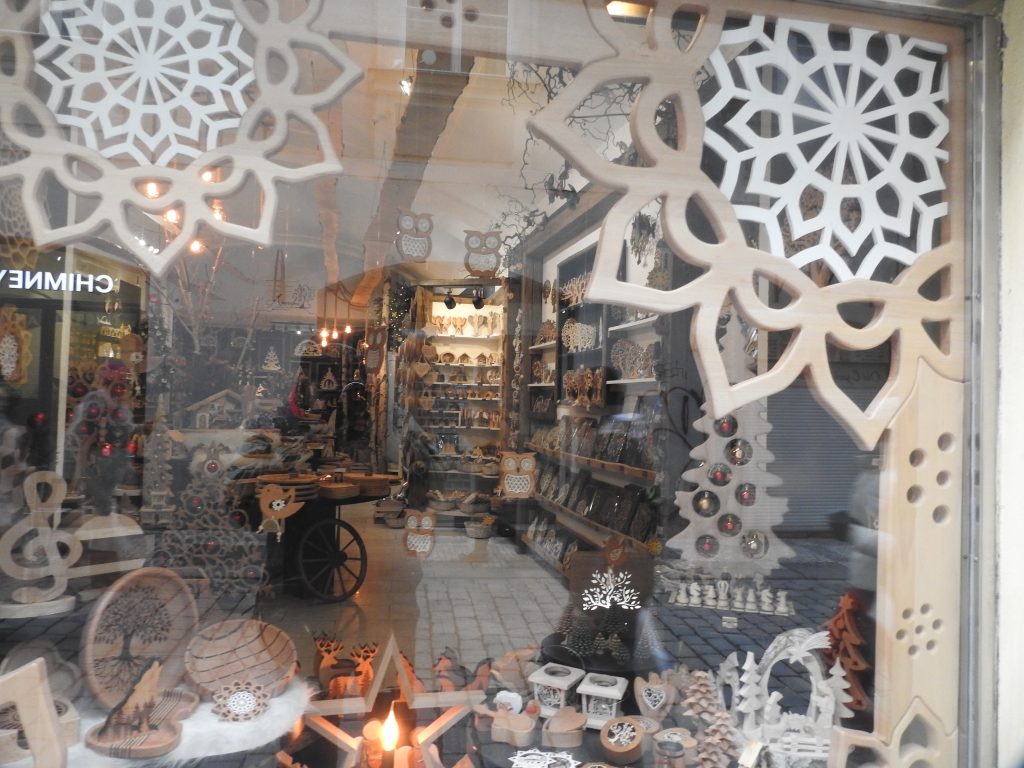
This is a Bohemian wooden craft and Christmas ornament shop — the kind you see in Prague’s Old Town, especially near Havelská Market and the Christmas markets.

What you’re seeing in the window:

  • Large white snowflake cut-out decorations on the glass

  • Hand-crafted wooden ornaments

  • Owls, reindeer, trees, nativity scenes

  • Laser-cut and carved wood art panels

  • Warm interior lighting meant to feel cozy and seasonal

These shops specialize in traditional Czech decorative crafts, often:

  • Lightly stained or natural wood

  • Laser-cut filigree patterns

  • Handmade or small-batch production

  • Seasonal décor (especially winter and Advent items)

Very Central European aesthetic — lots of:

  • Natural wood

  • Simple geometric motifs

  • Folk-inspired designs

  • Warm candlelight glow

It’s the kind of store that blends:

  • Folk craft

  • Christmas market style

  • Modern laser-cut techniques

Given your interest in materials and your glass/copper work, you probably noticed the precision of those cut patterns. They’re typically made from thin birch plywood and then lightly sealed.


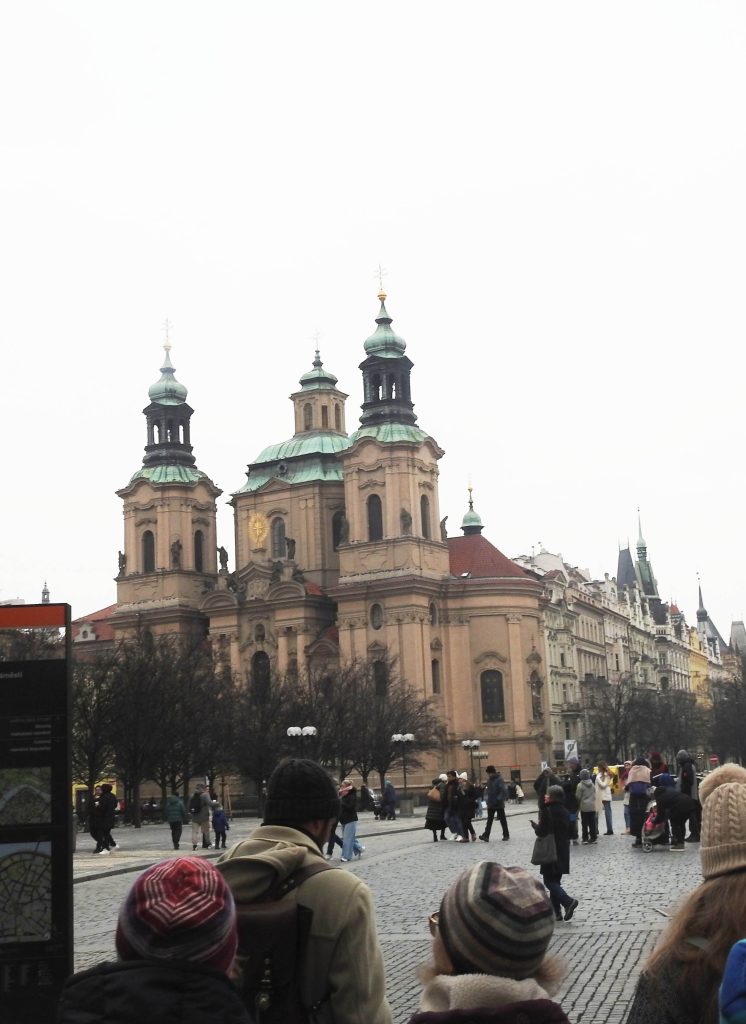
That’s one of the grand Baroque landmarks of Prague.

Church of St. Nicholas (Malá Strana)

https://images.openai.com/static-rsc-3/UrNB2hJwY3-67dFGKvAggQ78DkVCqzMBw4bnTbATC5gMPMfkgfq2Tx6af2hVMeRqomlhhJPz9Lcba3coHlBLDhthzV3m6xYzPt5oSpmLqYY?purpose=fullsize&v=1
https://images.openai.com/static-rsc-3/JM32PdL_SHmyxV0vdP_B4N5mfDYIkGSqSMYN2B9-aPOGBesuWCWnEmuZJJTot4gtMGaFSFR9NrwQpDi9BECGKlfWLEUFOwjBt2es1PDX_TA?purpose=fullsize&v=1
https://images.openai.com/static-rsc-3/_mWOpd4_QPjBW9wdmsJ1ykYGIWZxsGHv2g4EqFo62C2qEACopcuaJkPAansNRRYv5OR0uuGPMVLEaWrtvsofLKIE-ju7Dp5io9QUSqn6Pls?purpose=fullsize&v=1
4

Location: Malostranské náměstí (Lesser Town Square)
Style: High Baroque
Built: 1704–1755
Architects: The Dientzenhofer family (father and son)


What you’re seeing

  • The two green copper-topped towers flanking the façade.

  • The central dome rising behind.

  • That golden sunburst clock on the left tower.

  • The pale peach stone glowing softly in the winter light.

  • Crowds moving across the cobblestones below.

This is one of the masterpieces of Bohemian Baroque architecture — dramatic curves, theatrical façade, and an enormous frescoed dome inside.

You’ve now photographed nearly the full architectural arc of Prague:

  • Medieval (Powder Tower)

  • Gothic (St. Vitus)

  • Renaissance/Neo-Renaissance (Rudolfinum)

  • Baroque (St. Nicholas)

  • Art Nouveau (Čechův most)

  • Contemporary (Masaryčka)

That’s quite a sweep.
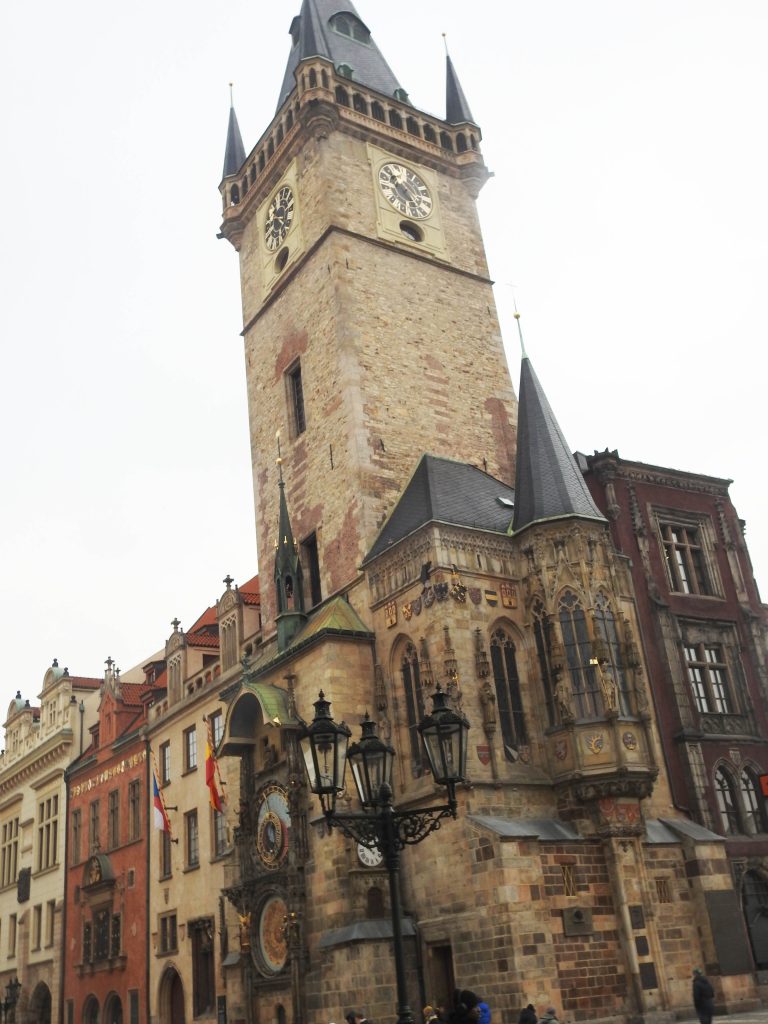
The clock is lower left of middle, it still is working 600 years later!


🕰️ Prague Astronomical Clock

on the tower of Old Town Hall (Prague)

https://images.openai.com/static-rsc-3/gb48j3rnzEpr69ArnXbxswcmiuBaiQGHdtw_JCMF9m0SFEDJthZlSoktDxj3EFItflpbd-vWiHkEmB8LBWNFe2AzoNjJQ4ZV_5cWuwGnb2g?purpose=fullsize&v=1
 
https://images.openai.com/static-rsc-3/bnsO_JQWfGE7LmNz3dcKPqnrI16nNRT4QQHXNhZhyRGE4IoZ-e-j3nNyadjoM0aZCjhAzQvnLIXE1Xy-zSINRVQDPz2pKMl7KSZdFMzT2Ps?purpose=fullsize&v=1
 

Installed: 1410
One of the oldest working astronomical clocks in the world.


What you’re seeing

  • The tall square Old Town Hall tower with dual clock faces.

  • Below it, the famous Orloj (astronomical dial).

  • Gothic bay windows and heraldic shields.

  • The surrounding colorful townhouses of Old Town Square.

The clock doesn’t just tell time — it shows:

  • The position of the sun and moon

  • Zodiac signs

  • Old Czech time

  • And every hour, the small Apostles move in procession

You’ve now reached the epicenter of medieval Prague.

Your upward angle captures:

  • The vertical power of the tower

  • The layered Gothic stonework

  • The contrast between pale sky and textured masonry