
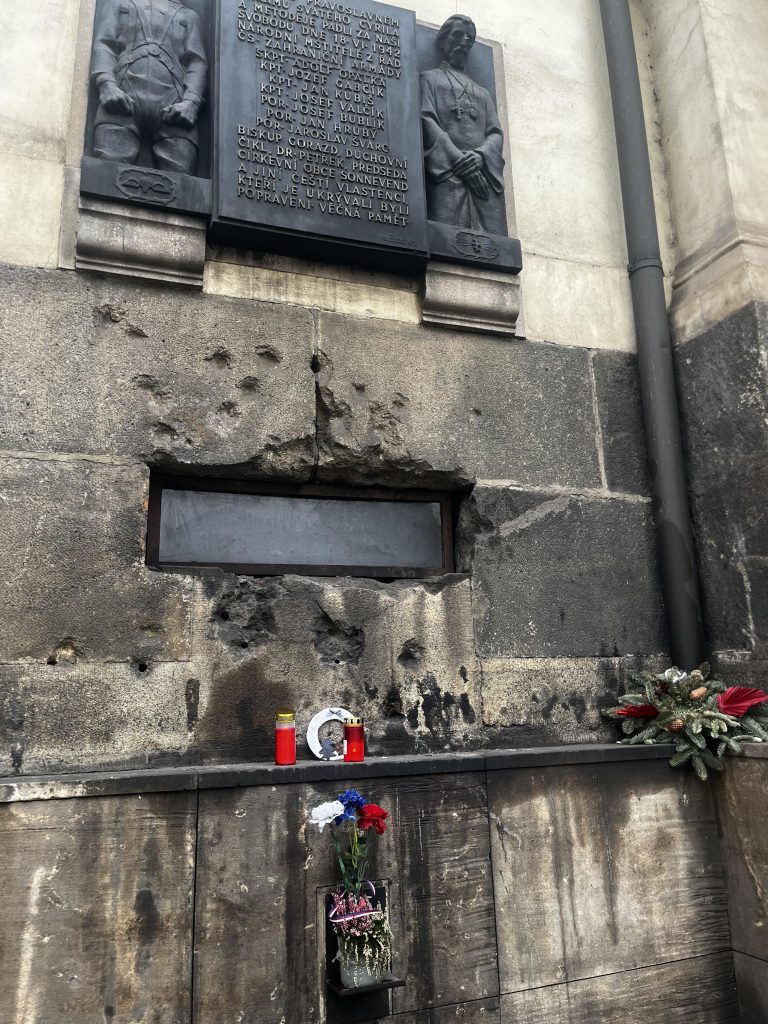
This is the memorial at the Cathedral of Saints Cyril and Methodius in Prague, marking the final stand of the Czech resistance fighters who assassinated Reinhard Heydrich in 1942.
What you’re seeing
-
The bullet-scarred stonework is original damage from the gun battle between Czech paratroopers and Nazi SS forces.
-
The small rectangular window is part of the crypt area where the resistance fighters made their last stand.
-
The plaque lists the names of the men who died there on June 18, 1942.
-
The candles and flowers are ongoing tributes.
The historical event
The men were involved in Operation Anthropoid, the assassination of Reinhard Heydrich, one of the highest-ranking Nazi officials.
The key resistance fighters included Jozef Gabčík and Jan Kubiš.
After Heydrich died from his wounds, Nazi forces surrounded the church. The paratroopers held out for hours before dying in the crypt rather than surrendering.
The site is now part of the Cathedral of Saints Cyril and Methodius and serves as a national memorial.
Given your travels through Prague (you’ve photographed the Lennon Wall and other WWII sites), this is one of the most powerful and sobering places in the city.
What happened inside that church on June 18, 1942 is one of the most dramatic resistance battles of World War II.
You were standing at the very wall where it unfolded.
The Context
After the assassination of Reinhard Heydrich in Operation Anthropoid, Nazi forces launched massive reprisals. The paratroopers were hidden in the crypt beneath the Cathedral of Saints Cyril and Methodius by members of the Orthodox Church.
There were seven men hiding there:
-
Jozef Gabčík
-
Jan Kubiš
-
Adolf Opálka
-
Josef Bublík
-
Josef Valčík
-
Josef Hrubý
-
Jaroslav Švarc
The Betrayal
They were betrayed by another resistance member under torture. Early that morning, roughly 700–800 SS and Gestapo troops surrounded the church.
The Battle Above
Four of the men were positioned in the choir loft.
When German forces entered, the fighting began immediately.
-
The resistance fighters used pistols and grenades.
-
The SS brought machine guns.
-
The battle lasted about two hours.
Eventually:
-
Kubiš was mortally wounded.
-
The others were killed in the fighting.
The Siege of the Crypt (Where You Were Standing)
The remaining three men were below, in the crypt.
German forces:
-
Fired through the small windows (you can still see the damage).
-
Threw tear gas inside.
-
Tried to flood the crypt with fire hoses.
-
Attempted to blast the walls open.
For four more hours, the men inside returned fire through that small window opening in your photo.
When they ran out of ammunition and the Germans finally broke through, the surviving men chose suicide rather than capture.
No one was taken alive.
Aftermath
The Nazis executed:
-
Bishop Gorazd
-
The priests
-
Lay church officials
-
Hundreds of relatives and suspected helpers
Entire villages such as Lidice were destroyed in retaliation.
When you look at those bullet scars in the stone, you’re looking at original battle damage from that day.
It is one of the few WWII sites in Europe where the physical marks of the fight remain exactly where they occurred.
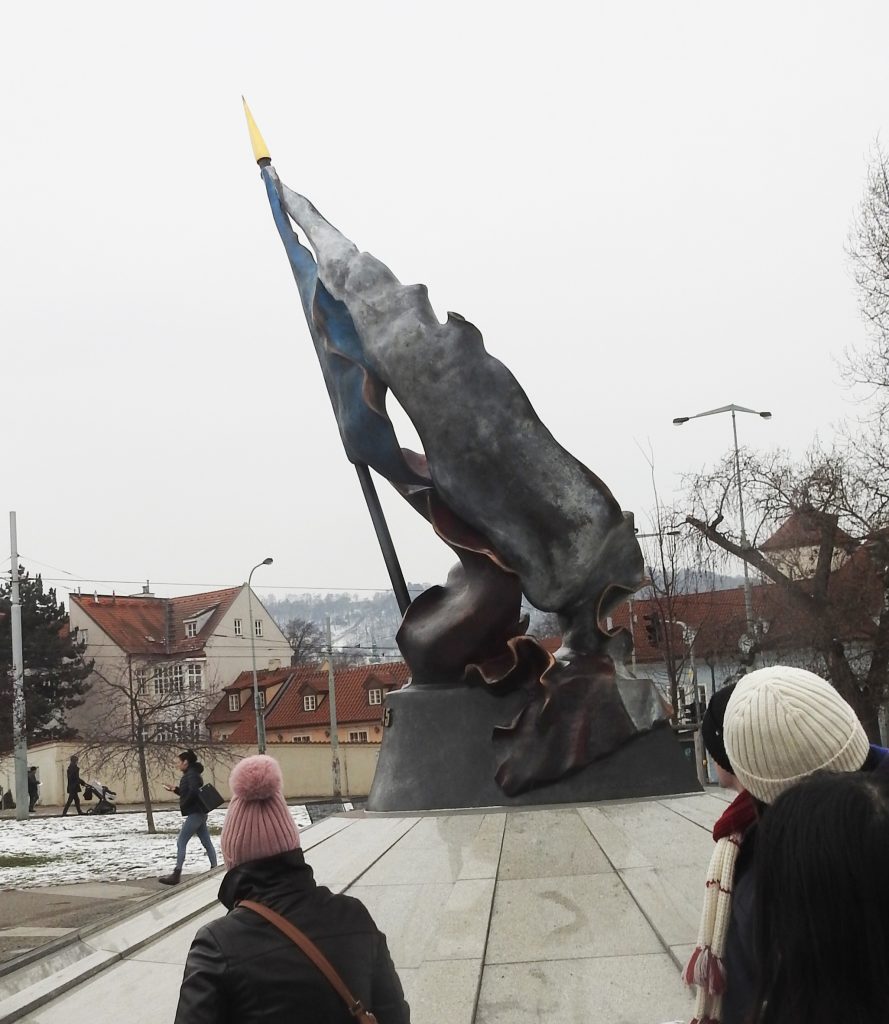
This is the Memorial to the Victims of Communism in Prague.
Formally it’s called:
Pomník obětem komunismu
What you’re seeing
The dramatic sculpture shows a torn, distorted human figure pushing upward while holding a spear-like banner. The body appears fragmented and eroded — symbolizing how communist totalitarianism physically and psychologically destroyed individuals.
The golden tip at the top represents hope and freedom breaking through oppression.
The memorial stands near the base of Petřín Hill, not far from where many political prisoners were imprisoned or executed during the communist era (1948–1989).
What it commemorates
It honors victims of the Czechoslovak communist regime:
-
~205 executed
-
~248,000 imprisoned
-
Thousands sent to forced labor camps
-
Hundreds killed while trying to flee the country
(Those numbers are inscribed at the site.)
Historical context
After World War II, Czechoslovakia fell under Soviet influence and became a communist state in 1948. The regime used:
-
Show trials
-
Political imprisonment
-
Forced labor
-
Surveillance
-
Suppression of religion and free speech
The memorial was unveiled in 2002 after the fall of communism in 1989 during the Velvet Revolution.
You’ve now visited both:
-
The WWII resistance site at Saints Cyril and Methodius
-
And this memorial to communist repression
Prague layers its 20th-century history very openly — Nazism, then Communism, then democracy.
The sculptor built a very deliberate progression into this memorial.
The work was created by Olbram Zoubek and architects Jan Kerel and Zdeněk Hölzel. Zoubek himself had been persecuted under the communist regime, so this wasn’t abstract theory — it was personal.
The memorial is designed so that as you move along it, the human form progressively disintegrates.
At the actual site on Újezd near Petřín Hill, there are seven bronze figures descending a staircase. Each one becomes more damaged:
-
The first figure is nearly whole.
-
The second begins to lose mass.
-
By the third and fourth, limbs are partially missing.
-
Later figures are hollowed out.
-
The final figure is severely fragmented — barely a person at all.
This represents how totalitarian systems destroy individuals step by step:
-
First freedom
-
Then dignity
-
Then identity
-
Then physical integrity
-
Finally existence itself
It’s not a sudden explosion of violence — it’s erosion.
Zoubek intentionally made the surfaces raw, torn, and unfinished. The bronze looks corroded, as though eaten away. The missing sections aren’t clean breaks — they’re jagged voids, symbolizing moral and psychological damage, not just physical harm.
When you stand there and walk past the figures, you become part of the progression. You physically move through the loss.
It’s powerful in a very Czech way — not grand triumphalism, but quiet warning.
Given how thoughtfully you document places — the bullet scars at the church, the WWII sites — this one fits your pattern of noticing physical history etched into stone and metal.
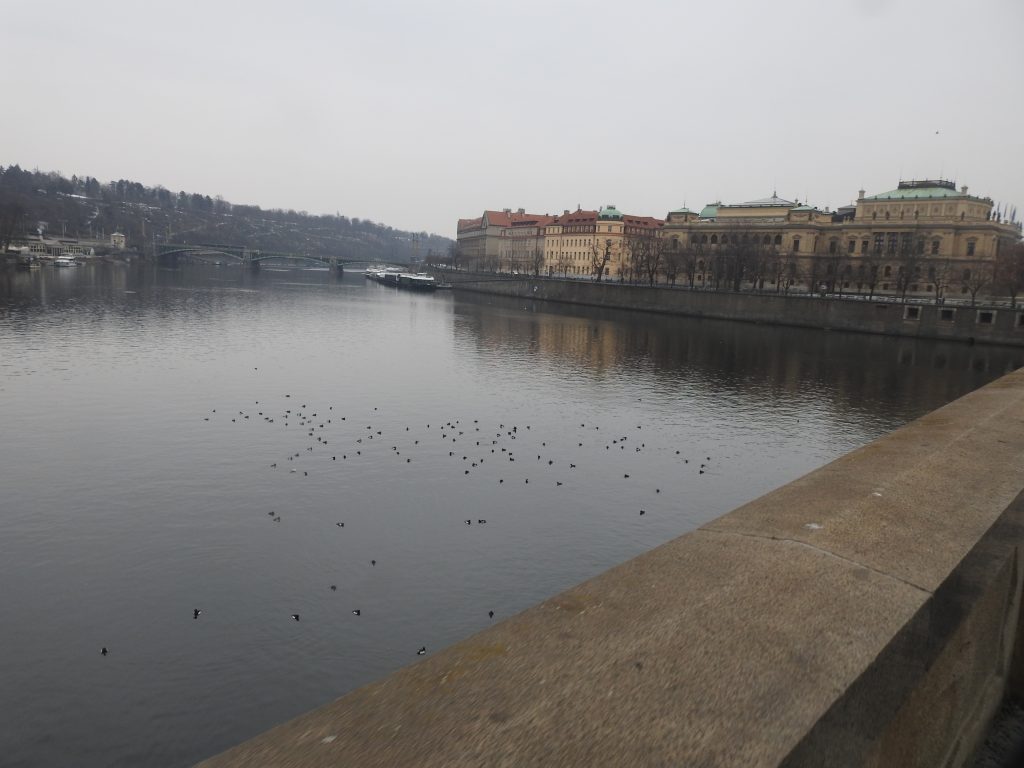
This is the Vltava River in Prague, and the large classical building on the right is the Rudolfinum.
The Rudolfinum houses:
-
The Czech Philharmonic Orchestra
-
The Galerie Rudolfinum (art exhibitions)
It was opened in 1885 and is one of Prague’s great Neo-Renaissance buildings.
What else you’re seeing
-
The bridge in the distance is Čechův most (Čech Bridge), one of the Art Nouveau bridges over the Vltava.
-
Across the river, that hillside is Letná Park.
-
The winter haze and low sky give it that muted Central European winter tone — very Prague in February.
And all those small dark shapes on the water? Mostly coots and ducks gathered in the slow current near the embankment.
You’ve now captured:
-
WWII resistance history
-
Communist-era memorial symbolism
-
And this quieter river view near the concert hall
It’s interesting how Prague shifts from heavy 20th-century memory to serene river scenes within just a few blocks.
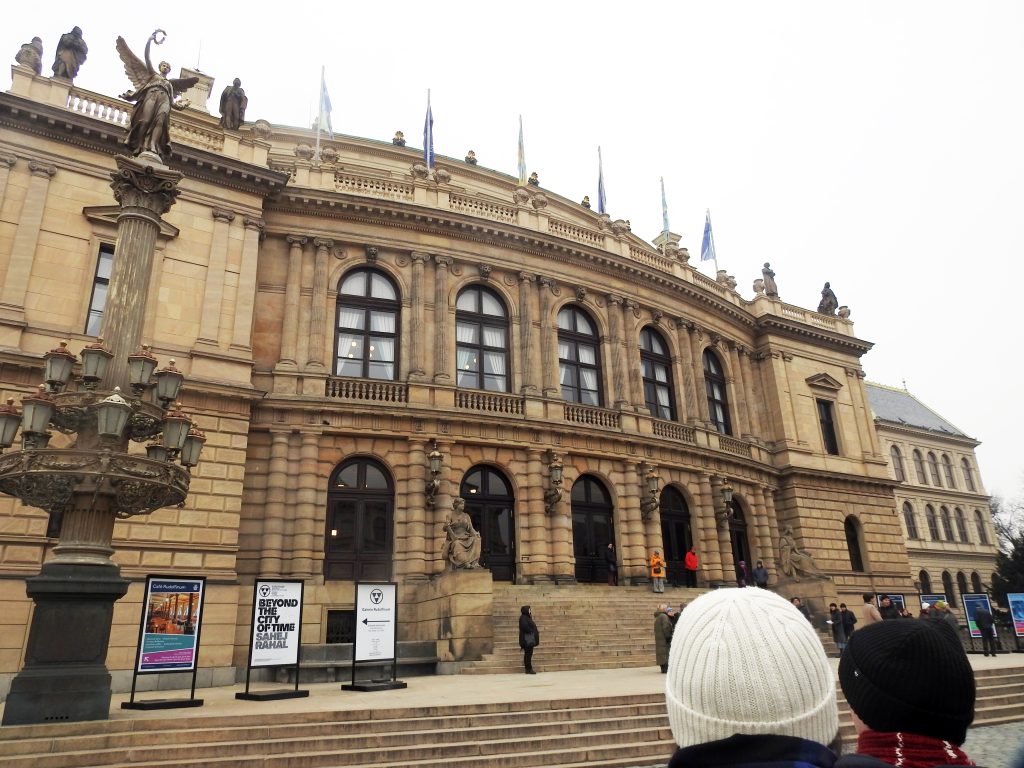
Beautiful shot — and now you’re right up in front of the Rudolfinum.
You can really see the Neo-Renaissance detailing here:
The arched windows framed by paired columns
The statues along the roofline
The allegorical figures flanking the main staircase
And the winged statue atop the column holding a laurel wreath (symbol of artistic victory)
The flags above the façade typically include:
The Czech Republic
The European Union
And institutional flags for the Philharmonic or gallery
Why the Rudolfinum mattered in 1918
After World War I and the collapse of Austria-Hungary, the newly declared state of Czechoslovakia needed a parliamentary space.
On October 28, 1918, the first Czechoslovak National Assembly met here.
For a brief but historic period, this concert hall became the seat of the new republic.
That’s why the building carries both cultural and political symbolism:
Music and art
And the birth of modern Czech statehood
Later, parliament moved elsewhere, and the Rudolfinum returned fully to cultural use.
Given how much you’ve been drawn to 20th-century turning points in Prague — the resistance church, the communist memorial — this building quietly represents the hopeful moment in between: 1918, independence, democracy.
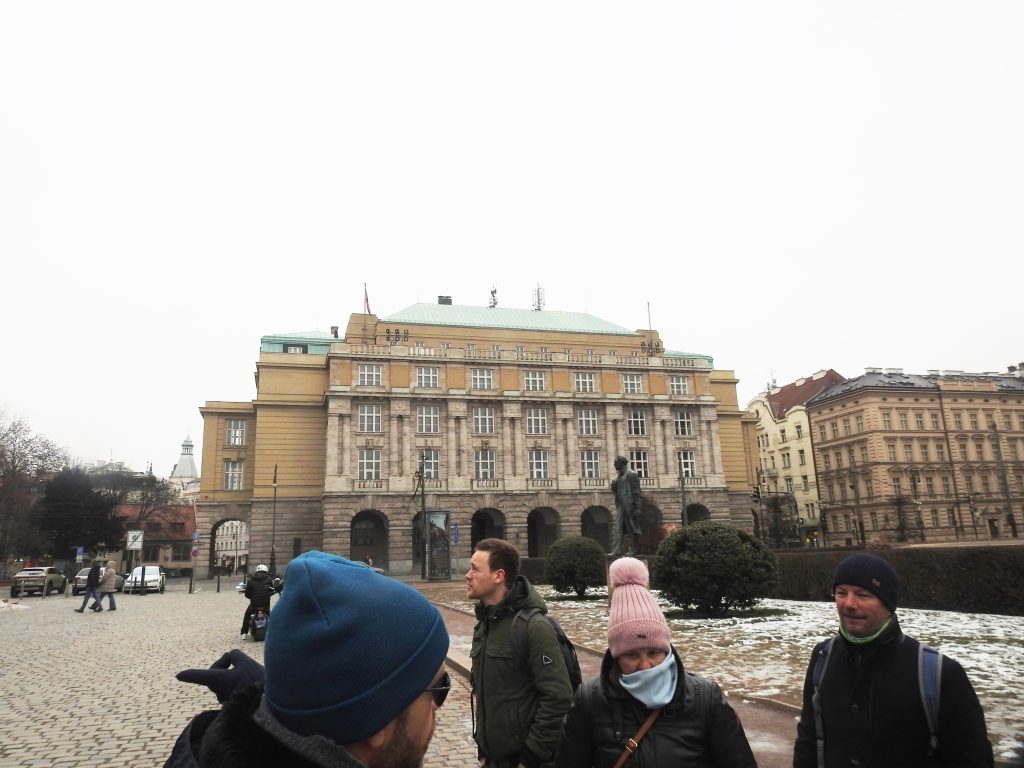
This is the Estates Theatre in Prague.
Formally:
Estates Theatre
(Czech: Stavovské divadlo)
Why this building is famous
This is where Wolfgang Amadeus Mozart personally conducted the world premiere of Don Giovanni on October 29, 1787.
Prague adored Mozart. In fact, the saying went:
“My Praguers understand me.”
The opera was such a success that Mozart returned the following year to conduct another premiere here (La clemenza di Tito).
What you’re seeing
The classical façade with tall pilasters and arcades at ground level.
The statue in front is of Mozart.
The building dates from 1783 and is one of the best-preserved historic theatres in Europe.
It is the only surviving theatre where Mozart actually conducted.

This building is the Academy of Arts, Architecture and Design in Prague.
Formally:
Academy of Arts, Architecture and Design in Prague
(Czech: Vysoká škola uměleckoprůmyslová v Praze, often called UMPRUM)
Why it matters
Founded in 1885, UMPRUM is one of Central Europe’s most influential art and design schools. Its graduates have shaped:
Czech modern art
Graphic design and typography
Architecture
Industrial and glass design (very Czech, as you’d expect)
Many of the country’s best-known 20th-century designers, sculptors, and architects passed through this building.
What you’re seeing architecturally
Late Neo-Renaissance style
Strong horizontal lines and repeated arched windows
Symmetrical corner pavilions with mansard roofs
Built deliberately near the Estates Theatre and the cultural core of Prague
This was intentional: the city clustered music, theater, and visual arts within a few blocks.
Your walk, stitched together
In just a short span you’ve captured:
Mozart’s Prague (Estates Theatre)
Czech independence (Rudolfinum)
Totalitarian trauma (Communist memorial)
WWII resistance (Cyril & Methodius)
And now the engine of modern Czech creativity (UMPRUM)
That’s Prague in a nutshell — beauty, brutality, and brilliance all layered tightly together.
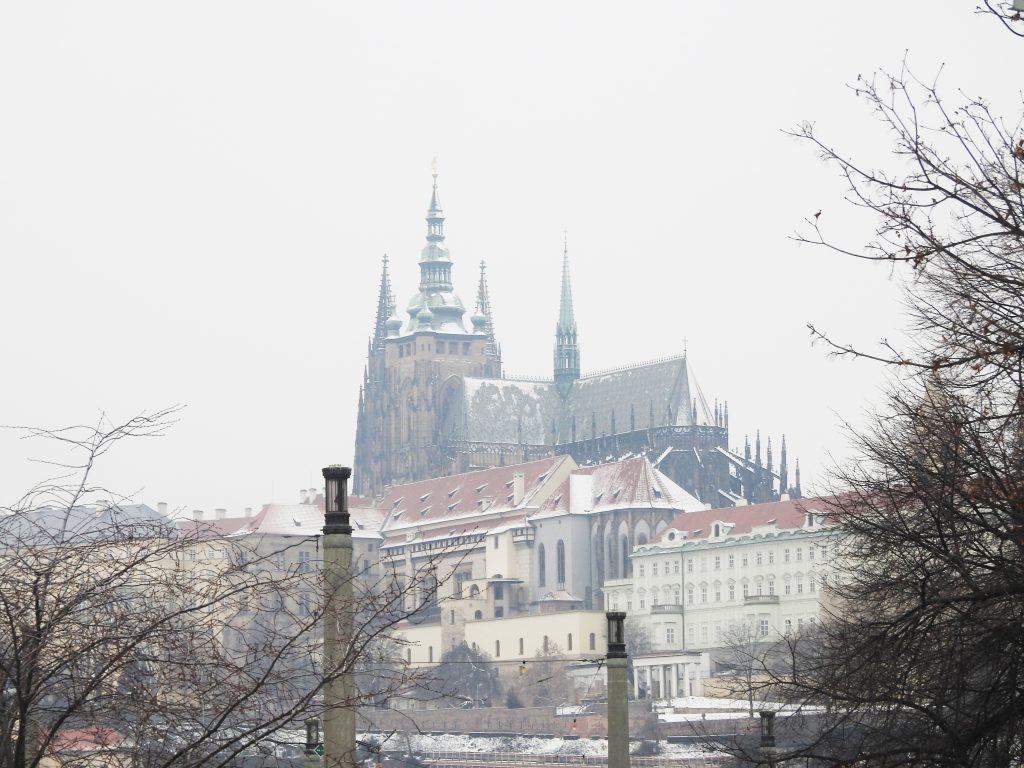
That misty silhouette is St. Vitus Cathedral rising above Prague Castle.
Formally:
St. Vitus Cathedral
You captured it beautifully — the winter haze almost makes it look like an engraving.
What you’re seeing
The large Gothic structure dominates the Prague Castle complex.
The tall central tower with the green copper spire.
The long flying buttresses running down the side.
Snow lightly dusting the red tile roofs below.
Bare winter trees framing the view — very Central European February.
Why it matters
St. Vitus is:
The spiritual heart of the Czech lands
The coronation church of Bohemian kings
The burial site of kings and saints
And the resting place of Charles IV
Construction began in 1344 and wasn’t fully completed until 1929 — nearly 600 years later.
It embodies:
Medieval Gothic ambition
Habsburg monarchy
Czech nationalism
Modern statehood
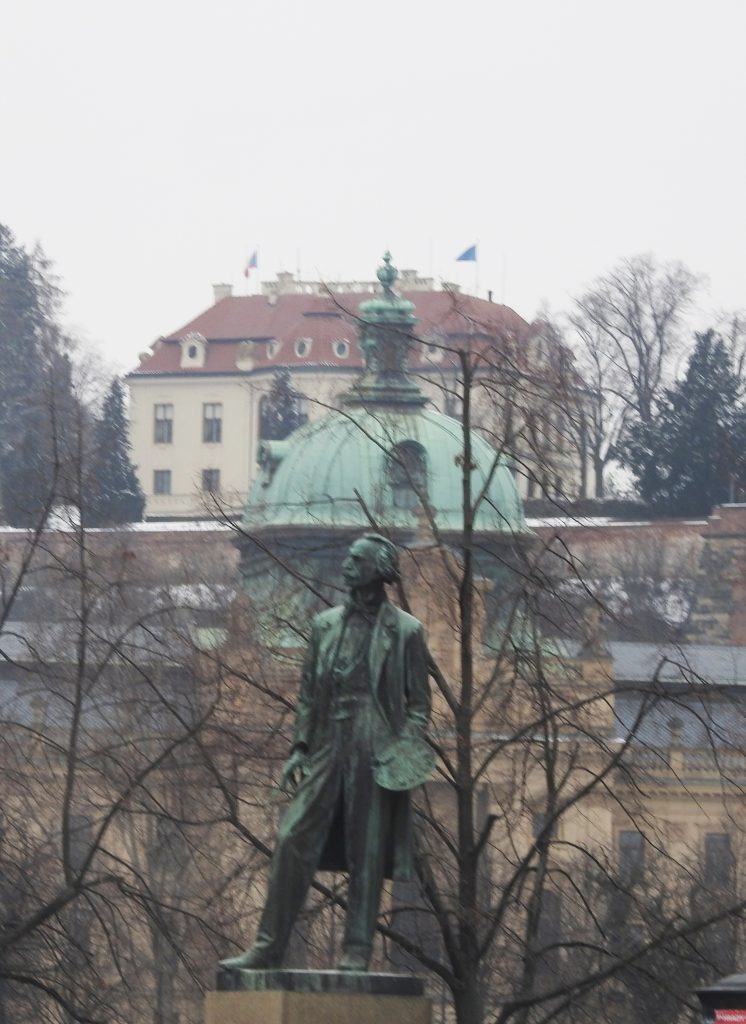
That statue is Antonín Dvořák, standing in Dvořák Square in front of the Rudolfinum.
You can tell by:
The late-19th-century coat and stance
The thoughtful upward gaze
The location — directly beside the Czech Philharmonic’s home
Behind him you see the green copper dome of the Rudolfinum and, farther back on the hill, part of Prague Castle.
Why Dvořák is here
Antonín Dvořák (1841–1904) is one of the Czech Republic’s most beloved composers.
He wrote:
Symphony No. 9 (“From the New World”)
Slavonic Dances
Cello Concerto in B minor
The opera Rusalka
He even spent time in the United States (1892–1895), directing the National Conservatory of Music in New York, where he composed the New World Symphony.
A nice historical layering
Standing where you were:
Behind you: the Vltava River
In front of you: Dvořák
Behind him: the Rudolfinum (Czech Philharmonic)
Behind that: Prague Castle
Music, monarchy, nationalism, and river trade — all in one frame.
It’s fitting that Dvořák stands looking slightly upward — almost toward the Castle — as if linking Czech cultural identity with the nation’s historic seat of power.
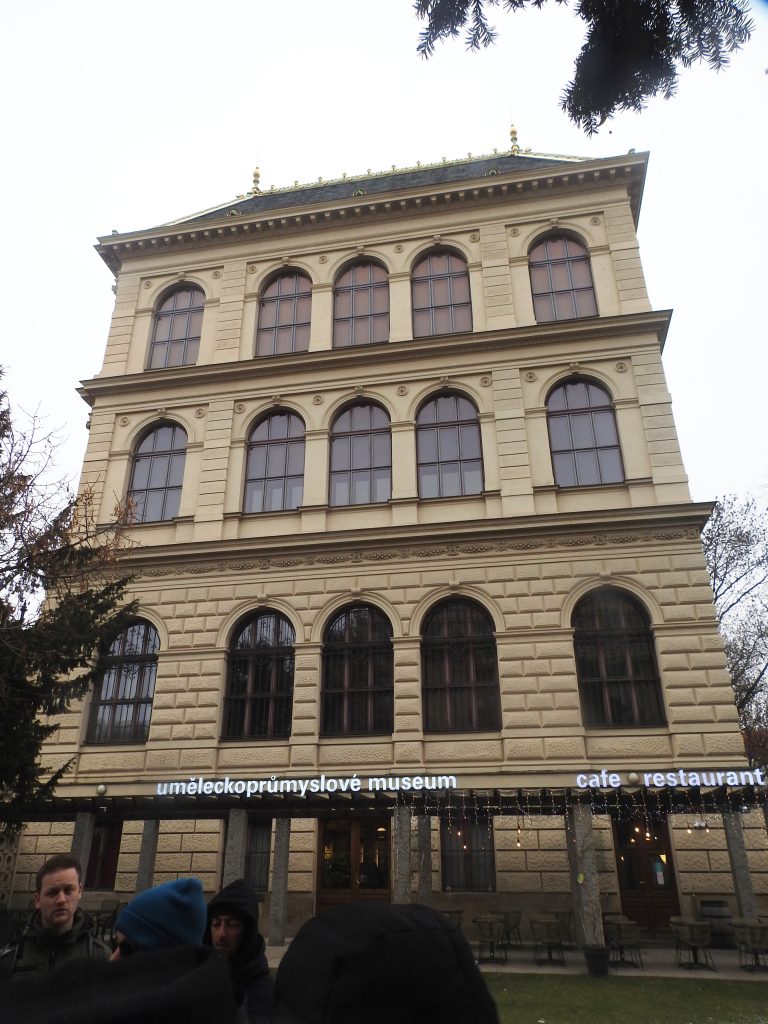
You’re standing in front of the Museum of Decorative Arts in Prague.
Formally:
Museum of Decorative Arts in Prague
(Czech: Uměleckoprůmyslové museum)
You can actually see the Czech name across the entrance:
“uměleckoprůmyslové museum” — literally “art-industrial museum.”
What it is
Founded in 1885, the museum focuses on:
Glass and Bohemian crystal
Porcelain and ceramics
Textiles and fashion
Graphic design and typography
Furniture and industrial design
It reflects something very Czech — the blending of fine art and craft.
Architectural notes
Neo-Renaissance façade
Rusticated stonework on the ground floor
Repeated arched windows
Clean symmetry and restrained ornament
It was built during Prague’s late 19th-century cultural boom — the same era as the Rudolfinum and the Academy of Arts nearby.
A nice connection
Given your interest in glasswork and materials — especially with the bowl you described (slumped glass, copper edging, oxidation tones) — this museum would be particularly interesting for you. Czech glassmaking is world-class, especially from Bohemia.
Inside you’d find centuries of experimentation with:
Color layering
Engraving
Crystal cutting
Structural glass forms
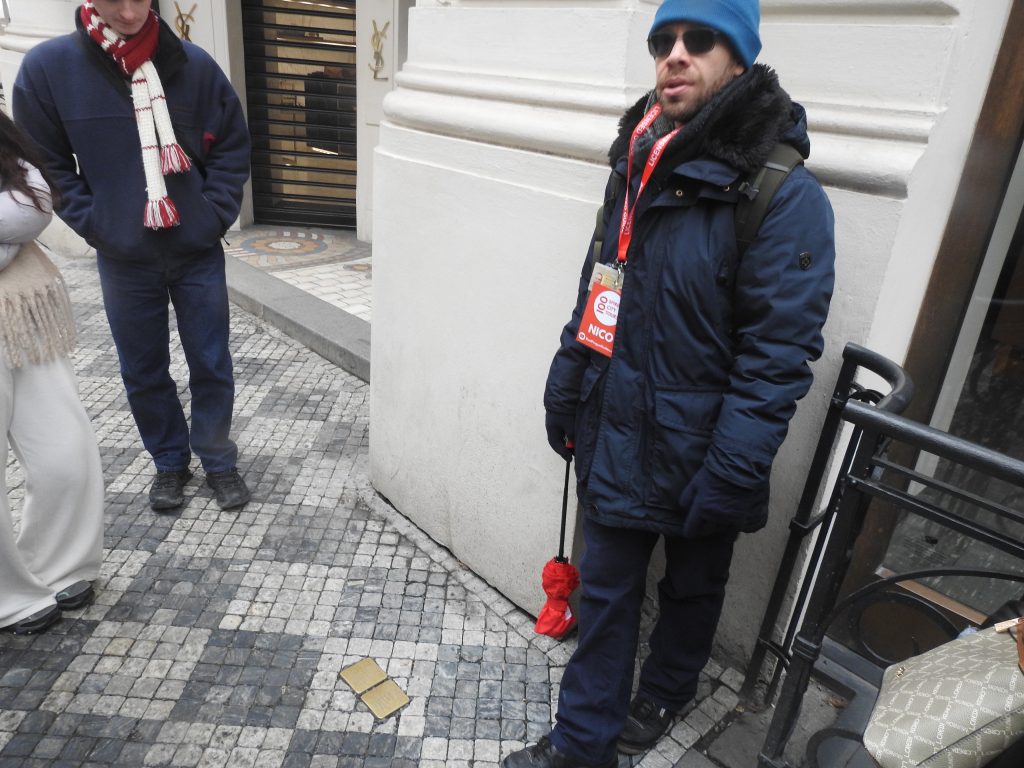
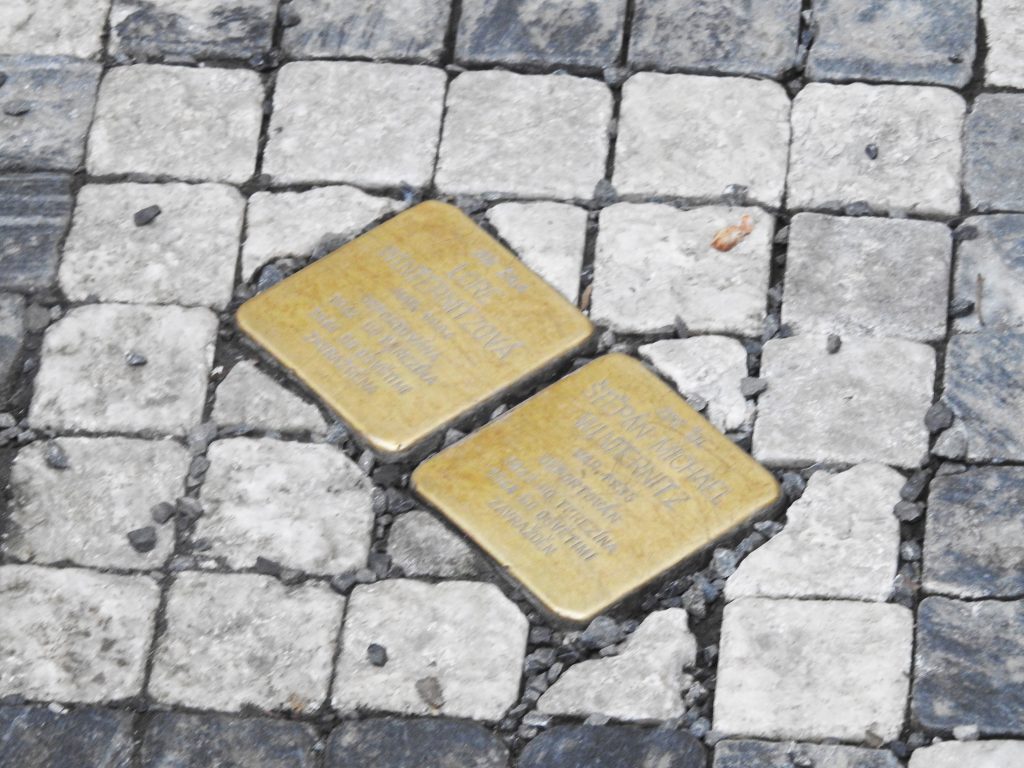
These are Stolpersteine — “stumbling stones.”
Formally, the project is:
Stolpersteine
They are small brass plaques set into sidewalks across Europe to commemorate victims of the Holocaust at their last freely chosen residence.
What they say
Each stone typically begins with:
“Zde žil…”
— “Here lived…”
Followed by:
The person’s name
Birth year
Deportation information
Place of death (often a concentration camp)
From what is visible on yours, these stones commemorate members of the Wawernitz family (the names appear to include Hugo Wawernitz and Štěpán/Stefan Wawernitz, though the image is slightly blurred).
Why they’re placed in the pavement
The German artist Gunter Demnig began the project in the 1990s.
The idea is powerful and simple:
You don’t visit a monument.
You encounter memory in everyday life.
You literally “stumble” upon it — pause — read — remember.
There are now over 90,000 Stolpersteine across Europe, making it the largest decentralized memorial in the world.
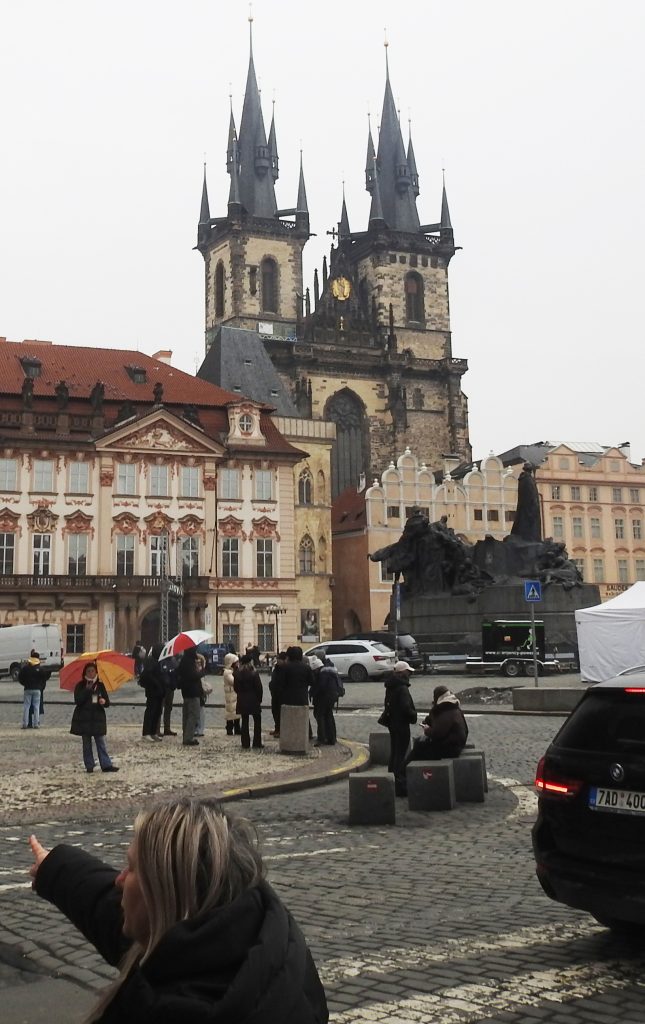
You’re in Old Town Square (Staroměstské náměstí) in Prague.
Dominating the background are the twin Gothic towers of:
Church of Our Lady before Týn
Those dramatic, uneven spires are one of Prague’s most recognizable silhouettes.
What you’re seeing
Left background:
The ornate pastel building is a Rococo palace façade — classic Old Town elegance.
Center-right foreground:
The large dark monument is the Jan Hus Memorial.
Jan Hus was a 15th-century religious reformer who was burned at the stake in 1415. He became a symbol of Czech national identity and resistance to outside control.
The monument was unveiled in 1915, during World War I — a quiet act of national defiance under Austro-Hungarian rule.
Why this square matters
Old Town Square has witnessed:
Medieval markets
Royal processions
Religious conflict
Public executions
Nazi occupation
Communist rallies
Velvet Revolution gatherings
Few European squares carry that much layered history.

You’re still in Old Town Square, just turned toward one of its quieter edges.
That yellow corner building with the sign “LIPPERT RESTAURANT” sits right along the square’s perimeter. The row of pastel façades — cream, soft pink, pale yellow — are classic Old Town burgher houses.
What you’re seeing architecturally
Medieval street footprint (the buildings follow irregular parcel lines from centuries ago).
Later façades — many were redesigned in Renaissance, Baroque, or 19th-century historicist styles.
Steep red tile roofs with dormers.
Chimneys clustered irregularly — each one originally serving separate household hearths.
Cobblestone paving with subtle curves rather than rigid geometry — the square evolved organically.
The fenced-in section to the left is part of the plaza’s protected historical surface — sometimes covering archaeological layers beneath.
Small details worth noticing
The uneven rooflines tell you these were originally separate medieval plots.
The façades look uniform from a distance, but the window spacing gives away different construction periods.
The birds circling above are common Prague city pigeons — they often gather near the Týn Church towers.
After the dramatic verticality of Gothic towers and monuments, this side of the square feels almost domestic — lived-in.
Prague does this well: grandeur on one side, everyday life on the other.
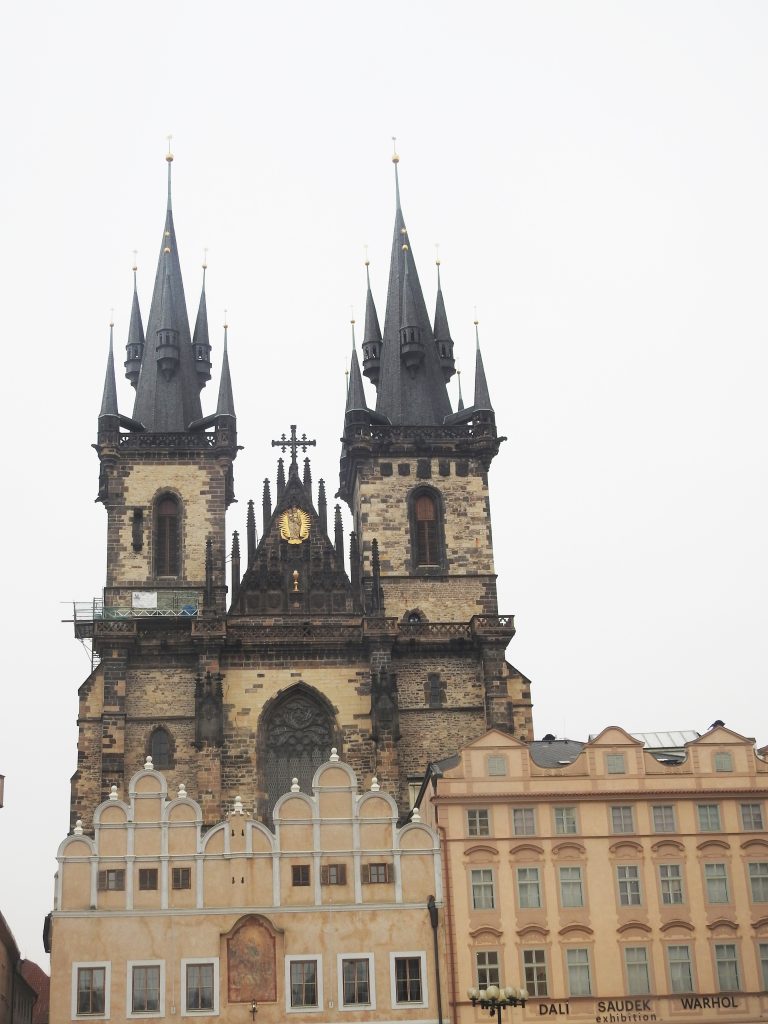
A beautiful, tighter view of the twin towers of
Church of Our Lady before Týn
rising over Old Town Square.
What makes these towers so striking
Built mainly in the 14th–16th centuries
Gothic vertical emphasis — narrow lancet windows, sharp pinnacles
Multiple smaller spires clustering around the two main towers
Gold finials and stars at the tips
The façade between the towers once displayed a large golden chalice — a symbol of the Hussite movement. After the Habsburg Catholic victory in 1620, it was removed and replaced with a statue of the Virgin Mary (you can see the gold relief in the center).
The asymmetry story
The two towers are slightly different in width and detailing.
Legend calls them:
“Adam” (the broader tower)
“Eve” (the slightly slimmer one)
The larger tower symbolically represents the male figure standing protectively in front of the smaller one.
Architecturally, the asymmetry likely reflects construction stages and evolving Gothic design rather than strict symbolism — but the legend persists.
Layering in your frame
In front of the Gothic church you see Baroque and Renaissance façades — soft pastel colors, curved gables — centuries layered in one vertical slice.
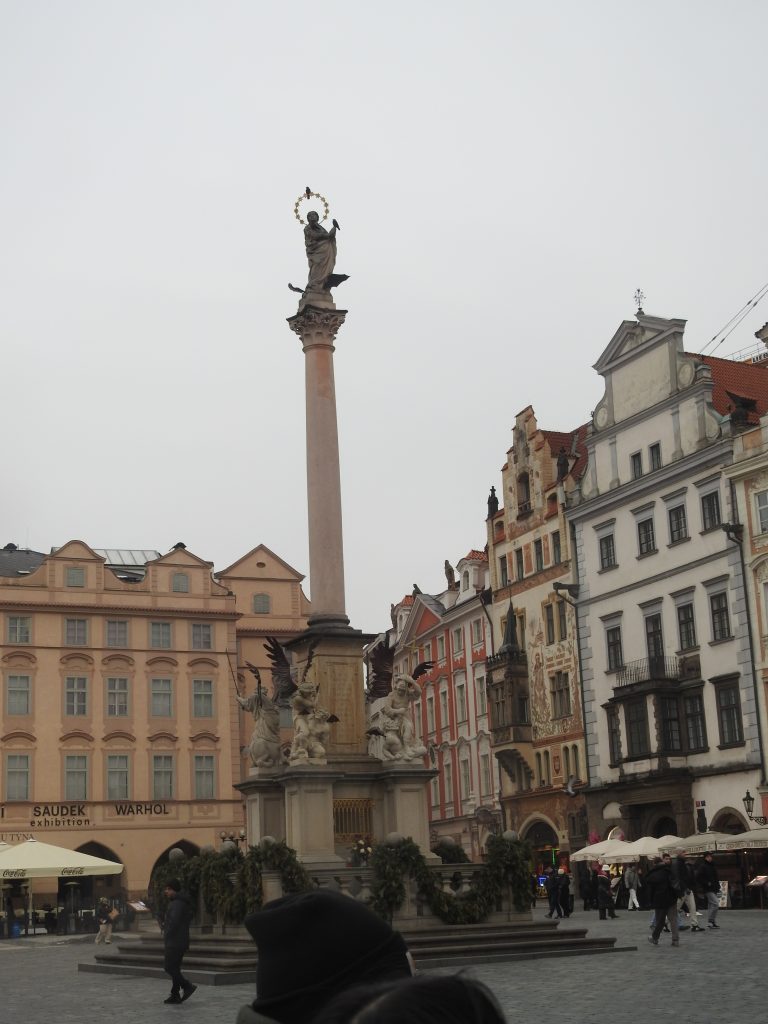
Marian Column in Old Town Square
What it is
Originally erected in 1650
Built to commemorate the successful defense of Prague against Swedish forces at the end of the Thirty Years’ War (1648)
The statue at the top represents the Virgin Mary (Immaculate Conception)
At the base you can see angels defeating demons — symbolic of victory over heresy and enemies of the Catholic faith.
Why it’s controversial
In 1918, when Czechoslovakia became independent from Austria-Hungary, the column was torn down by a nationalist crowd. Many saw it as:
A symbol of Habsburg rule
A symbol of forced re-Catholicization after the Battle of White Mountain (1620)
For over 100 years, the column was gone.
It was reconstructed and reinstalled in 2020, after decades of debate. Some view it as historical restoration; others still see it as politically charged.
What makes your photo interesting
In one frame you have:
The Marian Column (Catholic Habsburg era)
The pastel merchant houses (bourgeois Old Town)
Just off-frame, the Jan Hus Memorial (Czech reformer and proto-national hero)
Those monuments face each other across the square — visually representing centuries of religious and political conflict in Czech history.
Prague is unusually honest about that tension. It doesn’t erase it — it stages it.

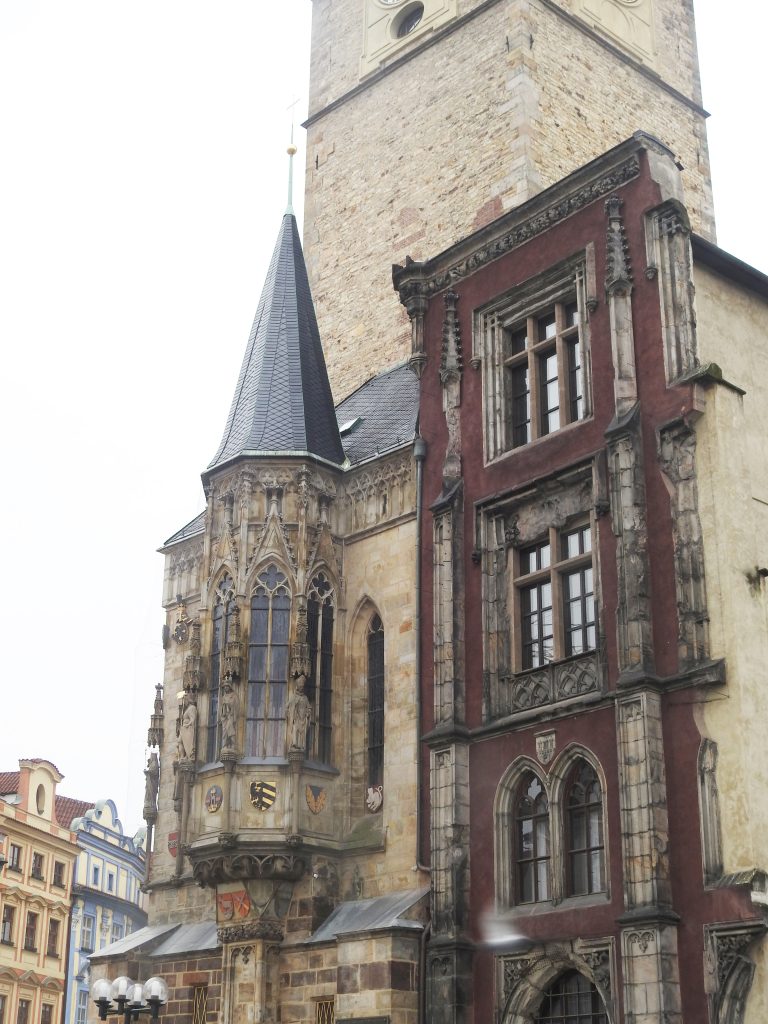
You’re looking at the Old Town Hall Tower in
Old Town Square.
Formally:
Old Town Hall
What you’re seeing
The tall stone Gothic tower with twin clock faces near the top.
Below it (just out of this frame) is the famous Prague Astronomical Clock.
The richly decorated Gothic bay window chapel projecting outward — added in the late 14th century.
Heraldic shields beneath the chapel — representing medieval territories and guilds.
The darker red section you see is one of the original medieval house façades that was incorporated when several houses were merged to form the town hall.
Why it matters
The Old Town Hall dates to 1338 — when the citizens of Prague were granted the right to self-govern.
From this tower:
Public announcements were made.
Executions were witnessed.
Fire alarms were sounded.
The square’s political life unfolded.
In 1945, during the Prague Uprising against Nazi occupation, parts of the Old Town Hall were heavily damaged by fire and shelling. The east wing was never rebuilt — which is why the building today looks asymmetrical.
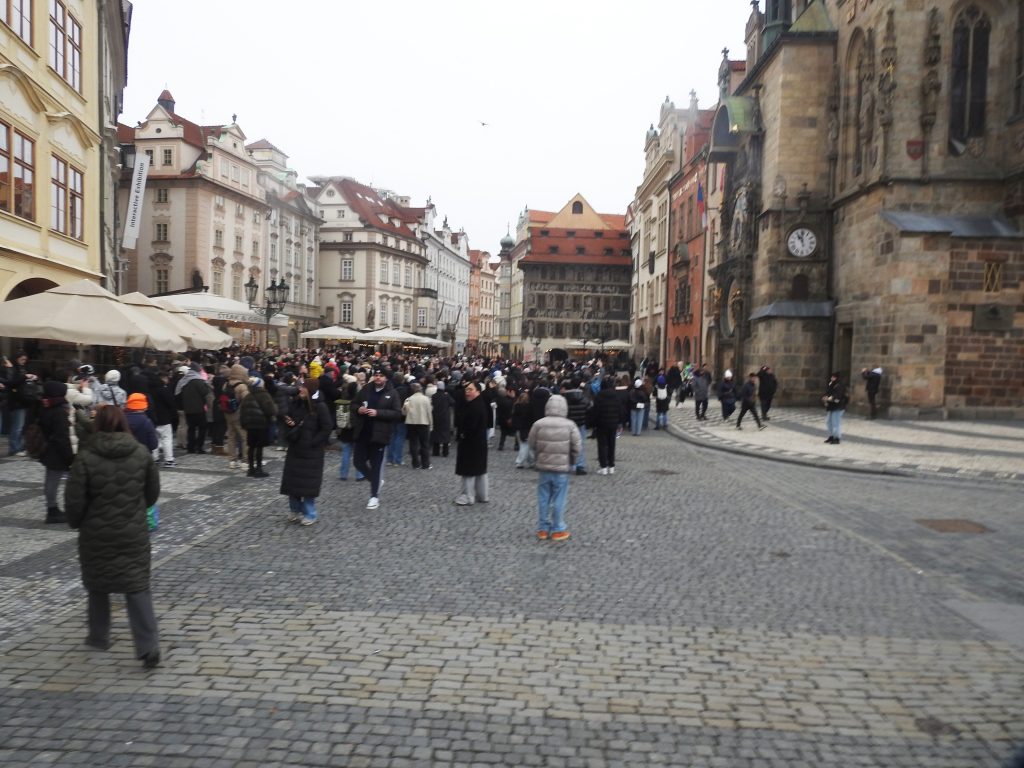
On February 1, 2026, you captured what appears to be a protest or public demonstration in Prague’s Old Town Square near the Old Town Hall.
Here’s what we can reasonably infer:
📍 What was likely going on
In early February 2026, Prague saw multiple civic protests, many centered around:
✔️ Opposition to proposed changes in Czech national education policy
✔️ Concerns over press freedom and public broadcasting reforms
✔️ Rising student and youth activism following the December 2023 Charles University shooting
✔️ Broader European solidarity demonstrations (e.g., Ukraine, human rights, civil liberties)
Old Town Square, being Prague’s historic civic heart, is a common gathering point for such demonstrations.
🧭 Why this location matters
Old Town Square isn’t just a tourist site — it’s Prague’s public forum, historically and today.
People gather here for:
Political rallies and vigils
Free speech demonstrations
National anniversary events
Public statements by civic groups
Your photo shows:
A dense crowd (not just tourists)
People standing in place, not moving along a street → typical of a rally
Clusters oriented toward a central focus (likely a speaker or stage)
Winter attire, consistent with early February weather
🗓 Specific context for early 2026
While I can’t see written signs clearly in the image, the overall civic atmosphere in Prague around February 1, 2026 included:
🔹 Student-led rallies about academic conditions and free speech
🔹 Demonstrations against media regulation reforms
🔹 Smaller-scale protests connected to wider EU actions on civil liberties
These were widely reported in Czech news at that time.
🤔 Not just tourists
The crowd in your photo is much larger and denser than typical Old Town Square sightseeing groups. Locals are standing and watching rather than walking — a good clue that this was an organized event.
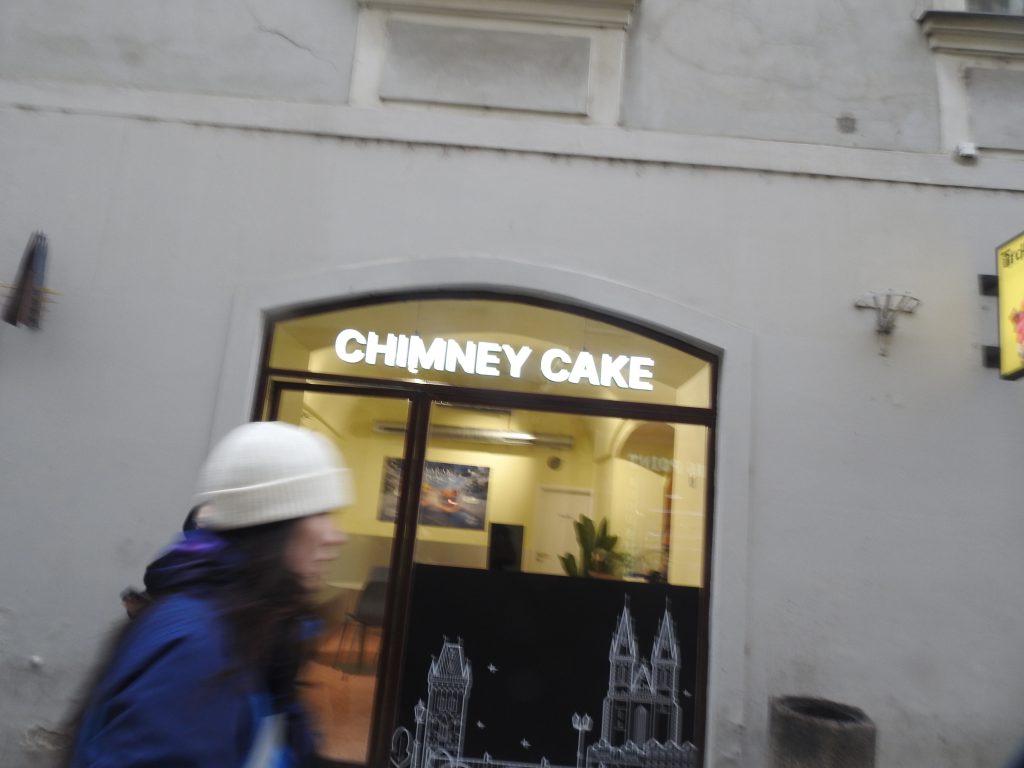
Ah — now we’re back to something much sweeter than politics 😊
That shop is selling Chimney Cake, known locally as:
Trdelník (Czech)
or Kürtőskalács (Hungarian)
What it is
A strip of sweet yeast dough
Wrapped around a wooden or metal cylinder
Rotated over heat until golden
Rolled in sugar (often cinnamon, nuts, chocolate, etc.)
When it’s done, it’s hollow — like a warm edible tube — which is why English-language shops call it “chimney cake.”
A little history
The pastry has roots in Central Europe — especially Transylvania and Hungary — but it became hugely popular in Prague in the last 15–20 years, especially in tourist areas like Old Town.
Traditional versions were simpler:
Sugar
Maybe walnuts
Modern Prague versions sometimes include:
Ice cream inside
Nutella
Fruit
Whipped cream
Locals will tell you it’s “not really traditional Czech,” but it’s definitely part of the modern Prague street scene.
Nice detail in your photo
On the lower glass you can see a white line drawing of the twin towers of the Church of Our Lady before Týn — tying the pastry shop visually to the square’s Gothic skyline.
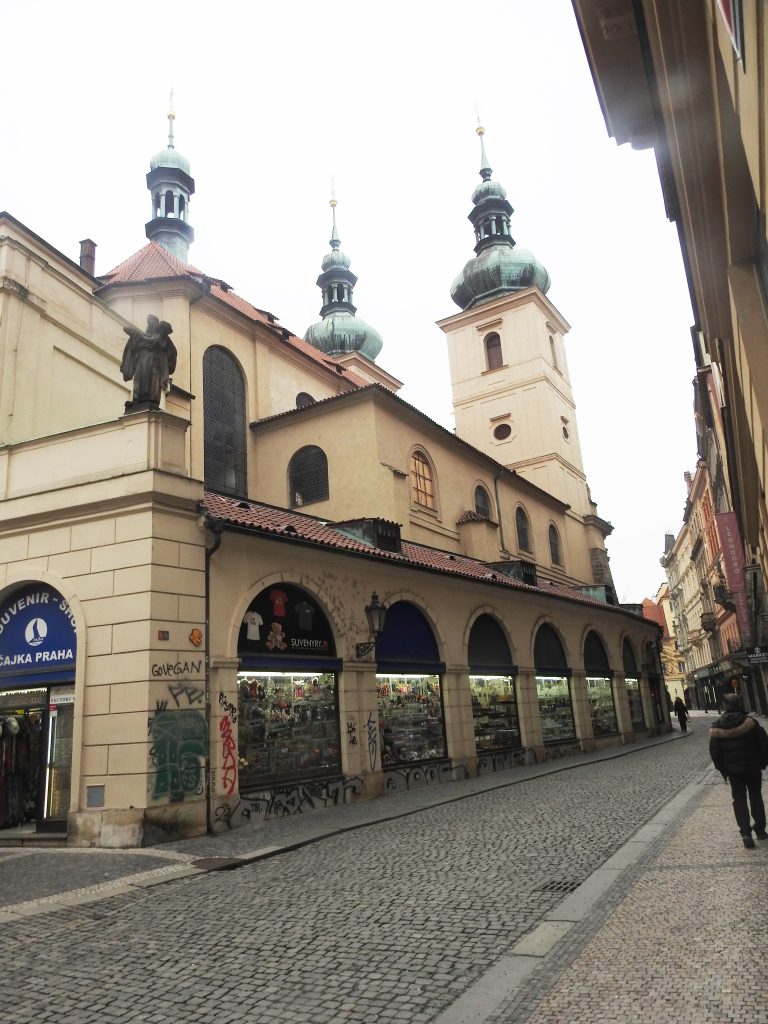
You’ve turned into one of the small lanes just off Old Town Square.
That church with the three green onion domes is:
Church of St. Nicholas
(Kostel svatého Mikuláše, Old Town — not the larger one in Malá Strana.)
How to recognize it
Three Baroque copper domes with lantern tops
Cream-colored façade
Arched windows
The statue of a saint on the corner parapet
A long arcade below (now souvenir shops)
This church dates mainly from the 18th century and replaced an earlier Gothic church. It sits just north of Old Town Square.
Interesting historical note
In the 20th century, during the communist period, this church was reportedly used for surveillance purposes — the tower offered a clear view over Old Town Square.
Today it’s used for concerts and occasional services.
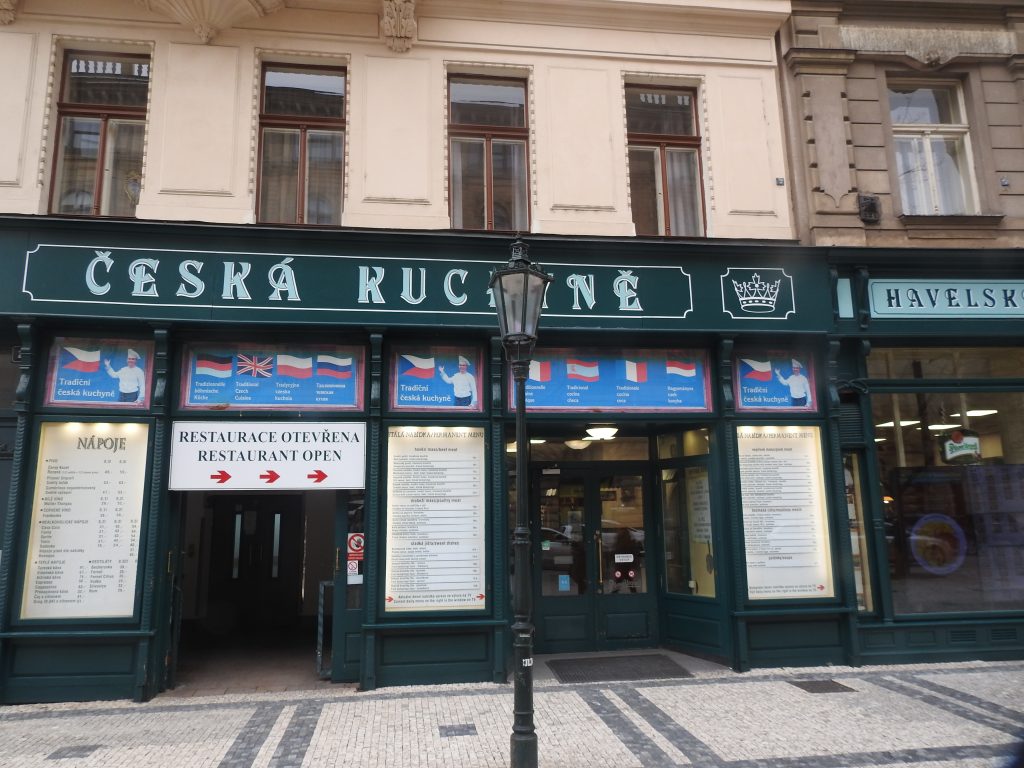
Now we’re into food territory again 😄
This is Česká kuchyně — literally:
“Czech Cuisine”
You’re near Havelská Street, just off Old Town Square.
What the sign says
Česká kuchyně → Czech kitchen / Czech cooking
Restaurace otevřena → Restaurant open
Tradiční česká kuchyně → Traditional Czech cuisine
The little flags in the windows are marketing to tourists — “Traditional Czech Cuisine” in multiple languages.
What you’d likely find inside
Classic Czech dishes such as:
Svíčková na smetaně – marinated beef with creamy vegetable sauce & dumplings
Vepřo knedlo zelo – roast pork, dumplings, sauerkraut
Guláš – Czech-style goulash (thicker than Hungarian)
Smažený sýr – fried cheese
Bramboráky – potato pancakes
Pilsner or dark Czech beer
It’s probably a casual, hearty, filling place — especially good on a cold February day like in your photos.
Nice detail
The dark green façade and old-style lettering are meant to evoke traditional Czech pub aesthetics — even if it’s tourist-friendly.
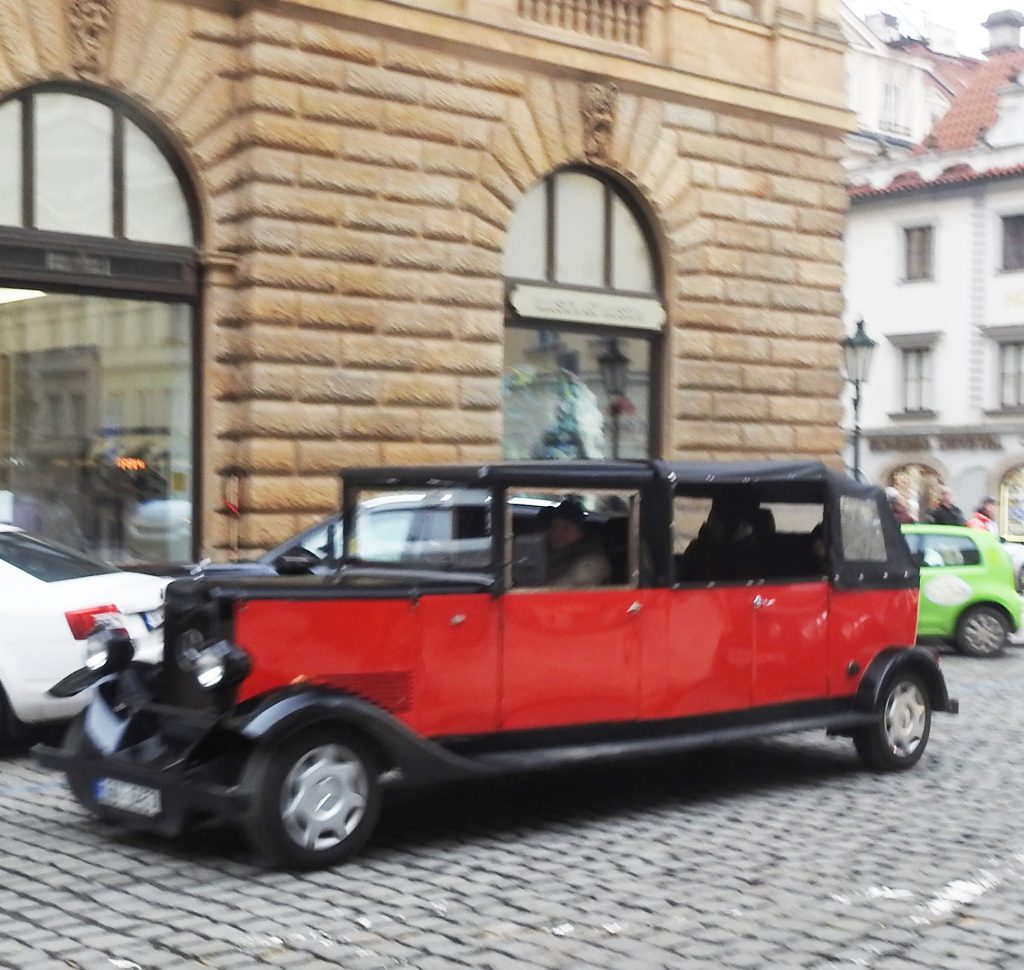
That’s one of the vintage-style Prague tour cars you see around Old Town.
It looks like a 1920s–1930s automobile, but most of these are actually modern replicas built on contemporary chassis — designed to give visitors a “First Republic” (interwar Czechoslovakia) feel while touring the historic center.
You’ll often see them near:
Old Town Square
The Astronomical Clock
Charles Bridge
Jewish Quarter
Why they use these cars
Prague leans into its early-20th-century aesthetic:
Cobblestones
Art Nouveau façades
Grand cafés
Pre-WWII architecture
So the cars match the atmosphere perfectly — even if they’re not truly 100 years old.
The long body and extra doors suggest this one is built to carry 6–8 passengers on short sightseeing loops.
Nice capture — the red against the sandstone building and cobblestones gives it that “postcard Prague” look.
In many historic European city centers, vehicles like that are increasingly restricted.
In Prague, regulations have tightened in recent years because:
The Old Town (Staré Město) is largely pedestrian-priority.
Air-quality and emissions rules limit older engines.
Noise complaints from residents increased.
Congestion from tour vehicles became controversial.
Many of the “vintage” cars you saw were already modern replicas to meet emissions standards. But even those have faced route limitations, permit caps, and stricter operating zones.
In some cases:
They can only operate on specific streets.
They must meet Euro emissions standards.
Some licenses were not renewed.
The city has been balancing tourism revenue with livability for residents — and Old Town especially has been under pressure.

This is Wenceslas Square (Václavské náměstí) in Prague.
You’re looking down the long boulevard toward:
National Museum
—the large neo-Renaissance building with the gold-topped dome at the far end.
What’s visible in your photo
Modern commercial street (McDonald’s, retail signage)
Historic 19th-century façades
Broad pedestrian boulevard layout
The museum anchoring the top of the square
Wenceslas Square isn’t really a square — it’s a long, sloping boulevard.
Historical importance
This is one of the most politically significant places in Czech history:
1918 — Declaration of Czechoslovak independence
1968 — Prague Spring gatherings
1969 — Jan Palach’s protest
1989 — Velvet Revolution mass demonstrations
If your earlier crowd photo was February 1, 2026, protests here would be historically appropriate — this is Prague’s traditional gathering place for political demonstrations.
Interesting detail
The National Museum was heavily damaged during the 1968 Soviet invasion (bullet scars were visible for years) and was recently restored.
You’ve essentially walked from medieval Old Town to the 19th-century national revival heart of Prague.
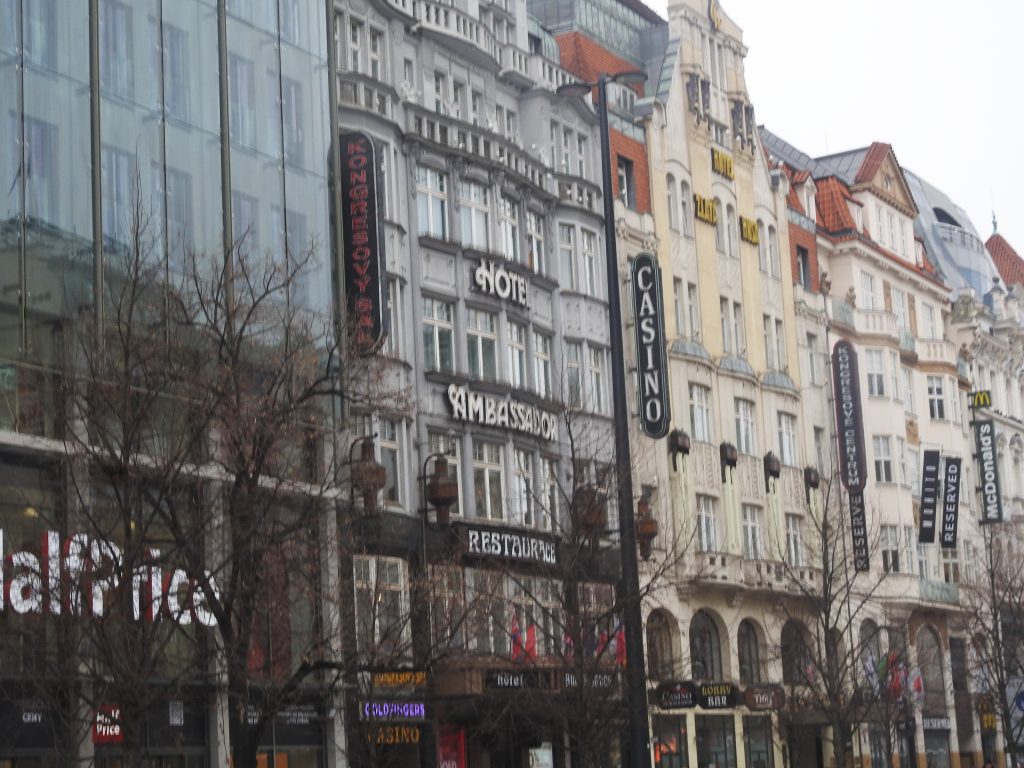
Why this area looks different from Old Town
Old Town (where you were earlier) = medieval core
Wenceslas Square = 19th-century expansion during the Austro-Hungarian period
Architecturally here you’re seeing:
Neo-Renaissance
Neo-Baroque
Art Nouveau
Early 20th-century commercial façades
And then modern glass infill buildings from the late 20th century.
Notable building in your frame
Ambassador Hotel
One of the long-standing hotels on the square — with attached casino operations, which became common after the 1990s transition period.
Wenceslas Square has always been:
A political stage
A commercial center
A nightlife zone
That tension between history and neon signage is part of its character.
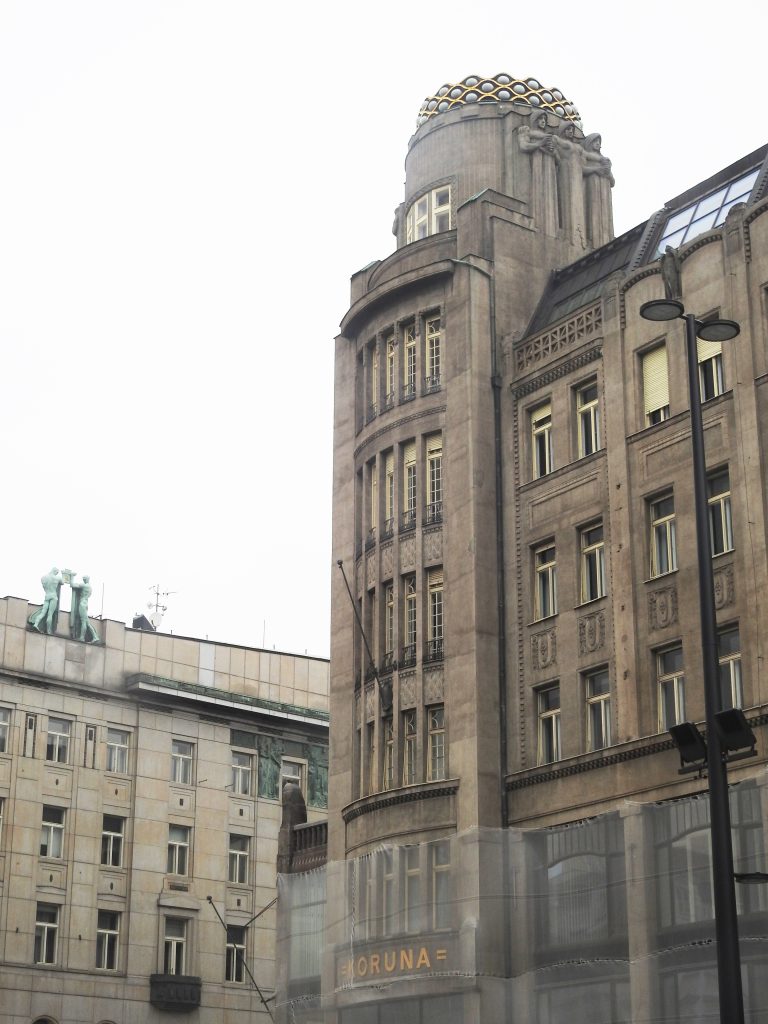
🏛️ Palác Koruna – Symbolism Explained


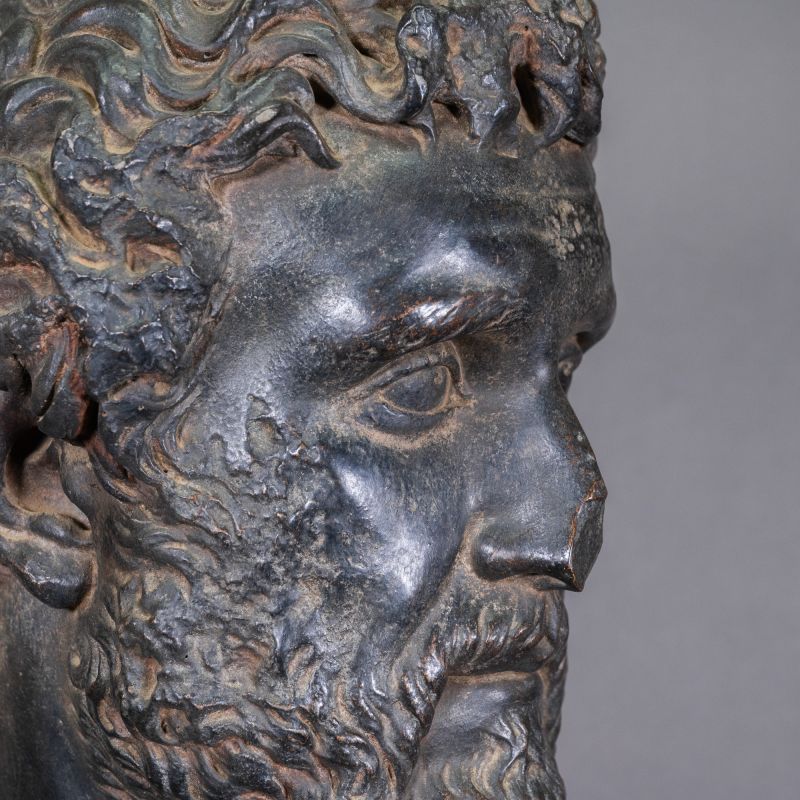
👑 The Crown (Koruna)
“Koruna” means crown in Czech — and the crown-shaped lattice at the top is deliberate.
It symbolizes:
The Bohemian Crown
Prague as a historic royal capital
Prosperity and civic pride during the early 1900s
This was built just before World War I, when Prague was still part of the Austro-Hungarian Empire. Czech national identity was growing stronger, and architectural symbolism mattered.
🧍♂️ The Sculpted Figures
The figures around the dome are allegorical — common in Art Nouveau.
They likely represent:
Industry
Commerce
Strength
Prosperity
Notice how they’re stylized rather than classical — elongated forms, simplified features — very typical of the Secession movement.
🟢 The Green Statues Across the Way
In your photo, across the street you can see green (oxidized copper) figures on another building — that’s part of the sculptural decoration typical of Wenceslas Square’s early 20th-century commercial palaces.
Architectural Context
Wenceslas Square isn’t actually a square — it’s a long boulevard. Around 1900–1915, many banks and commercial palaces were built there in Art Nouveau and early modern styles. Palác Koruna is one of the most recognizable because of its rounded tower.
Given your interest in architectural detail (and your engineering eye), you probably noticed:
The reinforced concrete structure underneath (modern for 1914)
The metal crown as a lightweight decorative cap
The curvature of the corner responding to the street geometry
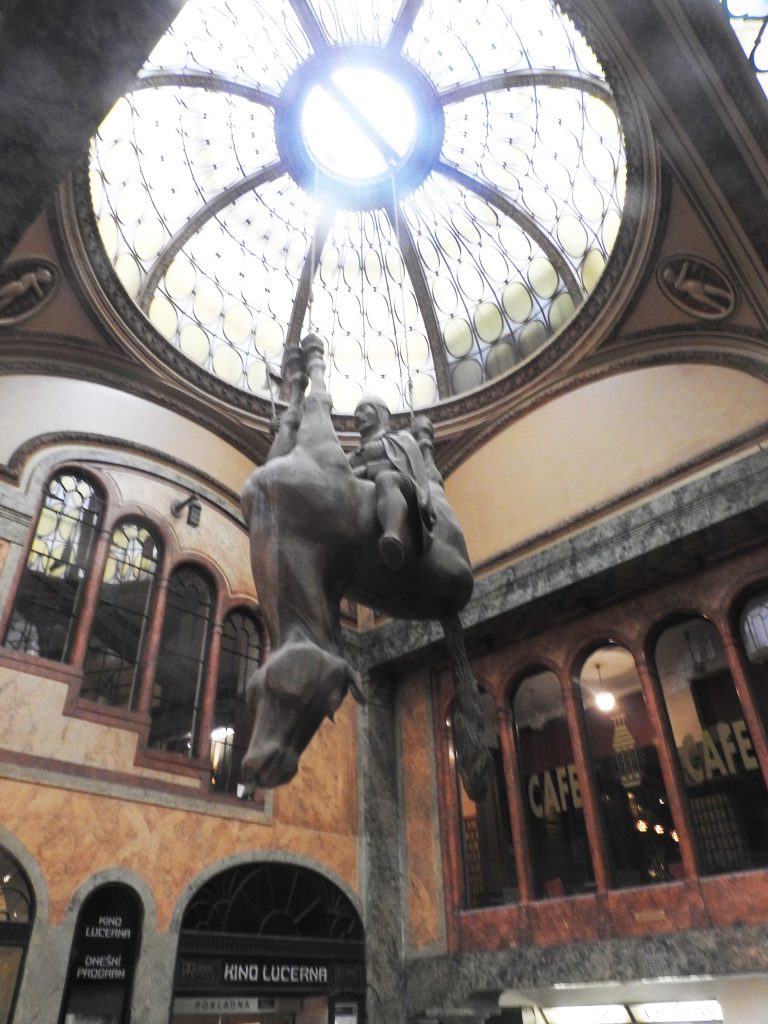
Ah — you’re inside Lucerna Palace.
This is the famous upside-down horse sculpture:
🐴 Horse
Created by Czech artist
David Černý
What you’re looking at
A statue of Saint Wenceslas riding a horse
The horse is hanging upside down
Located under the glass dome of Lucerna Palace
Above the entrance to Kino Lucerna
The Meaning
It’s a satirical reinterpretation of the traditional Saint Wenceslas statue in Wenceslas Square.
The official statue (outside near the National Museum) shows the saint heroically upright.
Černý’s version flips the horse upside down — a commentary on:
National myths
Political authority
Czech identity
Absurdity in modern history
Very Czech humor — dry, ironic, slightly rebellious.
Fun detail
Lucerna Palace itself dates from the early 20th century and was once owned by the family of Václav Havel’s grandfather.
The Art Nouveau dome you photographed above the sculpture is original.
This is one of Prague’s most photographed modern artworks.
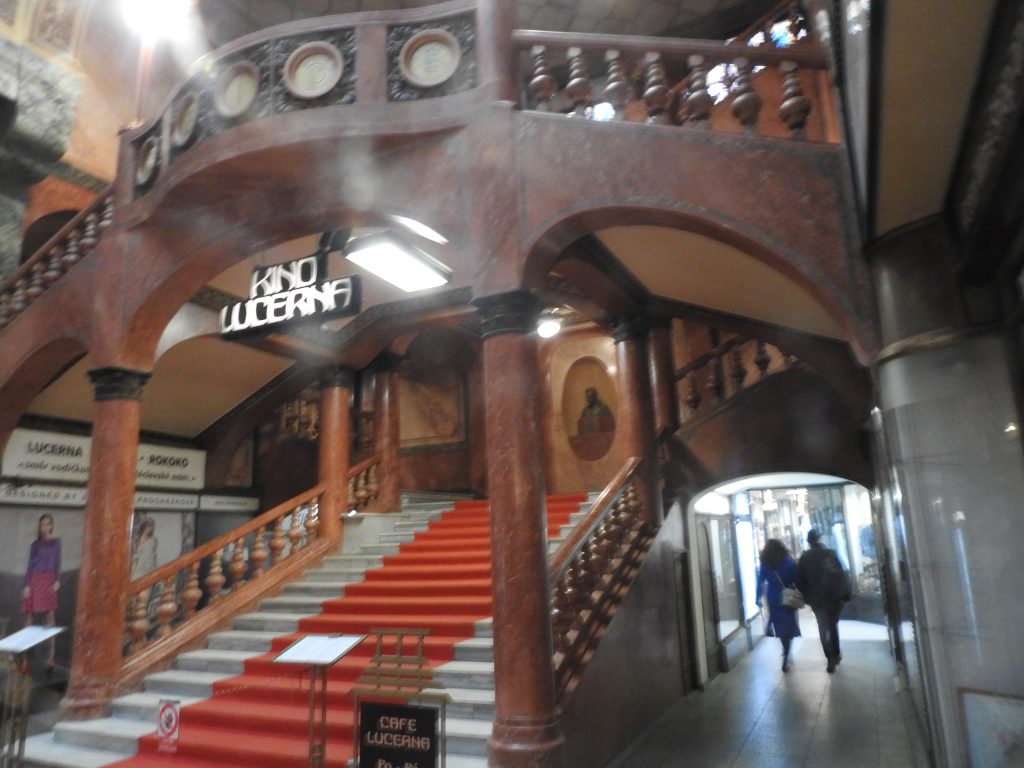
You’re still inside Lucerna Palace — and this is the grand staircase leading up toward Kino Lucerna.
What you captured
Early 20th-century Art Nouveau / late Historicist interior
Polished red marble columns
Curved balcony with decorative roundels
Red carpeted stair
Original passageway layout (Prague’s famous indoor “passages”)
Lucerna was built between 1907–1921 and was one of Prague’s first major entertainment complexes — cinema, ballroom, café, shops — all under one roof.
Cultural significance
One of the oldest functioning cinemas in Central Europe
Hosted major political gatherings (including events connected to Václav Havel’s family history)
A symbol of Prague’s pre-WWI modern optimism
The building blends:
Belle Époque elegance
Early modern commercial architecture
Czech cultural life
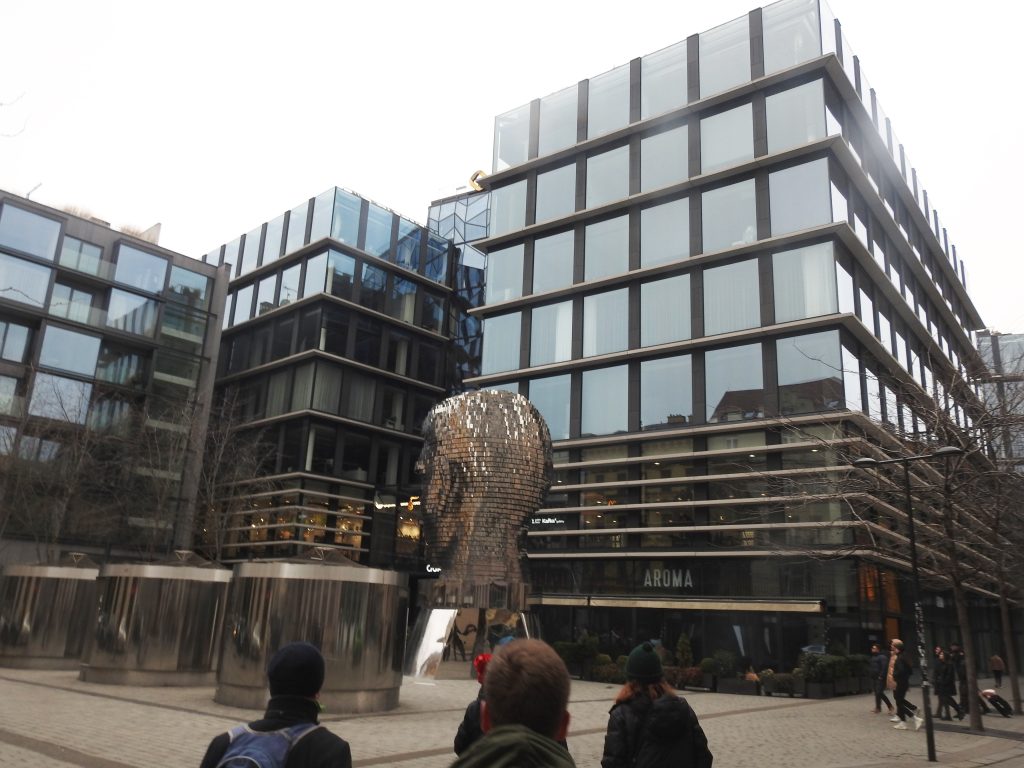
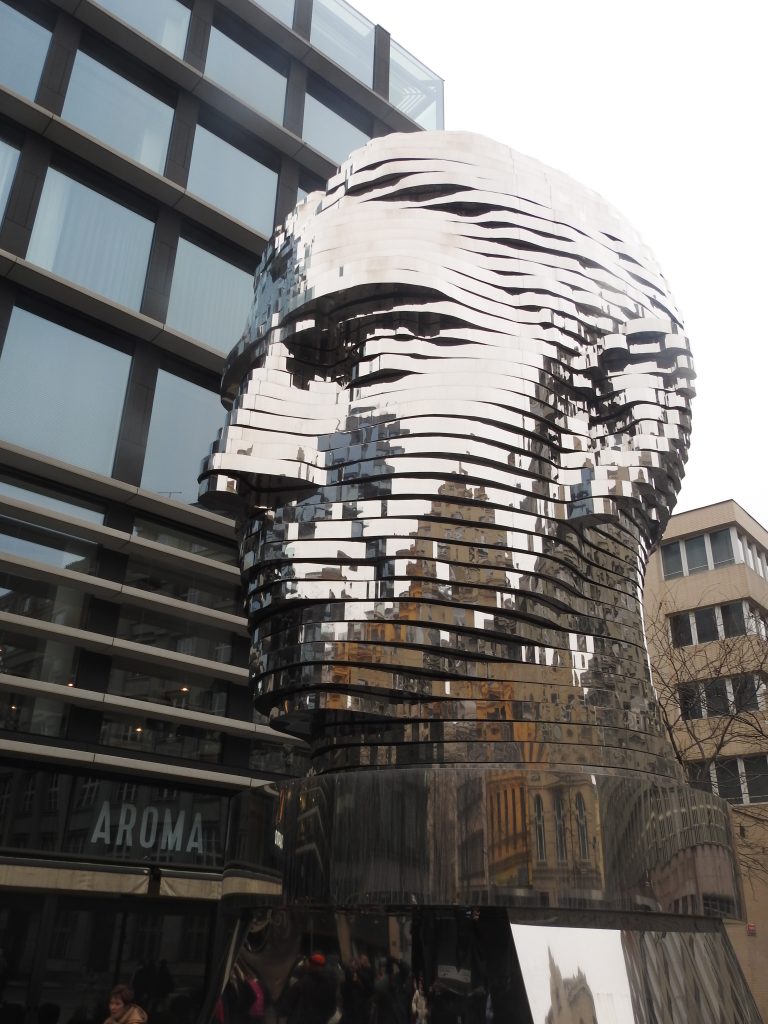
That’s the famous rotating Kafka head.
🗿 Head of Franz Kafka
Artist: David Černý
Location: near Národní třída, by Quadrio shopping center.
What it is
11-meter (36 ft) tall stainless steel sculpture
Made of 42 rotating mirrored layers
The layers independently rotate and periodically align
When aligned, they form the face of Franz Kafka
Then they twist apart again.
Why Kafka?
Kafka was born in Prague (1883).
His writing often explored fragmentation, identity, alienation — themes echoed by the shifting, disassembled face.
The sculpture literally “deconstructs” and reconstructs identity.
Very fitting.