
Prague – January 31, 2026

Train to Prague Jan 31

Prague, capital city of the Czech Republic, is bisected by the Vltava River. Nicknamed “the City of a Hundred Spires,” it’s known for its Old Town Square, the heart of its historic core, with colorful baroque buildings, Gothic churches and the medieval Astronomical Clock, which gives an animated hourly show. Completed in 1402, pedestrian Charles Bridge is lined with statues of Catholic saints. ― Google

Population: 1.398 million (Jan 1, 2025)

When we were leaving Wien (Vienna) , due to “technical” conditions we were 10 minutes behind schedule, heaven forbid!!
The ride was smooth but not as smooth and fast as the trains in Japan.
 
It is hard to tell which country we are in. No one comes around and says we are leaving “x” and arriving in “y”! Time for a four hour nap! There is a food service in the car ahead of us and a cart that just came through if we want more food. We brought some though.
 
While we’re waiting for the train I stopped in McDonald’s and had a snack. They did not have much for breakfast, no eggs, no milk, just a flat pancake with a thin slice of cheese and something that looked like bacon but I could not taste it!
The ride sways side to side a bit, good for sleeping.
Many hotels provide hot chocolate and apples! There is a grocery every block where we get a wrap for our meals, we are doing very well on the cheap!!
 
We have not seen any military, only a few police – one guy with a gun in front of the casino! That is all.

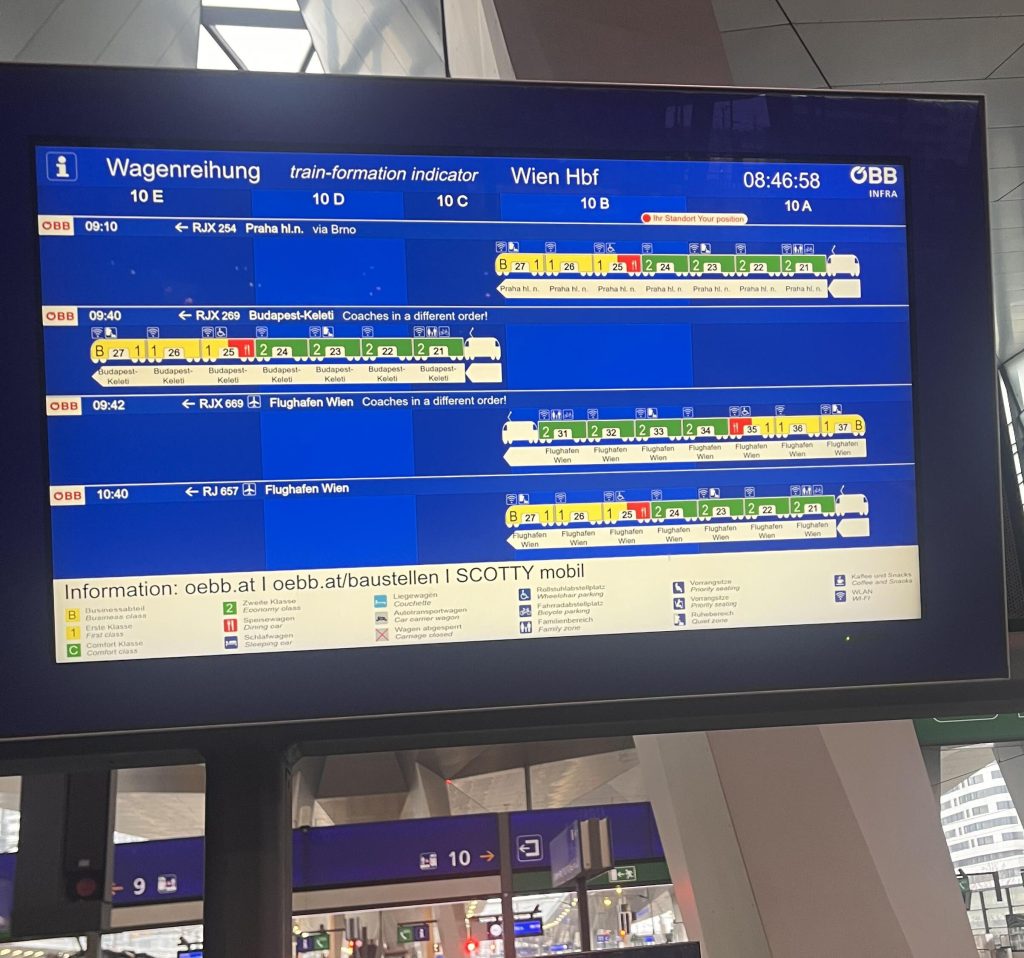
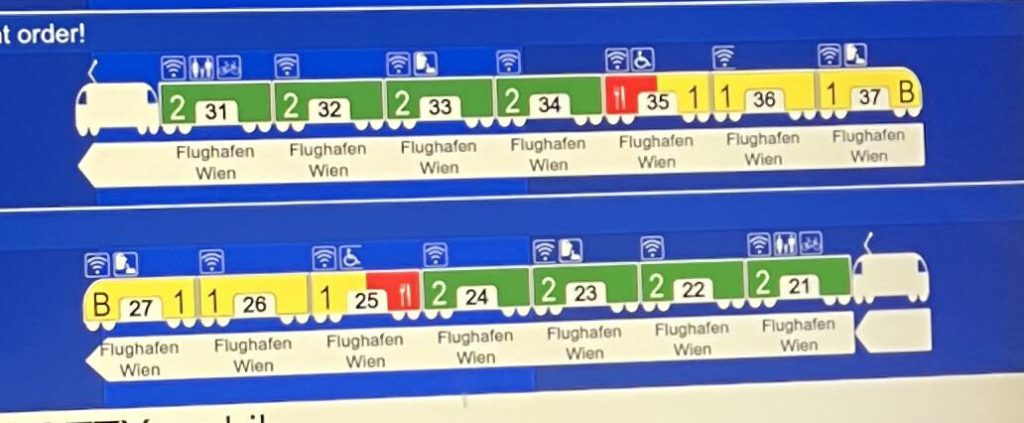
While waiting for the train in Wien Hbf, this is the screen we used to find our train.

Our seats were 22 and 23 in car number 24, so we knew what to look for – just after the meal car! They had really good WiFi as well.

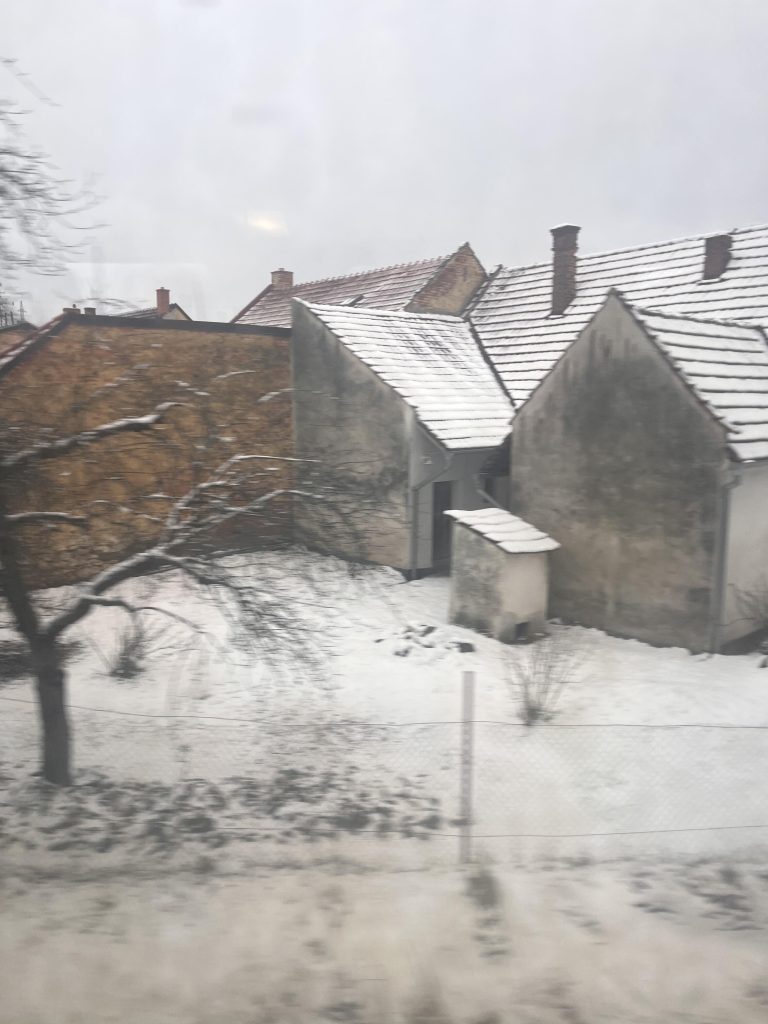
New snow in the country, it had melted in the city, but it was still cold!!
A dog on the train, there were a lot of dogs everywhere.
Our landmark we used to find our hotel.

We stayed at the Hotel Central R&R  just a half block from this tower. 

This is the Powder Tower (Prašná brána) in Prague.

You can tell by:

  • The dark Gothic stone façade

  • The large pointed arch gateway

  • The statues of Bohemian kings set into the niches

  • The decorative crest band below the roofline

Built in 1475, it was one of the original city gates and marked the beginning of the Royal Route — the ceremonial path taken by Bohemian kings on their coronation procession to Prague Castle.

Later it was used to store gunpowder — hence the name.

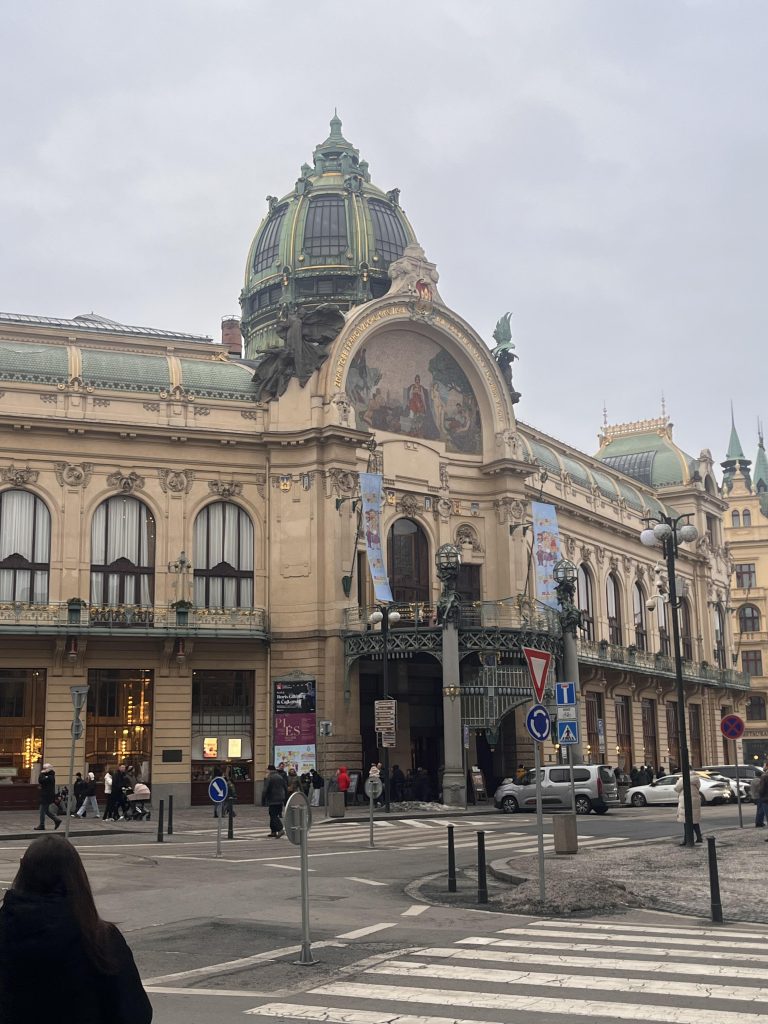
From your angle, you’re standing near the transition between Old Town and the newer parts of Prague — just steps from the Municipal House (Obecní dům), which you photographed earlier.

Prague has such a different feel from Vienna — darker Gothic drama versus imperial Baroque elegance.

This was on the bank next door! I guess the building that was here in 1829 and 1830 was occupied by (translation) "Creators of Polish Folk Music lived in the house in 1829 and 1830 who was in these places." Chopin, I guess. Now there is a huge bank there.

Chopin visited Prague twice while still very young — just before he left Poland permanently. Within a few years he would settle in Paris, where he composed most of his great works.

It’s interesting to see his presence marked in Prague — a reminder of how interconnected Central European culture was in the 19th century: Polish composer, Austrian Empire territories, Bohemian cities, Viennese salons.

This is the Rudolfinum in Prague — home of the Czech Philharmonic.

You can tell by:

  • The large green copper dome

  • The grand arched mosaic above the entrance

  • The Neo-Renaissance façade with ornate detailing

  • The wrought iron balcony over the main doorway

It opened in 1885 and is named after Crown Prince Rudolf of Austria. Today it houses the Dvořák Hall, one of Europe’s finest concert venues.

Interesting contrast — you’ve moved from Vienna’s Musikverein to Prague’s Rudolfinum. Two imperial capitals, two extraordinary musical traditions.

Hotel Central in Prague — a beautiful example of early Czech Art Nouveau architecture.

You can see classic Secessionist features:

  • Flowing floral reliefs around the entrance

  • Decorative gold lettering

  • Curved balcony forms

  • Ornamental iron and glass canopy

  • Subtle pastel façade with sculpted botanical motifs

It was built in 1900 and designed by architects Bedřich Bendelmayer and Alois Dryák. The organic plant forms around the doorway are very much in the spirit of Alphonse Mucha’s era.

This sits not far from the Powder Tower and Municipal House — so you were right in the heart of Prague’s Art Nouveau district.

🏗️ Masaryčka Building

https://images.openai.com/static-rsc-3/zKjD9JXve1lX6EAMyh2yIz32rO0HZ9OXaOlx64C1HNxBNebU52tjr3-OF3uNVSYcmaKdku7F_xbAIF6glR2QXOB1UPyRfj0sdX_rhmrB2nw?purpose=fullsize&v=1
https://worldarchitecture.org/cdnimgfiles/extuploadc/01_zha_masarycka_photobyboysplaynice.jpg
https://upload.wikimedia.org/wikipedia/commons/2/26/02_Masarycka_train_station_exterior.jpg
 

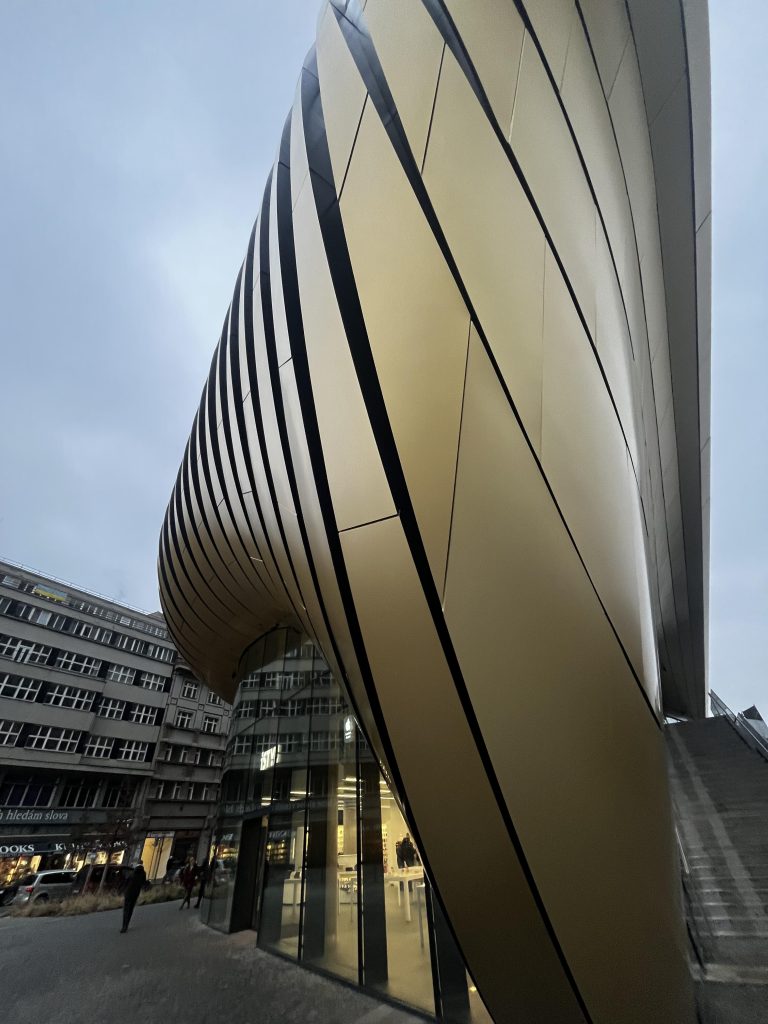
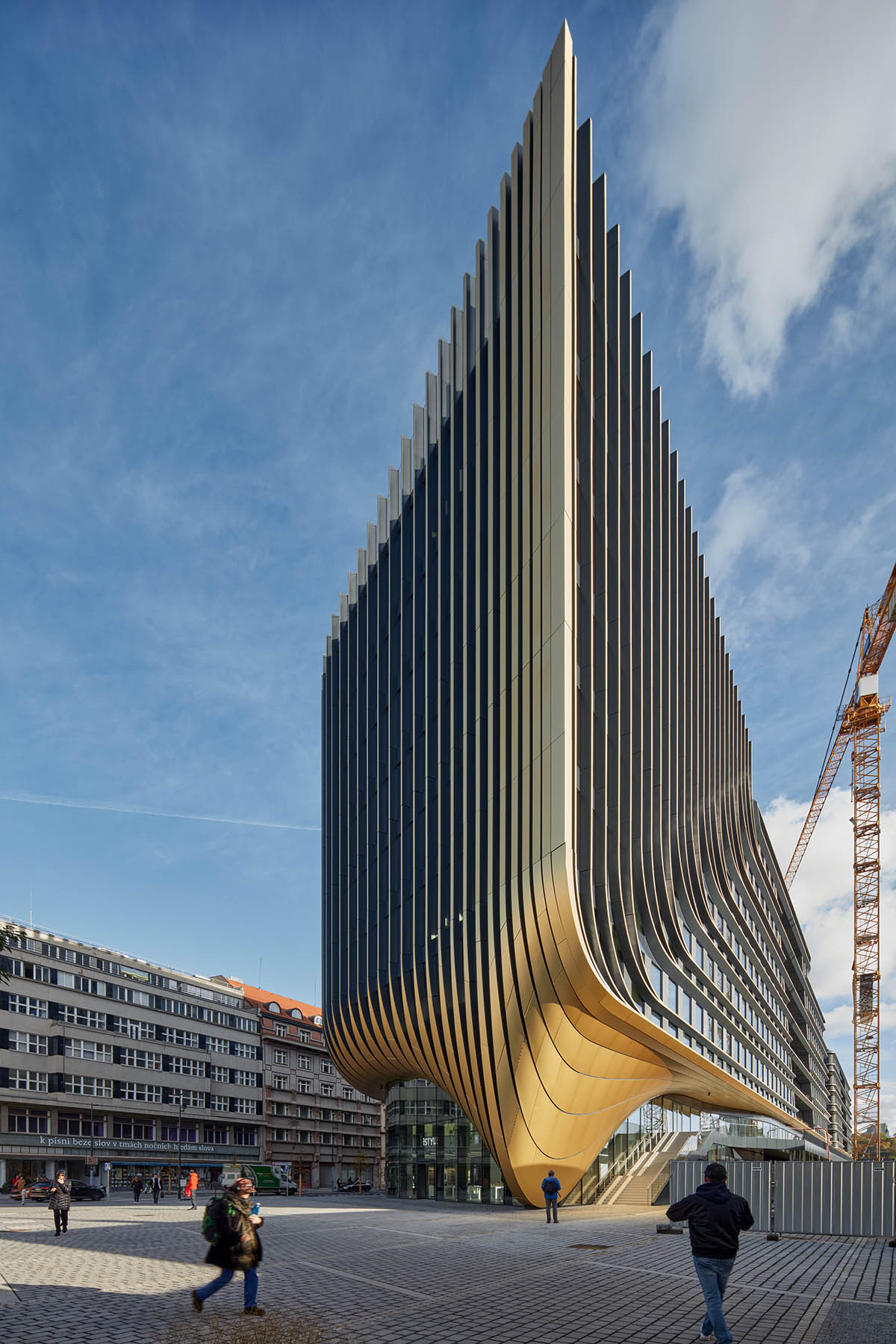
This striking gold, flowing façade is the Masaryčka Building, designed by Zaha Hadid (completed 2023).

It sits beside Masarykovo nádraží (Masaryk Railway Station) in Prague.

You can recognize it by:

  • The sweeping, wave-like form

  • Gold-toned aluminum panels

  • Deep vertical ribs

  • Dramatic overhang above the glass entry

It’s meant to echo the motion of trains and the curved geometry of railway tracks — very contemporary, very fluid — a sharp contrast to the Gothic and Art Nouveau architecture you’ve been photographing.

You’ve gone from medieval gates → Art Nouveau → Baroque concert halls → and now 21st-century parametric design.

Prague really layers its centuries.

We walked the length of it along the stores on the first level thinking we might find some food store, but it was all high end stuff.

Walk the City

A full day in Prague, we walked 22,400 steps, 11 miles plus! We walked around a bit trying to find the subway station we needed to go to to find our guide. We found our guide about 5 minutes late, but off we all went. He showed us a lot of places. Half way through we had a 15 minute stop, then continued on. He told us all about things that happened in many places, 200,000 strong protesting at various times. We crossed the river and continued. We saw a building that was built after WWII – the americans had gotten lost and dropped their bombs here in Prague, a friendly country when they were headed for Germany! The architect had designed a building that looks like a man and a woman, Fred Astaire and Ginger Rogers! There are many many wonderful buildings here, tall arches, wonderful domes. 

The last stop was an nondescript small church. We stood in front of it along a street that was also nondescript with very little traffic. He regaled to us the story of a time when the Germans held the country. There was one German was #3 after Adolf and one other person. Per ChatGPT:

Assassination of Reinhard Heydrich, the top Nazi official in Prague during WWII.

Reinhard Heydrich

 
https://germanhistorydocs.org/media/volume-7/image-1925/28910_ca_object_representations_media_4433_frontend.jpg
https://www.mdr.de/nachrichten/Reinhard-Heydrich-ss-gruppenfuehrer-100-resimage_v-variantBig16x9_w-832.jpg?version=37183
4
  • Title: Reichsprotektor of Bohemia and Moravia

  • One of the main architects of the Holocaust

  • Nicknamed “The Butcher of Prague”

  • Ruled Prague with extreme brutality after the Nazi occupation of Czechoslovakia

The two men who carried it out

Jozef Gabčík & Jan Kubiš

 
https://upload.wikimedia.org/wikipedia/commons/thumb/a/ad/Jan_Kubi%C5%A1.jpg/250px-Jan_Kubi%C5%A1.jpg
https://upload.wikimedia.org/wikipedia/commons/6/6d/Pamatnik-Operace-Anthropoid-1-33.jpg
4
  • Czechoslovak soldiers trained in Britain

  • Parachuted back into occupied territory

  • Mission name: Operation Anthropoid

What happened (May 27, 1942)

https://upload.wikimedia.org/wikipedia/commons/6/6d/Pamatnik-Operace-Anthropoid-1-33.jpg
https://austria-forum.org/attach/Wissenssammlungen/Essays/Alt%C3%B6sterreich_heute/Die_Heydrich-Kurve/Heydrich_Mahnmal_Karte.jpg
 
 
  • They ambushed Heydrich’s open-top car at a tight curve in Prague’s Libeň district

  • Gabčík’s gun jammed

  • Kubiš threw a modified grenade at the car

  • Heydrich was badly wounded and died of infection days later (June 4, 1942)

Aftermath

  • The Nazis retaliated with savage reprisals

  • The village of Lidice was destroyed; men executed, women and children deported

  • Thousands were arrested or killed

  • Gabčík, Kubiš, and other resistance fighters made a last stand in the crypt of Saints Cyril and Methodius Cathedral, where they died after a siege

This operation became one of the most famous acts of resistance in WWII Europe—and a powerful symbol in Czech history.


We were at that church. To get to the crypt where they were hiding the church had placed a grave stone over a small hole in the floor through which they had gone. One of the people who were hiding some of the soldiers had his mother decapitated and the Germans threatened him and his father to give up the location. When the Germans found out they had 200 come and try to smoke them out and then tried to drown them. They committed suicide in the crypt, nowadays they had cut a door into the side of the crypt so the public could enter, which we did. Quite emotional. 
When we had approached the church at first I had noticed spots on the side of the church, my thought was that they were not maintaining it well, but afterward we saw that the spots were bullet holes. The Germans had shot the place up, and tried to get into the crypt through a tiny window, there were a number of holes in that wall as well.
 
The story of Communism and German occupation were quite something. When the country escaped Communism they had an election, the Communist Party won the election, but their promises were not to have come to fruition and now they have not been a force any more.
 
There are Communist stores still that you can go in he said (we were in front of one). He said it is very representative of what restaurants were like in the past, you get what they want to give you and if the place was busy you had to stand and they demand you leave after a certain time! 
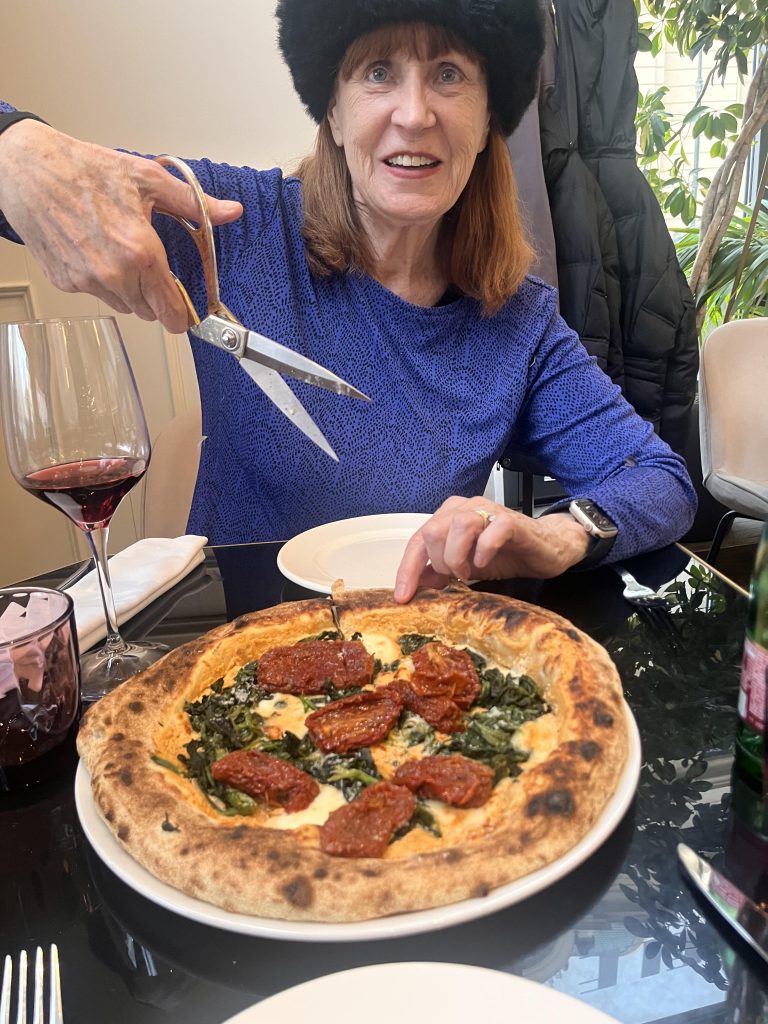
Veggi pizza for dinner!

Click here for February 1, 2026 Prague