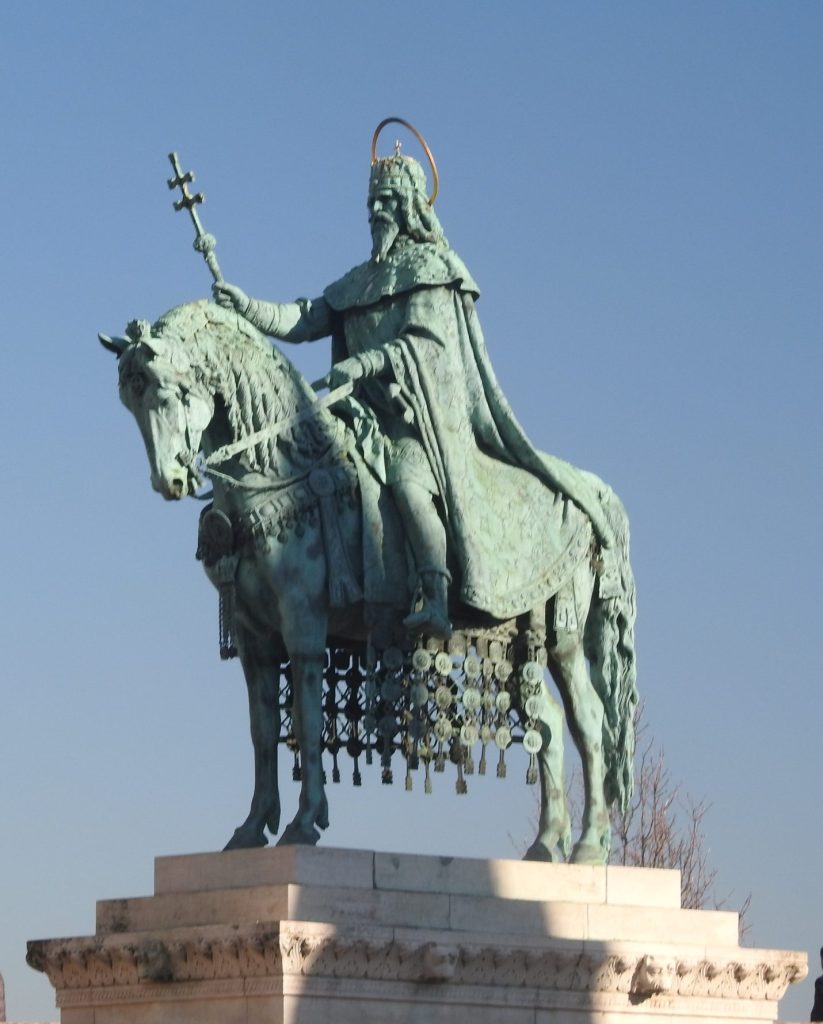
Saint Stephen, the first king of Hungary, shown as an equestrian statue.
A few quick tells:
The halo marks him as a saint
The double cross is a Hungarian Christian symbol
The chainmail decorations on the horse echo medieval regalia
Where it is:
The statue stands by Fisherman’s Bastion in Budapest, overlooking the Danube.
Our trip
January 24 to February 3, 2026 Eileen and I toured Budapest, Vienna and Prague.
It was cold (mostly in the 20’s) and we had sun one or two days. We hiked every day covering 18,000 to 22,000 steps each day. With our long strides that was 10 to 12 miles of walking, much of it up and down stairs and up and down slopes.
January 24 flight to Frankfort, Germany, then on to Budapest (Discovery Airlines)
January 25, 2026
Budapest, Hungary’s capital, is bisected by the River Danube. Its 19th-century Chain Bridge connects the hilly Buda district with flat Pest. A funicular runs up Castle Hill to Buda’s Old Town, where the Budapest History Museum traces city life from Roman times onward. Trinity Square is home to 13th-century Matthias Church and the turrets of the Fishermen’s Bastion, which offer sweeping views.—Google Population: 1.685 million (2025)
January 26, 2026
We stayed at the Eurostar Palazzo Zichy in the Pest half of Budapest, a real palace! Everything but the rooms were outsized!
We put in more than 19,000 steps today. We saw ;
St. Stephen’s church
Hungarian Parlament
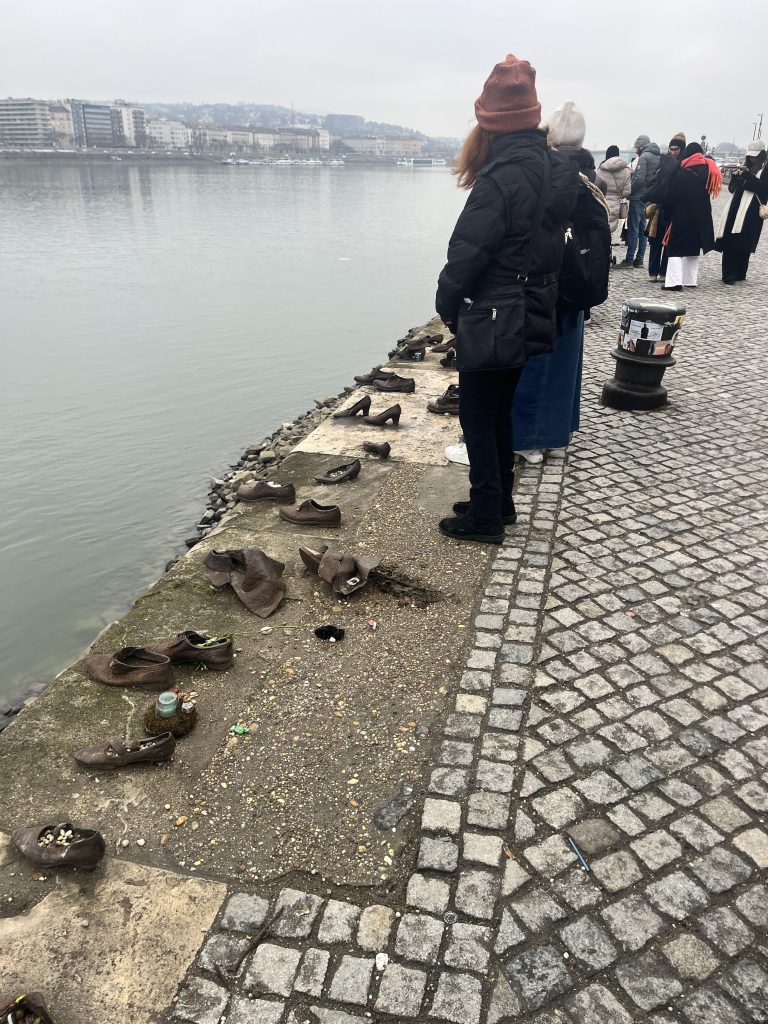
Shoes on the Danube (a real tear jerker to see those shoes where the Jews were forced to take off their shoes before they were pushed into the Danube to drown)
Vorosmarty Square
Cafe Gerbeaud (where a poor man made great by opening a cafe where the rich and famous go) (many stories!)
Chain Bridge
Vigado – Concert hall
Hungarian Academy of Science
Elizabeth Square
Danubuis Fountain
Grestian Palace – Four Seasons Hotel
Hungarian House Parliament
Our hotel is in an elegant building that once was Zichy Palace!!
We had a great breakfast and skipped lunch but had Japanese tempura for dinner!
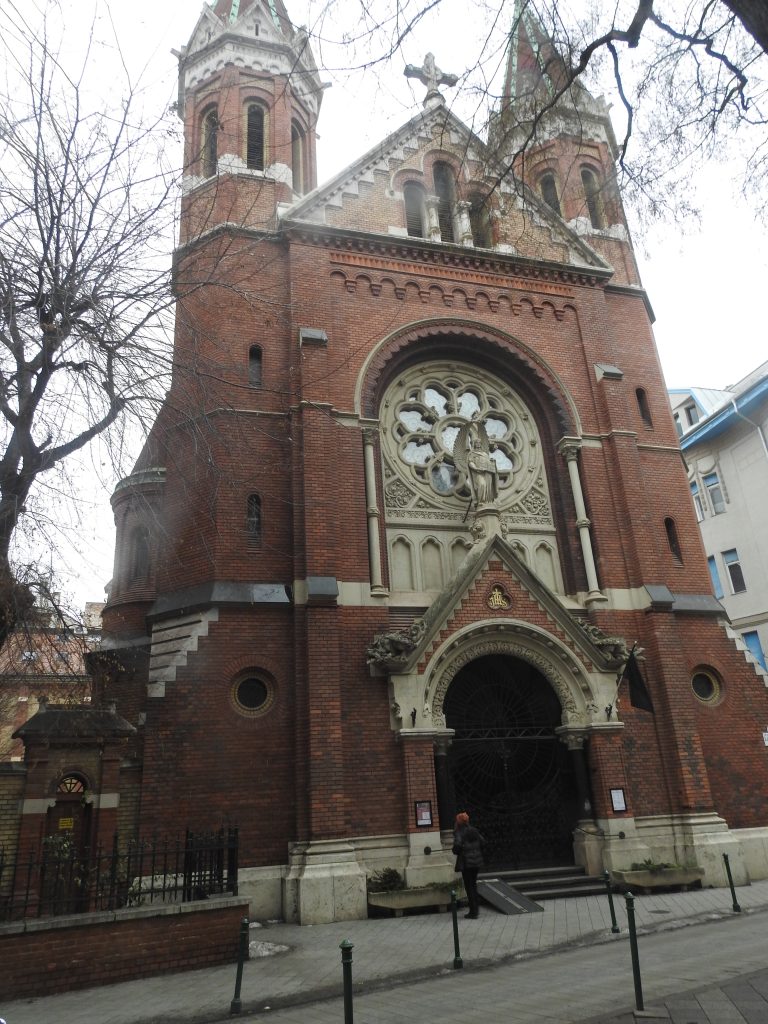
St. Francis of Assisi Church
The St. Francis of Assisi Church in Budapest, Hungary, is a historic Roman Catholic church located in the Ferencváros district near the Danube River. It is an architectural and spiritual landmark, known for its Baroque design and its connection to the Franciscan order, which played a key role in the area’s religious and cultural life.
Miksa (Maximilian) Várady (1861–1922) was:
A prominent Hungarian politician and civic leader
Strongly associated with the Ferencváros (District IX) area
Known for social and municipal reform efforts during Budapest’s rapid modernization
He served in Parliament and worked on issues affecting working-class districts — which makes sense given this neighborhood’s industrial roots.
Why He’s Here
Ferencváros in the late 19th and early 20th centuries:
Was heavily working-class
Needed infrastructure, schools, sanitation reform
Experienced political tension during the fall of the Austro-Hungarian Empire
Local leaders who pushed civic improvements were later memorialized in neighborhood squares like this one.
What I Notice in Your Photo
Hungarian flags displayed nearby (reinforcing the national context)
The statue’s pose — coat draped, forward stance — typical of early 20th-century civic memorial style
Intimate courtyard setting rather than grand plaza — very “neighborhood hero” scale
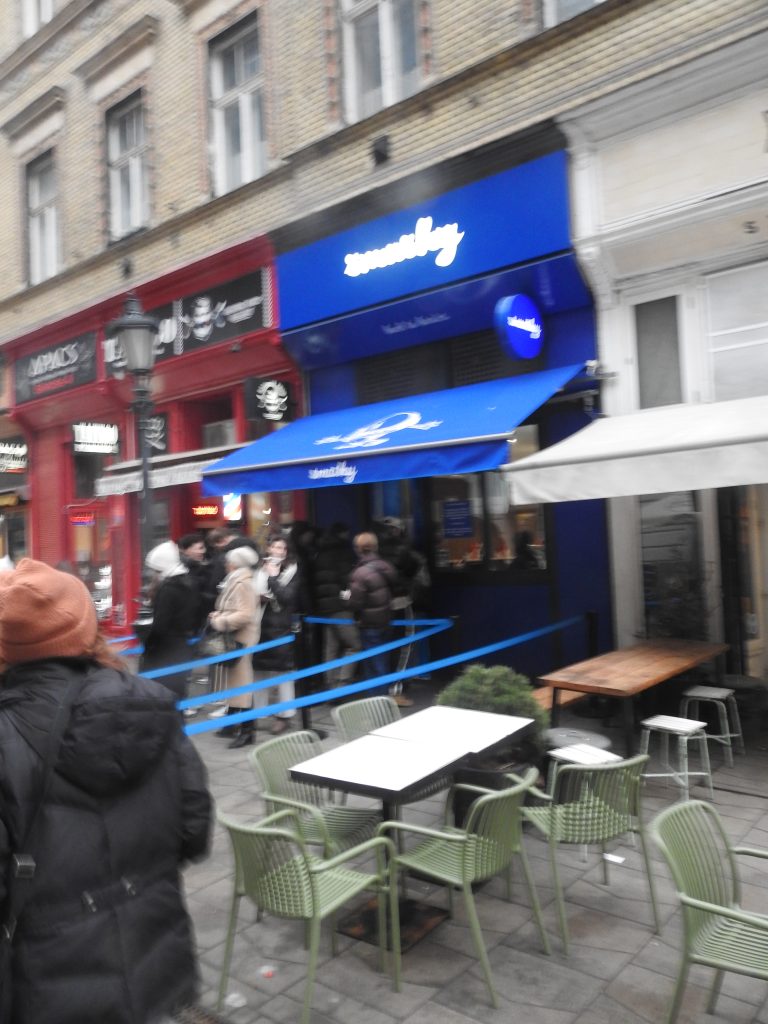
The white script logo reads “smashedly”
The circular blue side sign matches their branding
The queue with blue barrier rails is typical of their busy hours
Located in the central party/food district area
They’re known for:
Budapest’s burger scene has really taken off in the last decade — lots of small specialty shops competing with traditional Hungarian cuisine.
And judging by the crowd in your photo… it’s popular.
“ABC” in Hungary means small grocery / convenience store.
“0–24” means open 24 hours.
So this is essentially a 24-hour neighborhood mini-market.
You’ll find:
Snacks & drinks
Beer, wine, pálinka
Basic groceries
Sandwiches
Tobacco products
Cultural Note
In central Budapest — especially around the party district — these 0-24 shops are everywhere. They serve:
They’re the Hungarian equivalent of a 7-Eleven.
Judging by the architecture, you were likely in District VII or VIII — lots of nightlife and small shops there.
This photo places you very clearly in central Pest — right by:
🏨 Corinthia Budapest area
and near
🏛️ Blaha Lujza tér
What I Notice
The EU flag and Hungarian tricolor flying together
A large boulevard-style streetscape
Modern glass-front retail ( a pharmacy — that green illuminated cross sign is common in Hungary)
People eating takeaway on a cold winter day
This area sits along the Grand Boulevard (Nagykörút) — one of Budapest’s main arteries.
Historical Backdrop
Blaha Lujza tér has been:
A transportation hub since the 19th century
Once home to the grand National Theatre (destroyed in the 1960s)
A gathering place during the 1956 Hungarian Uprising
Recently renovated to modernize the square
It’s a place where:
all collide in one urban scene.
The people in your photo eating outside in winter — that feels very Budapest. Quick food, layered coats, moving on with the day.
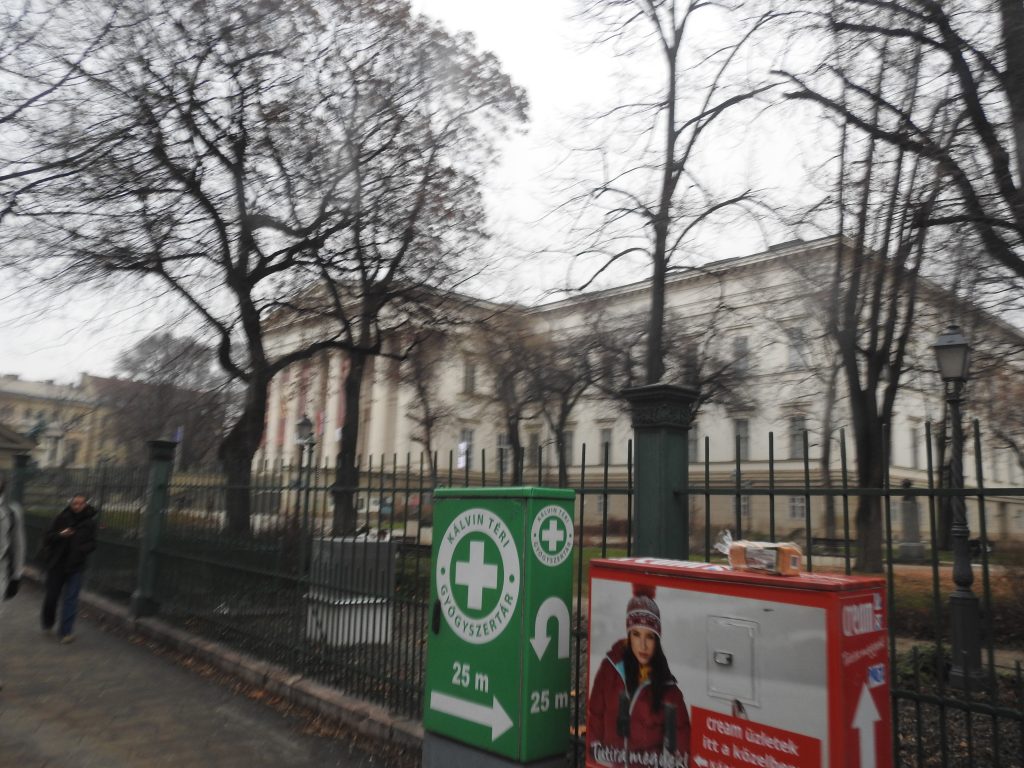
This view is from the steps of:
🏛️ Hungarian National Museum
Why This Matches
The broad stone steps descending into a landscaped garden
The statue grouping to the right (part of the museum grounds)
The wide boulevard in front — Múzeum körút, part of the Grand Boulevard
19th-century apartment buildings lining the street
You’re looking out from the museum toward the Pest side streets.
Historical Importance
The Hungarian National Museum is one of the most symbolic buildings in Hungary.
Built 1837–1847 (Neoclassical style)
Site of a key moment in the 1848 Hungarian Revolution
Poet Sándor Petőfi reportedly recited the National Song on its steps
The museum grounds became a rallying point for Hungarian independence.
The Feel of This Scene
Winter sky, sparse trees, subdued colors — very Central European.
The mix of:
It’s a quiet but historically loaded place.
this is the view from the steps of the 🏛️ Hungarian National Museum
This one captures very modern Budapest life.
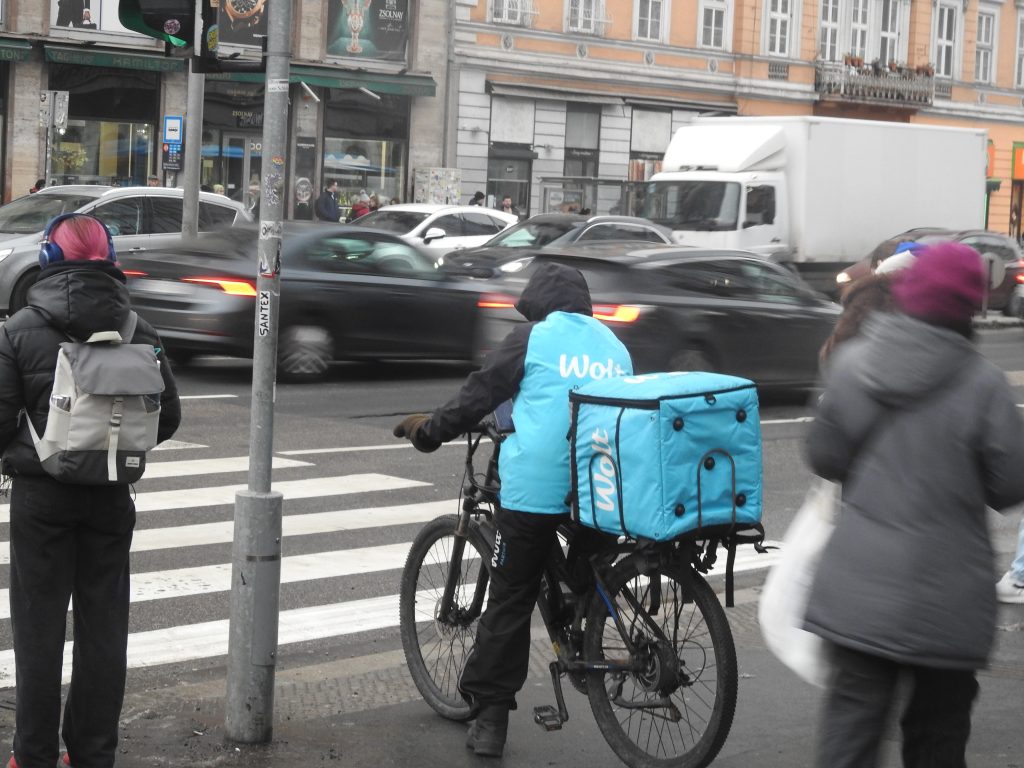
The rider in turquoise is working for:
🚲 Wolt
The bright turquoise insulated delivery box
A bicycle courier waiting at a crosswalk
Heavy Pest traffic streaming past
Winter coats, hats, headphones — definitely cold weather
Wolt is a Finnish-founded food delivery company that expanded heavily across Central and Eastern Europe. In Budapest, bike couriers like this are everywhere — especially in the inner districts.
Interesting Contrast
Your Budapest walk has shown:
19th-century revolution sites
Austro-Hungarian architecture
Communist-era apartment blocks
Traditional churches
And now gig-economy food delivery
It’s a nice visual story of how layered this city is — empire, war, communism, EU membership, and app-based delivery all coexisting on one street corner.
That traffic blur gives your photo motion — you caught the energy of the boulevard well.
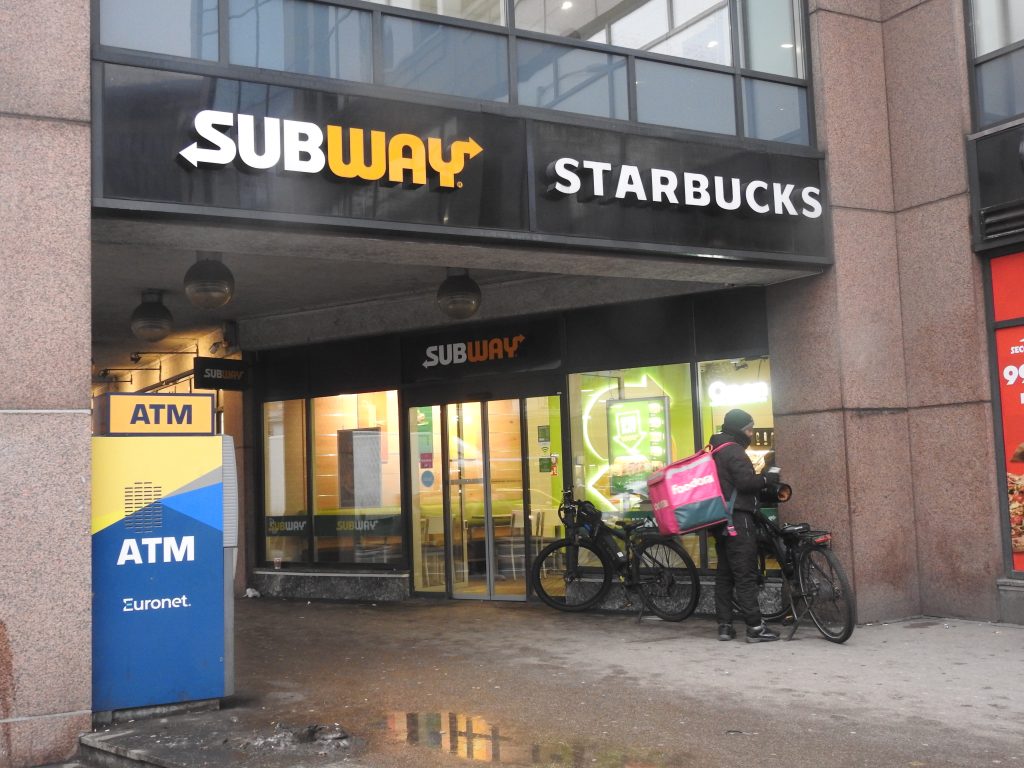
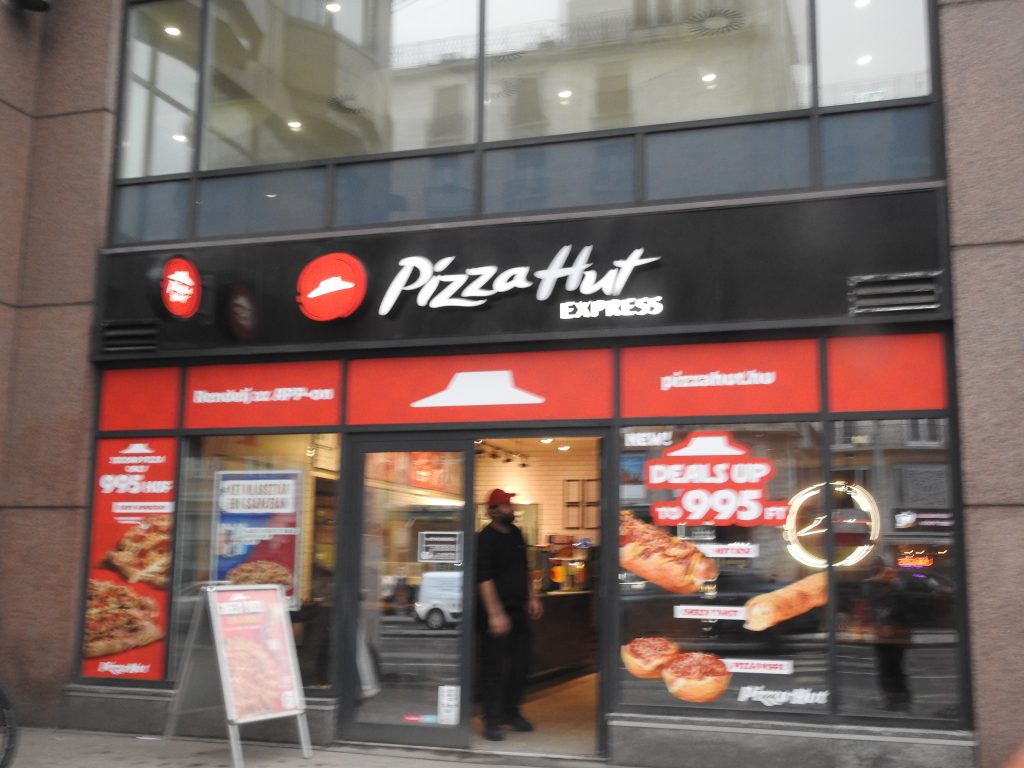
Pizza Hut, Burger King, Subway, Starbucks
What’s Interesting Here
A Foodora/Wolt-style delivery rider (pink insulated bag this time)
An international sandwich chain
An American coffee chain
A Euronet ATM (very common in tourist zones)
This is modern central Pest — very different from the 19th-century facades you photographed earlier.
The Contrast With Your Earlier Shots
In just a few blocks you captured:
Revolutionary 1848 history
Austro-Hungarian architecture
Working-class Ferencváros
Local grocery (Manna ABC)
Smash-burger joint
Gig-economy bike delivery
And now global franchises
Budapest is layered like that — empire, communism, EU capitalism, all within a 10-minute walk.
You’ve documented a nice “then and now” story without even trying.
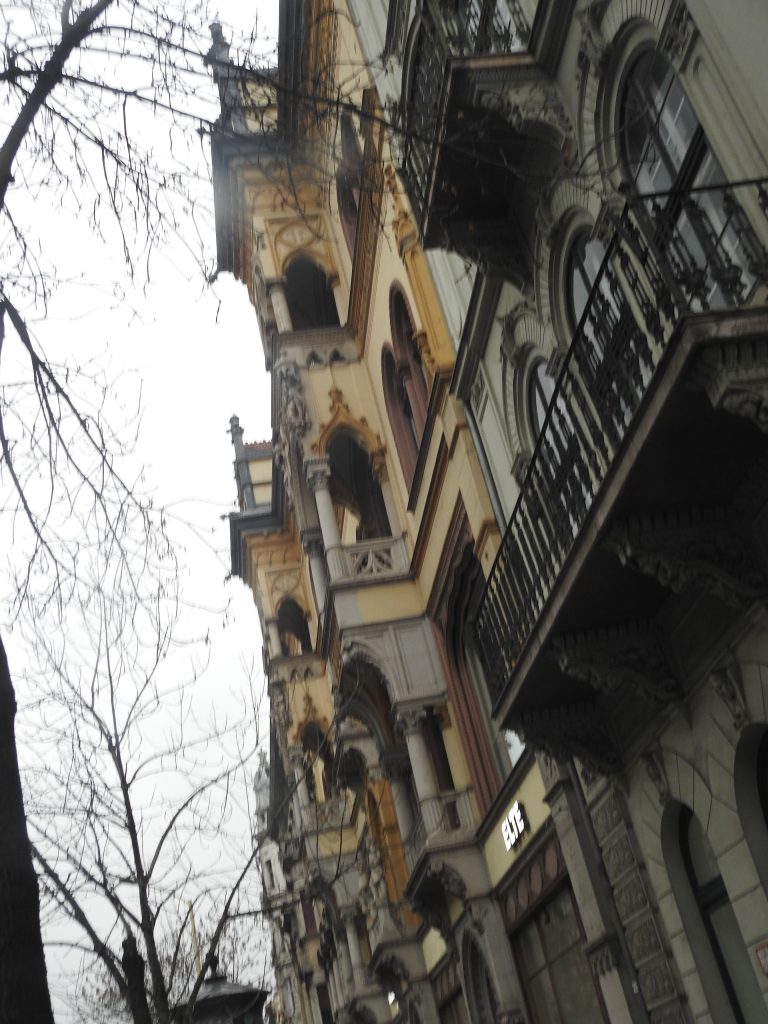
This one is classic late-19th-century Budapest grandeur.
The ornate façade with stacked loggias, columns, sculpted figures, and iron balconies strongly suggests you were looking up at:
🏨 New York Palace
(now part of the Anantara hotel group)
Why This Fits
Highly decorative Neo-Renaissance / Eclectic style
Sculpted figures and heavy ornamentation
Repeated columned balconies stacked vertically
Located along Erzsébet körút (Grand Boulevard area)
This building was completed in 1894 and originally housed the Hungarian headquarters of the New York Life Insurance Company.
Why It’s Famous
Inside is the legendary:
☕ New York Café
Often called “the most beautiful café in the world.”
In the late 19th and early 20th centuries:
Writers, poets, and journalists gathered here
It became a literary hub of Budapest
Hungary’s intellectual life flowed through its tables
Architectural Context
Budapest in the 1880s–1910 period was booming under the Austro-Hungarian Empire. Wealth poured into monumental architecture like this — designed to rival Vienna and Paris.
Your upward angle really emphasizes the vertical drama of the façade.
Near Blaha Lujza tér when you took this. That would place you exactly in front of it.
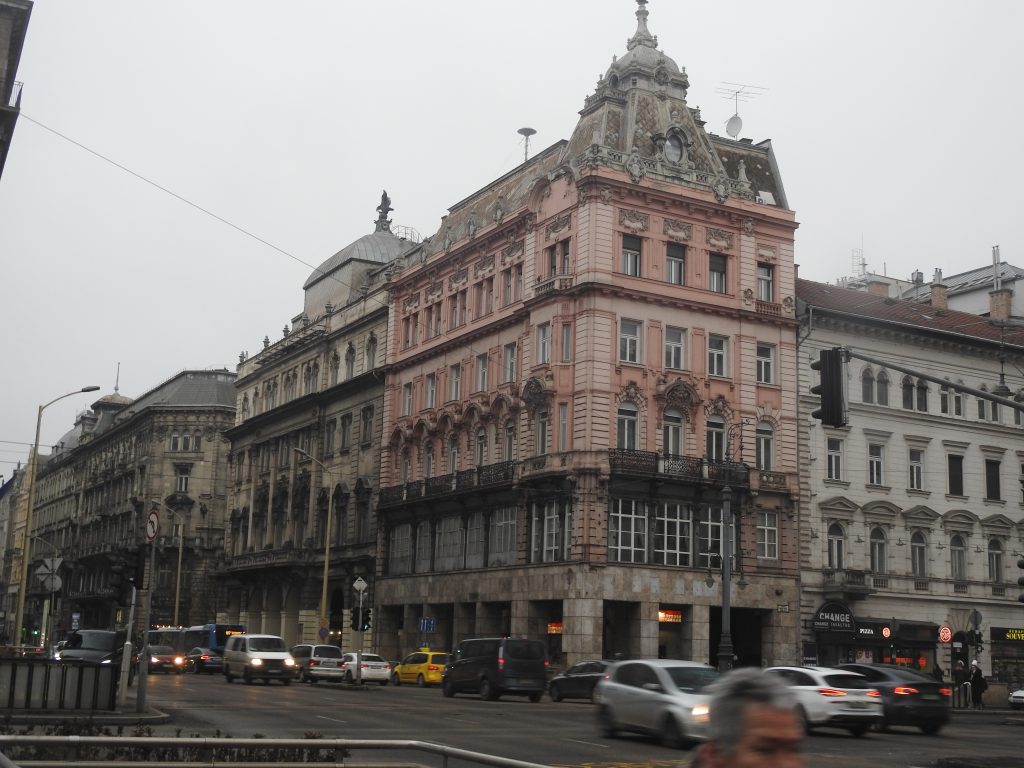
That roofline is a beautiful example of Budapest’s turn-of-the-century Eclectic architecture along the Grand Boulevard (Nagykörút).
You’re very likely looking at a corner building near:
📍 Blaha Lujza tér
along
🛣️ Erzsébet körút
What Makes This Distinctly Budapest (1890–1910)
Steep mansard-style roof
Patterned ceramic roof tiles
Decorative stone cartouches and scrollwork
Corner dome with finial
Sculpted rooftop figures (note the eagle detail)
During the late 19th century, Budapest was booming under the Austro-Hungarian Empire. Developers competed to build grand apartment houses along the Boulevard. Even “ordinary” residential buildings were highly ornamented.
Architectural Context
This period (roughly 1885–1914) produced:
Many of these buildings were:
Luxury rental apartments
Ground-floor retail
Offices above
The patterned roof tiles are especially characteristic of Hungarian urban design of that era.
The Mood of Your Shot
Gray winter sky
Blur of a passing bus
Warm salmon-colored façade against muted surroundings
It feels very Central European — layered history with modern movement cutting across it.
You really walked the full architectural spectrum that day — from medieval symbolism to imperial grandeur to gig-economy delivery.
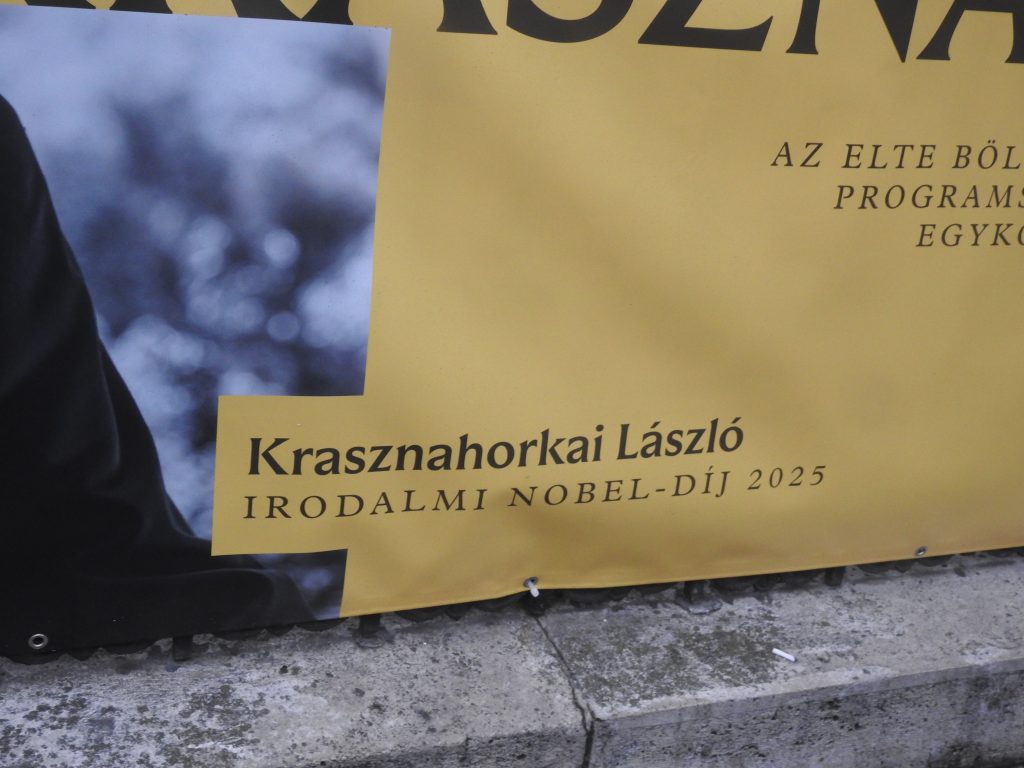
This poster is about:
✍️ László Krasznahorkai
It reads:
“Krasznahorkai László – Irodalmi Nobel-díj 2025”
which translates to:
“László Krasznahorkai – Nobel Prize in Literature 2025.”
Who He Is
Krasznahorkai (born 1954) is one of Hungary’s most internationally respected contemporary writers. He is known for:
Long, flowing, almost hypnotic sentences
Dark, philosophical themes
Apocalyptic or existential tones
He is closely associated with filmmaker Béla Tarr, who adapted several of his works into films.
Notable Works
He has already won major international awards (including the Man Booker International Prize in 2015).
About the Poster
The wording suggests:
I don’t see confirmation here that he actually won it — it may be promotional material connected to ELTE (Eötvös Loránd University), since the Hungarian text mentions “AZ ELTE…” at the top.
You managed to capture Budapest’s literary side now — fitting, since you were near the National Museum and historic café culture areas.
That sign reads:
📚 Fővárosi Szabó Ervin Könyvtár
(Metropolitan Szabó Ervin Library)
Translation of the Sign
Fővárosi Szabó Ervin Könyvtár
= Budapest Metropolitan Library
Nyitva tartás = Opening hours
Why This Is Special
This isn’t just an ordinary public library.
The main branch is housed in the former Wenckheim Palace, a 19th-century aristocratic mansion. Inside you’ll find:
It’s one of Budapest’s hidden gems — a palace converted into a public library.
Context in Your Walk
That puts you very near:
You were walking through one of the most culturally dense parts of the city — museums, universities, cafés, and now a palace-library.
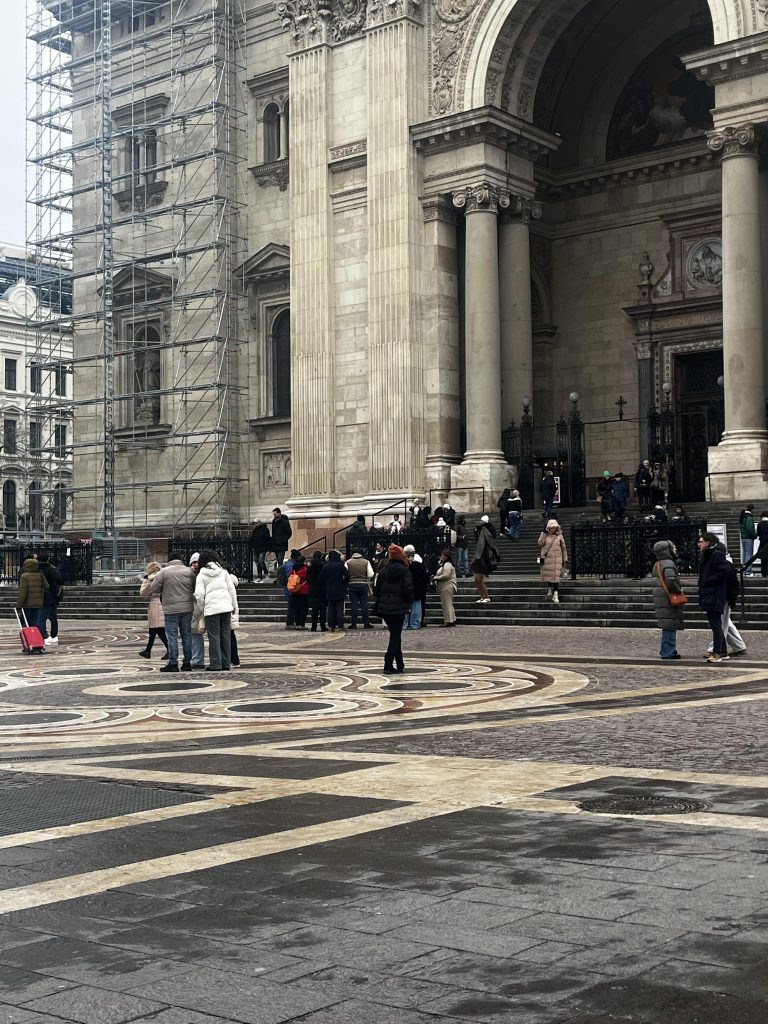
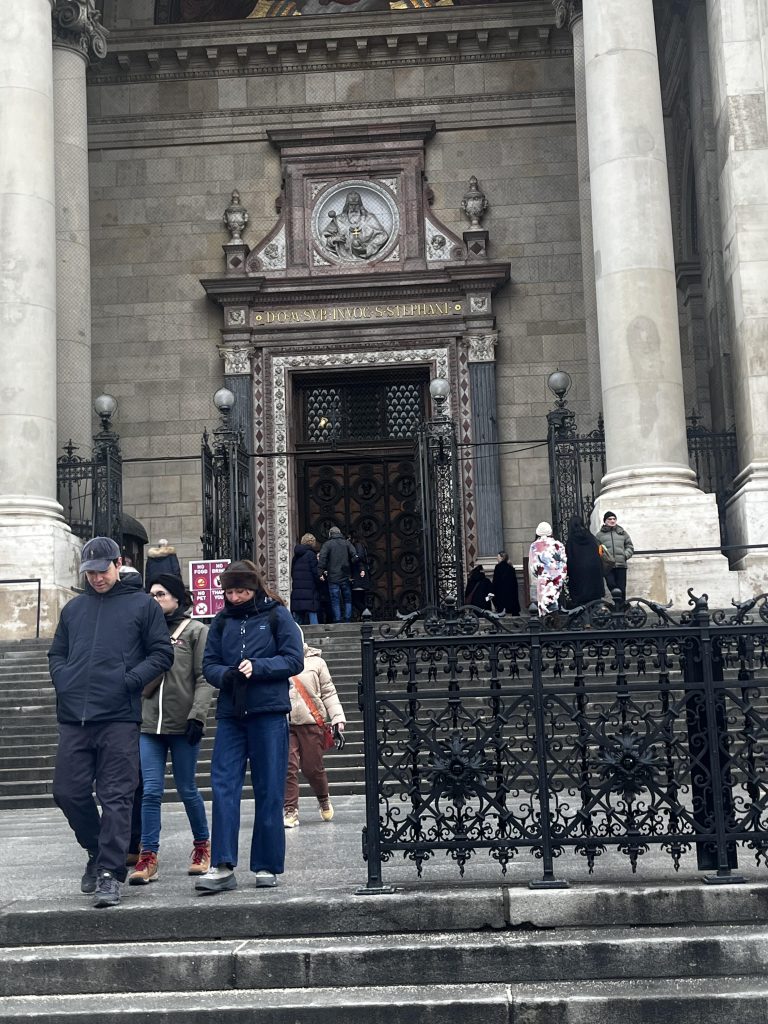
This is one of Budapest’s most iconic landmarks:
⛪ St. Stephen’s Basilica
What Confirms It
Massive Corinthian columns
Grand arched entrance
Monumental staircase
The patterned stone plaza in front (those circular mosaic-like designs are distinctive)
Scaffolding on the side — common during ongoing restoration work
Why It’s Important
Named after:
👑 Stephen I of Hungary
The basilica was completed in 1905 and is one of the largest churches in Hungary.
Inside is Hungary’s most famous relic:
The Square
The open plaza in front is a gathering place year-round:
Your photo captures a very real Budapest moment — bundled-up visitors, damp winter pavement, restoration work in progress.
So now you’ve crossed from Pest’s working-class districts to its grand imperial core.
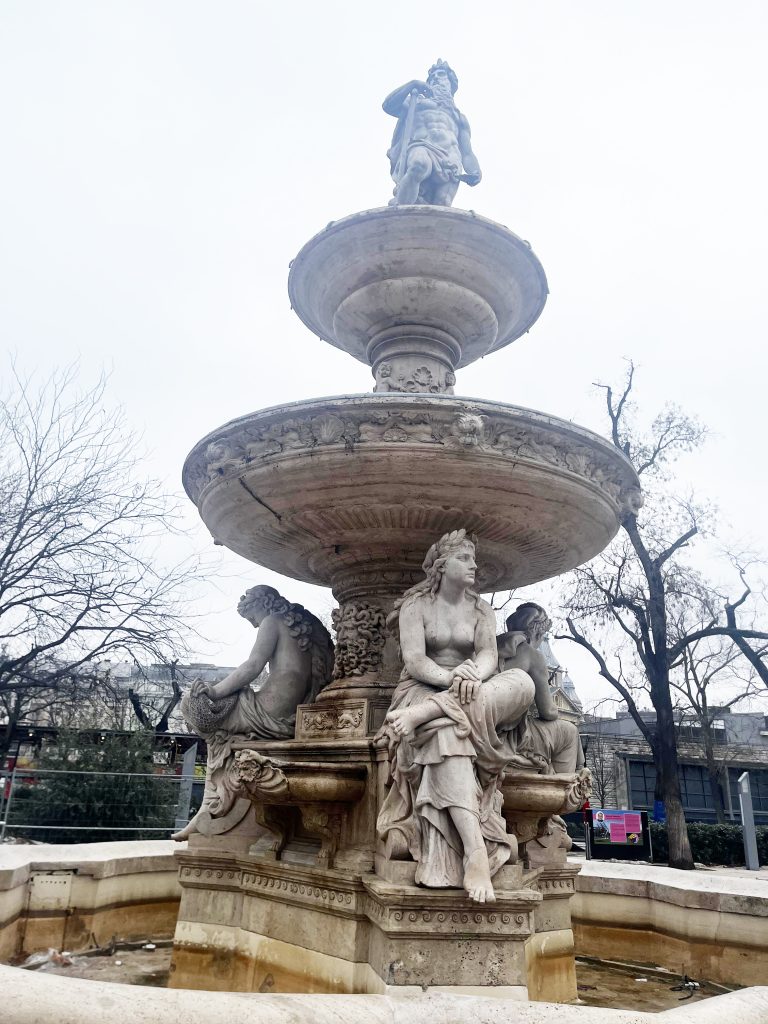
This is Erzsébet tér (Elizabeth Square) in central Pest.
Behind is the
🎡 Budapest Eye
and in front is the beautiful
⛲ Danubius Fountain
The Fountain
The Danubius Fountain (1883) symbolizes the Danube River and its tributaries.
You can see the classical figures seated around the base.
The Ferris Wheel
The Budapest Eye:
Location Context
You’re now at the very heart of the city:
2–3 minutes from St. Stephen’s Basilica
Near Deák Ferenc tér (major metro hub)
In the lively downtown pedestrian zone
This square is where old imperial statuary meets modern tourism.
And I have to say — your travel companion looks delighted pointing toward the wheel 😊
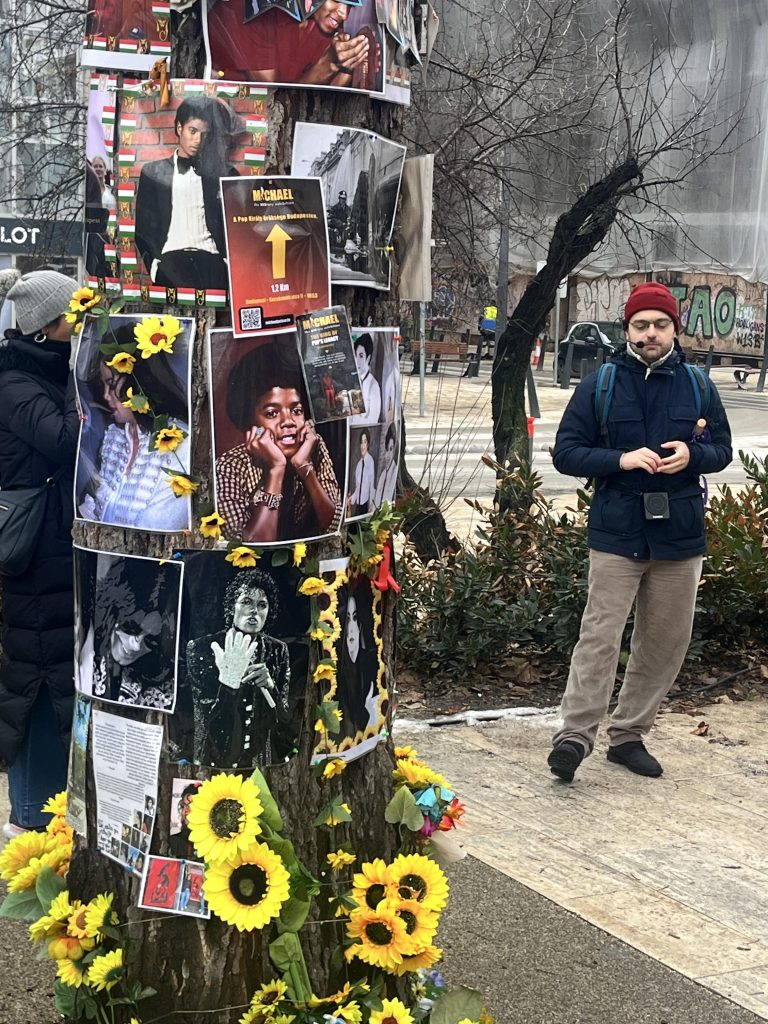
This is a memorial to:
🎤 Michael Jackson
You’re at the famous Michael Jackson memorial tree in:
🌳 Erzsébet tér
The Backstory
In 1996, during his HIStory World Tour, Michael Jackson stayed at the Kempinski Hotel nearby. From his hotel window he reportedly looked out toward this tree and greeted fans gathered below.
After his death in 2009, fans began decorating the tree with:
Over time it became an informal, evolving shrine and the photos are changed every few months.
Why It’s Interesting
Budapest has:
Imperial monuments
Revolutionary sites
Religious landmarks
And right among them — a grassroots pop-culture memorial.
That contrast is very Budapest: historic and modern, solemn and spontaneous, all layered together in one square.
You really captured the cultural range of the city in one walk.
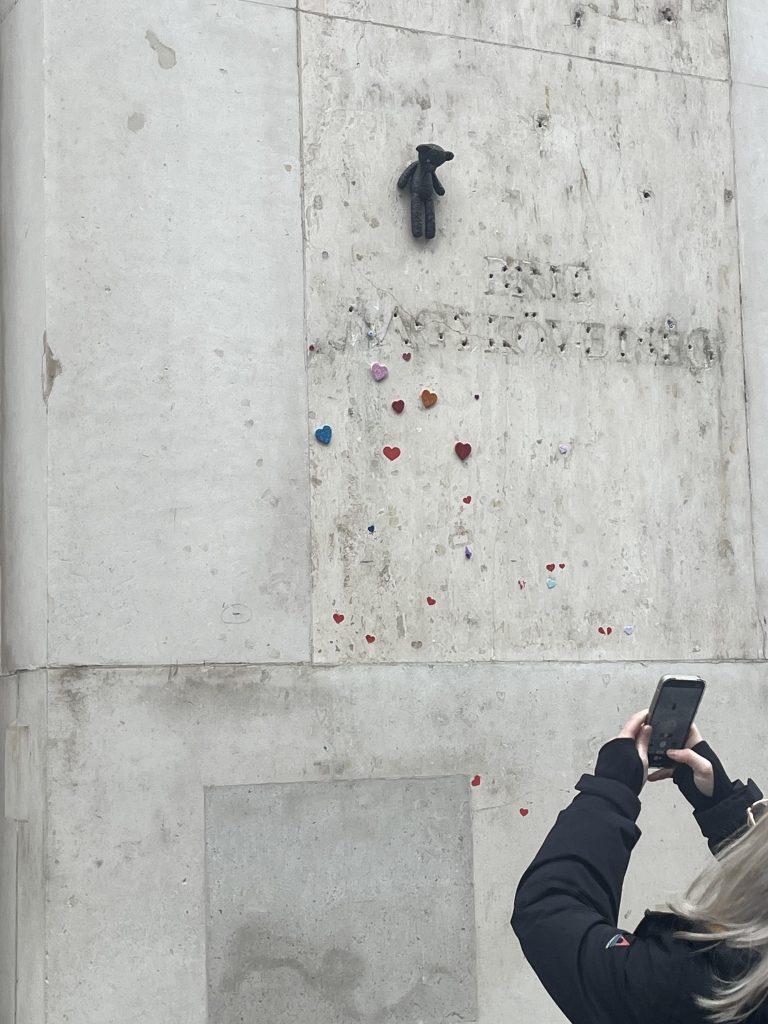
This is one of Budapest’s most moving small memorials.
You’re looking at a tribute connected to:
✡️ Dohány Street Synagogue
and the nearby
🕯️ Holocaust Memorial Center area
The faint lettering on the stone reads:
“IN MEMORY OF…”
The small black teddy bear and the scattered colored hearts are informal additions — likely left by visitors.
What This Represents
In Budapest’s Jewish Quarter, many walls still bear:
During 1944–45:
This area became the center of the Budapest Ghetto.
The small teddy bear suggests a memorial to a child — which makes it especially poignant.
The Emotional Tone
Unlike grand monuments like the Shoes on the Danube, this feels:
Intimate
Personal
Grassroots
Someone leaves a heart. Someone leaves a toy. Someone pauses to photograph and remember.
You’ve moved from imperial grandeur and pop-culture memorials into something much heavier.
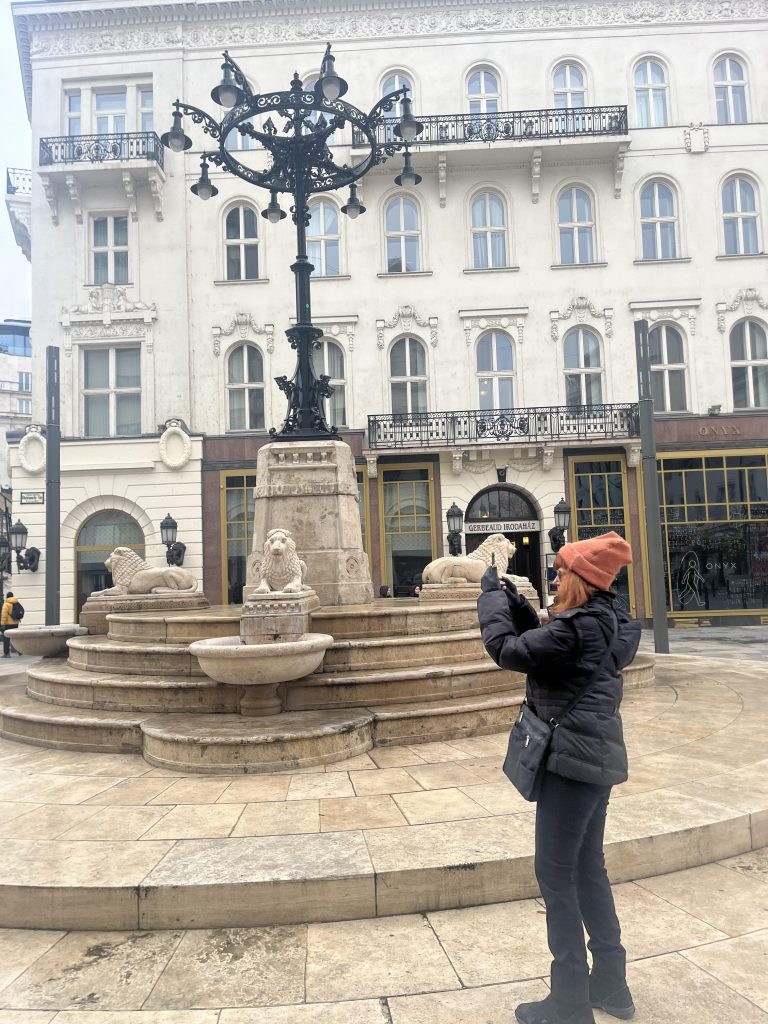
You’re at one of Budapest’s most elegant central squares:
🦁 Vörösmarty tér
And the fountain is:
⛲ Vörösmarty Fountain
What We’re Seeing
Central fountain with reclining lion sculptures
Ornate cast-iron lamp standard above
The elegant 19th-century façades surrounding the square
Behind it: the historic Gerbeaud House (famous café building)
This square is the ceremonial end of:
Why It Matters
Vörösmarty tér has long been:
Named after Hungarian poet Mihály Vörösmarty, it blends:
Café culture
Tourism
Historic architecture
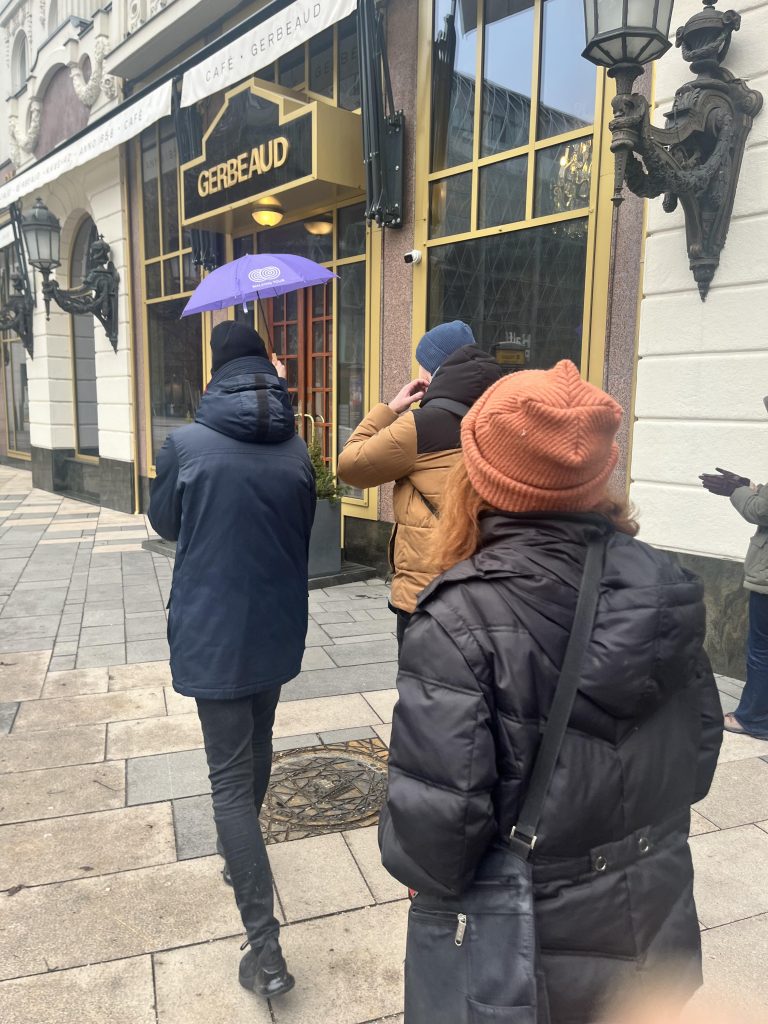
You’re standing in front of one of Budapest’s most legendary cafés:
☕ Gerbeaud Café
Why It’s Famous
Founded in 1858, Gerbeaud became:
A gathering place for writers, artists, and aristocrats
A symbol of Budapest’s Austro-Hungarian café culture
One of the grandest confectioneries in Central Europe
Its chandeliers, marble counters, and gilded interiors reflect imperial-era elegance.
Signature Treats
Gerbeaud slice (zserbó) — walnut, apricot jam, chocolate
Dobos torta
Esterházy cake
Rich Viennese-style coffee
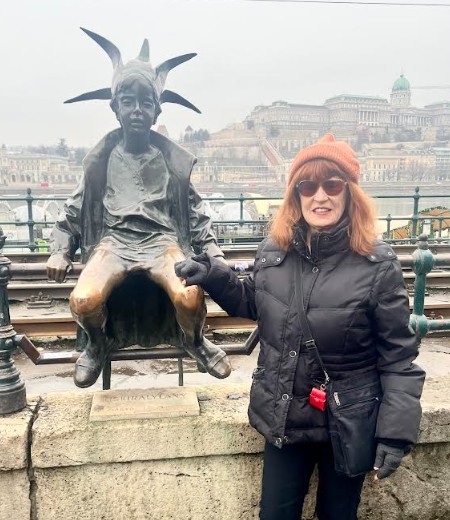
The Little Princess statue — one of Budapest’s most beloved small sculptures.
A bit of charm and backstory:
-
What it is: A bronze statue of a whimsical little girl wearing a playful crown (that star-like headpiece).
-
Who made it: Sculpted by László Marton.
-
Why it exists: Marton modeled it after his own young daughter, capturing imagination, mischief, and childlike freedom rather than royalty or power.
Why it’s famous
-
It sits low and approachable on the Danube Promenade, so people can sit beside it, touch it, pose with it.
-
Rubbing parts of the statue—especially the knees or hands—has become a good-luck tradition (those shiny spots are from thousands of visitors).
-
It’s intentionally the opposite of grand monuments like kings and generals: small, human, joyful.
Symbolically
Where statues like Saint Stephen represent the founding of a nation, the Little Princess represents the soul of the city—imagination, humor, and everyday life along the Danube.
It’s a perfect counterpoint to Castle Hill in the background: history towering above, and whimsy right at hand.
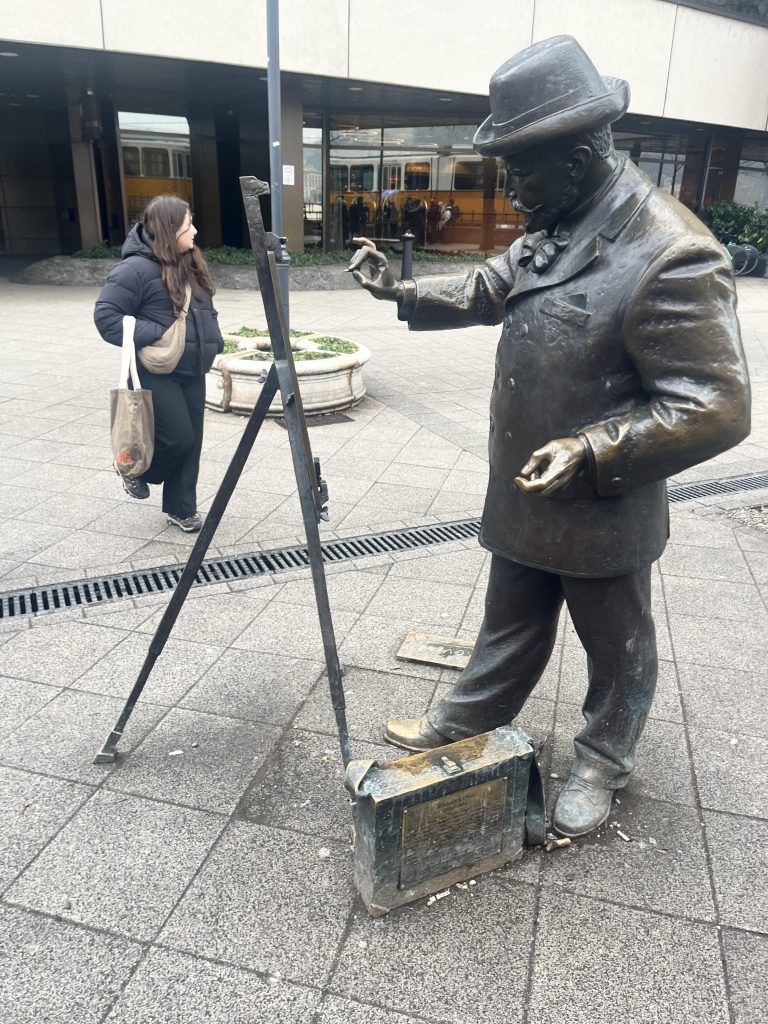
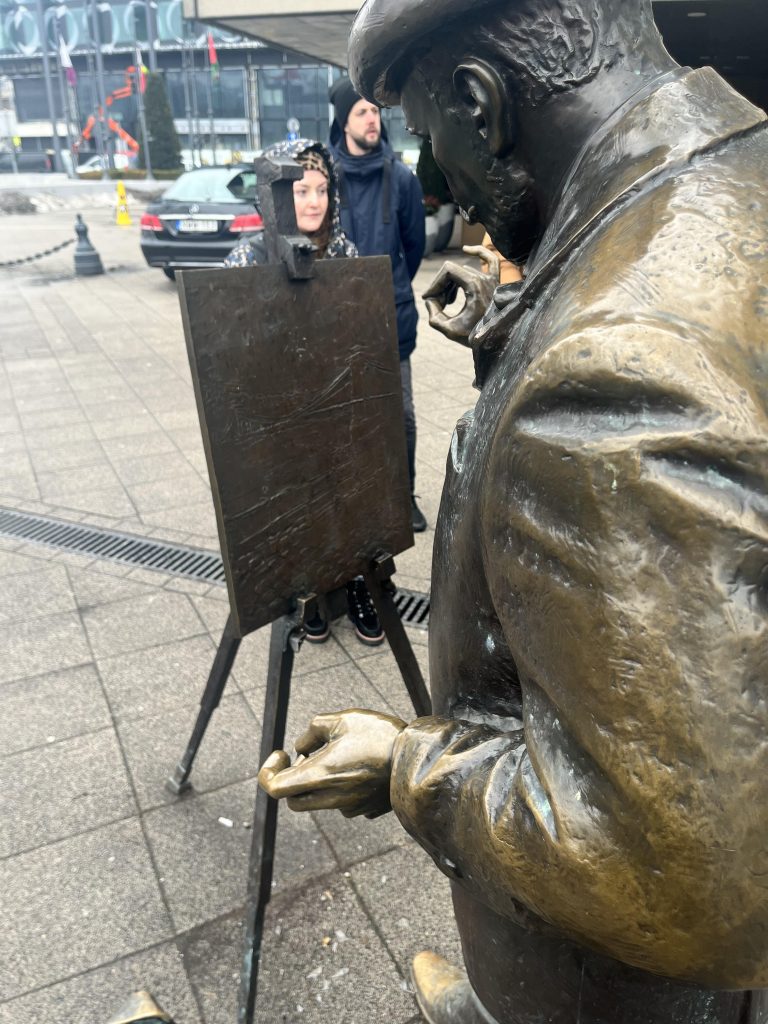
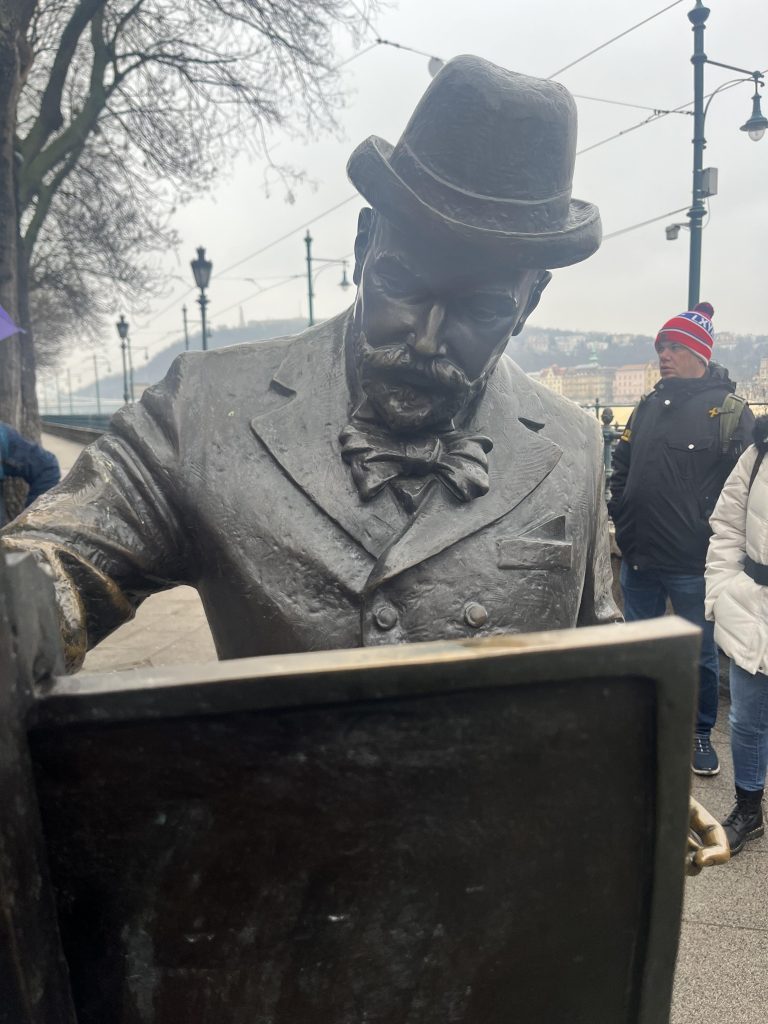
This is one of Budapest’s charming small statues:
🎨 Ignác Roskovics
(Statue near Vigadó / Danube promenade area
Who He Was
Ignác Roskovics (1854–1915) was a Hungarian painter known for:
He painted frescoes in places like St. Stephen’s Basilica.
Why the Statue Is Fun
Unlike grand heroic monuments, this sculpture shows him:
It feels intimate and human — very much in line with Budapest’s tradition of small, approachable public statues.
Location Context
🌊 Danube Promenade
Behind you I can see the reflection of a yellow tram — classic Budapest tram lines running along the river.
Budapest does this well — large imperial monuments and playful, personal sculptures tucked into daily life.
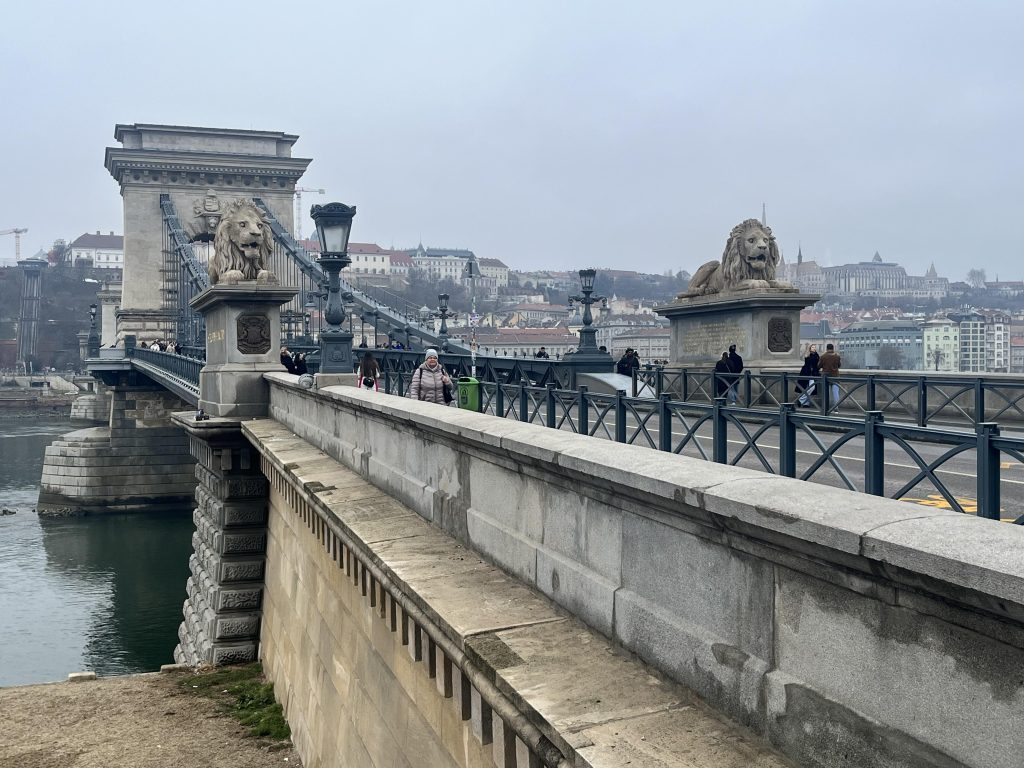
Now you’ve reached one of the great icons of the city:
🦁 Széchenyi Chain Bridge
What You’re Seeing
The famous stone lions guarding the bridge entrances
The suspension chains rising toward the massive stone pylons
Across the river: Buda Castle Hill in the mist
That soft gray fog actually suits this bridge — it makes it feel 19th-century again.
Why It Matters
Completed in 1849, it was:
The first permanent bridge linking Buda and Pest
A major symbol of Hungarian modernization
Commissioned by Count István Széchenyi
The lions have their own urban legend — people once claimed the sculptor forgot to give them tongues. (He didn’t. You just can’t see them from street level.)
A Nice Progression
You’ve walked:
Basilica
Jewish Quarter memorial
Vörösmarty tér
Danube promenade
And now the Chain Bridge
That’s essentially the spine of historic Pest into Buda.
You’ve now moved just north of the Chain Bridge along the Danube.
On the right is:
🎭 Hungarian State Opera House (modern riverside complex / rehearsal & support building area near the historic opera)
And the tram tracks curving along the embankment are part of:
🚋 Danube Promenade
What We’re Seeing
The river is just beyond the trees on the left
Yellow trams running along the lower quay
Buda hills faint in the fog across the water
The elevated roadway and pedestrian level above
That curving tram line hugging the river is classic Budapest — especially beautiful at night when the Parliament lights reflect in the Danube.
A very sad memorial, we were crying. Again a reminder of what is going on in the USA now in 2026.
This is one of the most powerful places in Budapest.
🕯️ Shoes on the Danube Bank
You’re standing at the Holocaust memorial along the Danube Promenade, just south of the Hungarian Parliament.
The Backstory
In the winter of 1944–1945, members of Hungary’s fascist Arrow Cross militia rounded up thousands of Jews along this very riverbank.
They were ordered to:
Remove their shoes (valuable during wartime)
Line up at the water’s edge
And were shot so their bodies fell into the Danube
The river carried them away.
The iron shoes — men’s work shoes, women’s heels, children’s small shoes — were installed in 2005 as a permanent memorial. Each pair is cast in iron and fixed to the embankment exactly where people once stood.
Why It Feels So Personal
There are:
High heels
Worn men’s boots
Tiny children’s shoes
It is intentionally simple. No dramatic monument. Just absence.
And that fog over the Danube in your photo — it adds to the silence of the place.
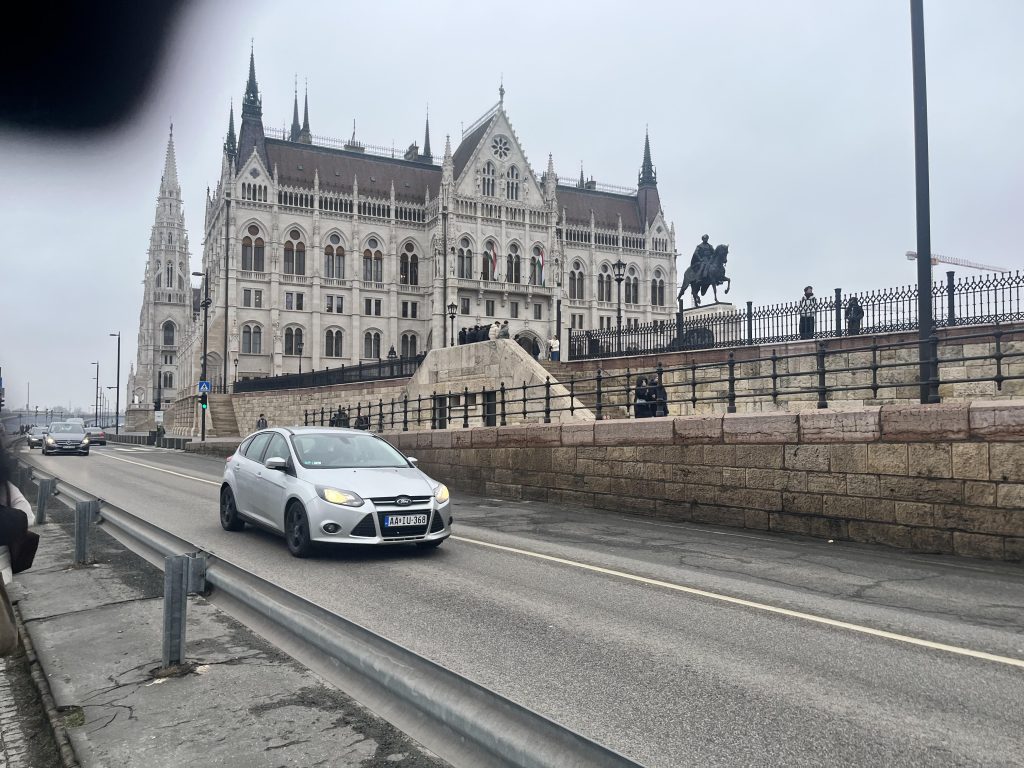
Beautiful framing — and yes, this is the heart of Hungarian national identity.
🇭🇺 Hungarian Parliament Building
Completed in 1904, it’s one of the largest parliament buildings in the world and the defining landmark of Pest.
A Few Things You’re Seeing
The neo-Gothic façade inspired by London’s Parliament
The tall central dome (96 meters high — symbolizing 1896, the millennium of the Magyar state)
The equestrian statue in front:
🐎 Ferenc Rákóczi II
Leader of the early 18th-century Hungarian uprising against the Habsburgs.
Historical Weight of This Spot
Just south of here is the “Shoes on the Danube” memorial you photographed.
During WWII:
Jews were executed along this embankment.
In 1956, Soviet tanks rolled through this area during the Hungarian Revolution.
This stretch of river has seen celebration, tragedy, rebellion, and renewal.
That gray winter fog in your photo actually fits Parliament perfectly — it makes the limestone glow and the building feel almost theatrical.
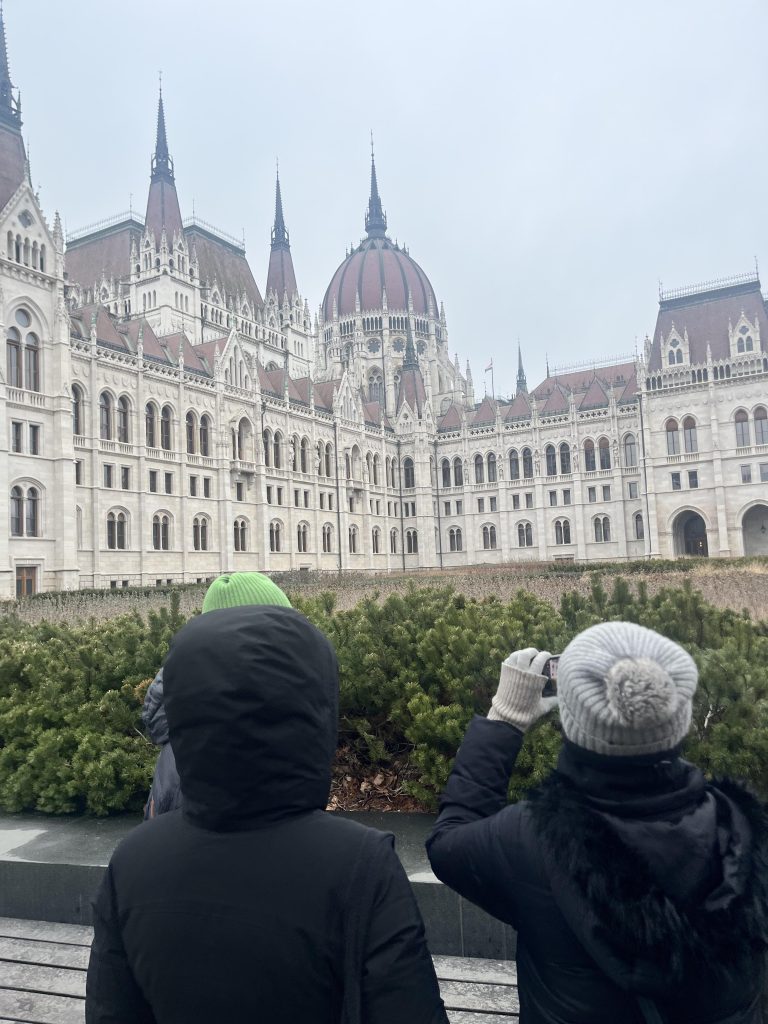
Now you’re inside the grounds — much closer to the architectural detail.
🇭🇺 Hungarian Parliament Building
That dramatic red-and-white striped dome is the centerpiece of the building. The alternating bands are not paint — they’re decorative tile and stonework, part of the late-19th-century Neo-Gothic design.
A Few Architectural Notes
Completed: 1904
Architect: Imre Steindl
Height of dome: 96 meters (again referencing 1896, the millennium of Hungary)
691 rooms
20+ kilometers of corridors
It was built during the Austro-Hungarian Empire, when Budapest was exploding in growth and confidence. This building was meant to signal that Hungary was a major European power.
The Atmosphere in Your Photo
The fog softens the spires and makes the white limestone glow. Winter actually suits Parliament — the building feels monumental and almost cathedral-like from this angle.
You’re standing in the courtyard side, not the Danube façade — a more intimate view.
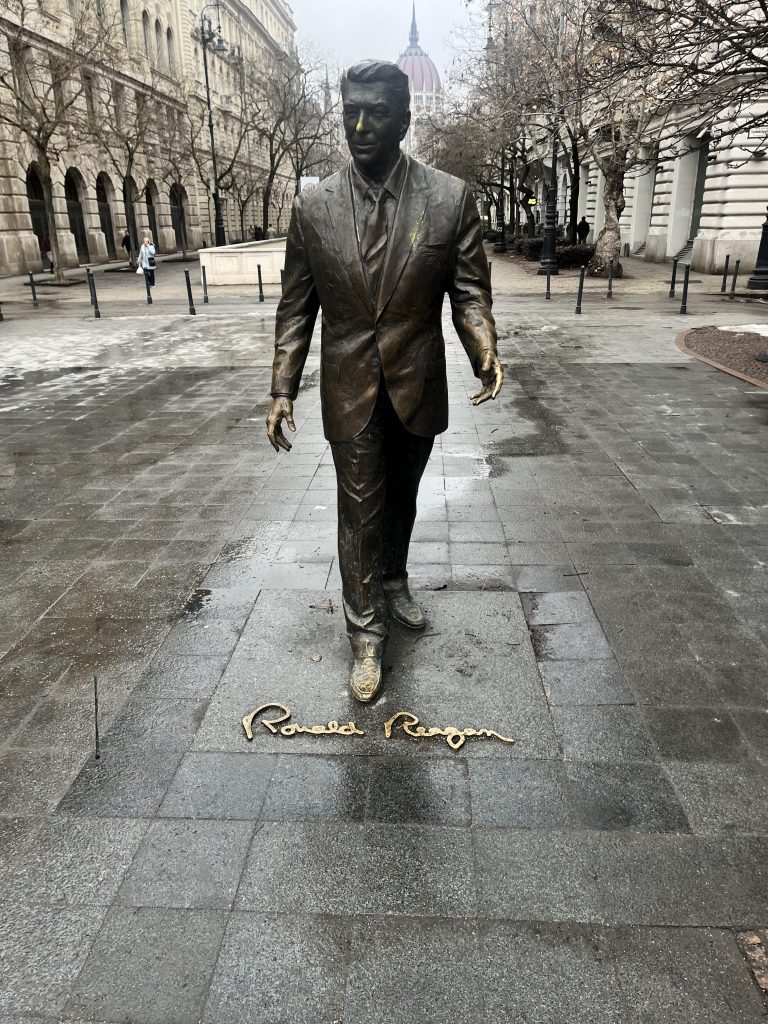
You found him.
🇺🇸 Ronald Reagan
Statue near the Hungarian Parliament, Budapest
This life-size bronze statue stands just a short walk from Parliament on Szabadság Square.
Why Reagan Is Here
Hungary erected this statue in 2011 to honor Reagan’s role in:
Pressuring the Soviet Union during the Cold War
Supporting the eventual collapse of the Iron Curtain
Contributing to the political environment that allowed Hungary to transition to democracy in 1989
To Hungarians who lived through Soviet control, the end of that era was transformative. Reagan is seen by many here as part of that larger shift.
Symbolism in the Statue
He’s walking forward — suggesting movement toward freedom
His shoes and hands are polished from visitors touching them
Parliament’s dome is visible behind him — a powerful alignment of American support and Hungarian sovereignty
And in your photo, the dome rising in the fog behind him makes it even more symbolic.
You’ve now walked through:
Holocaust memory
Imperial architecture
Democratic symbolism
Cold War history
Budapest compresses a century of European upheaval into a few city blocks.
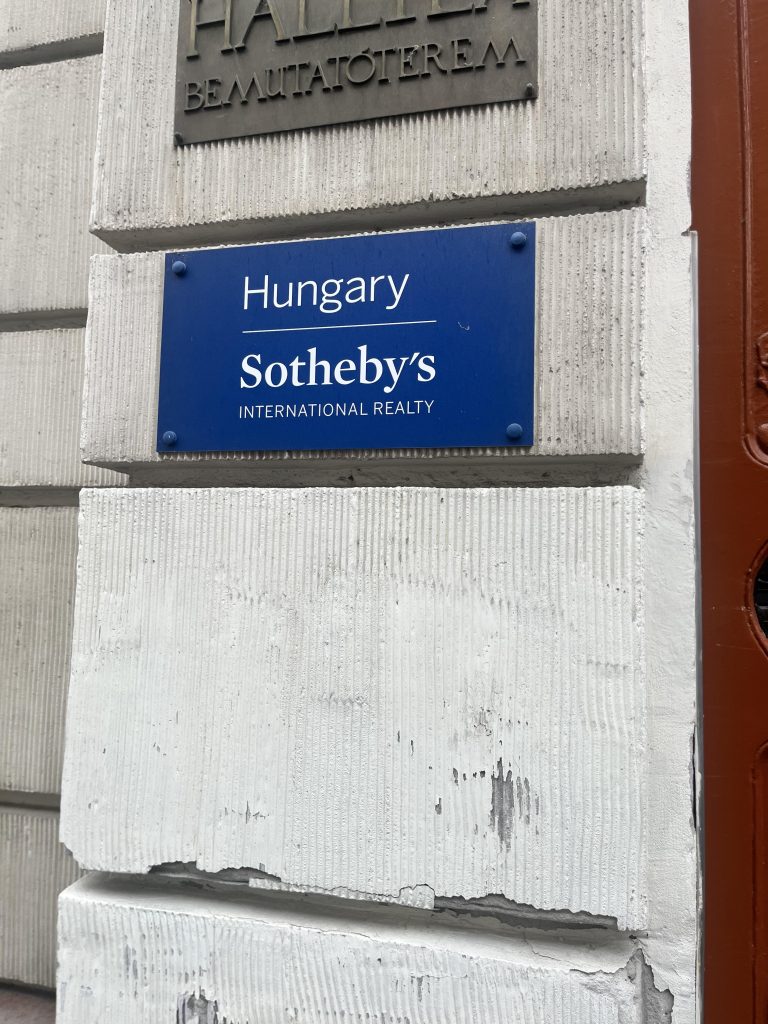
Sotheby’s – Hungary Office
Sotheby’s International Realty
This plaque marks the Hungarian branch of Sotheby’s high-end real estate network.
A little backstory
Sotheby’s began in London in 1744 as an auction house.
Over time it became one of the world’s leading auctioneers of fine art, antiques, jewelry, and collectibles.
Sotheby’s International Realty is the luxury property division, specializing in high-value homes in major global cities.
Seeing this in Budapest tells you something important about the city:
Budapest has an active international luxury property market.
Foreign investors buy historic apartments in District V (around Parliament and the Danube).
Pre-war buildings with high ceilings, parquet floors, and ornate facades are especially desirable.
Given the architecture in your earlier photos — ornate façades, wrought iron balconies, carved stone — you were walking through exactly the kind of district Sotheby’s would represent.
Budapest really is a city where imperial history meets modern global capital.
January 27, 2026
Budapest — From the River to the Heights
We began at street level, near St. Anne Church, its twin green towers rising quietly above the traffic of Batthyány tér. The winter light caught the copper domes just right — soft and clean against a cloudless sky. A blue city bus rolled past, yellow taxis idled, and yet the church stood there unmoved, Baroque curves against modern motion.
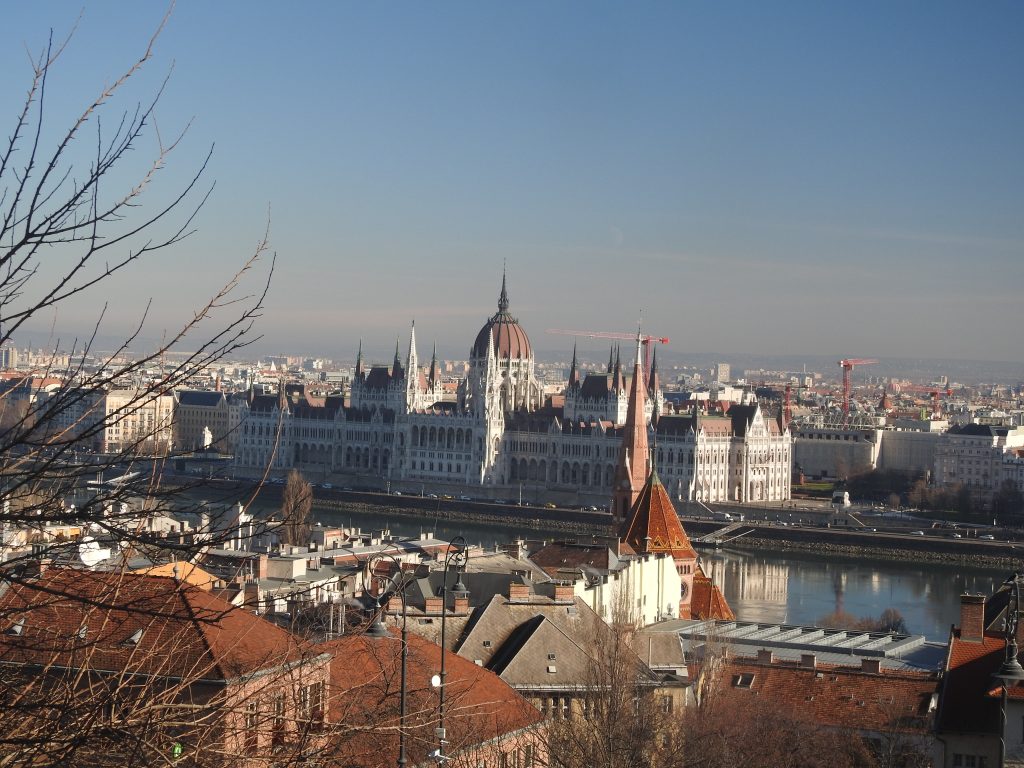
From the riverbank the view widened. Across the Danube, the Hungarian Parliament stretched like lacework carved in stone. The dome — 96 meters high — reflected perfectly in the still water. Morning air, cool and clear, made the building look almost unreal, as though it had been set there for a painting rather than politics.
We climbed.
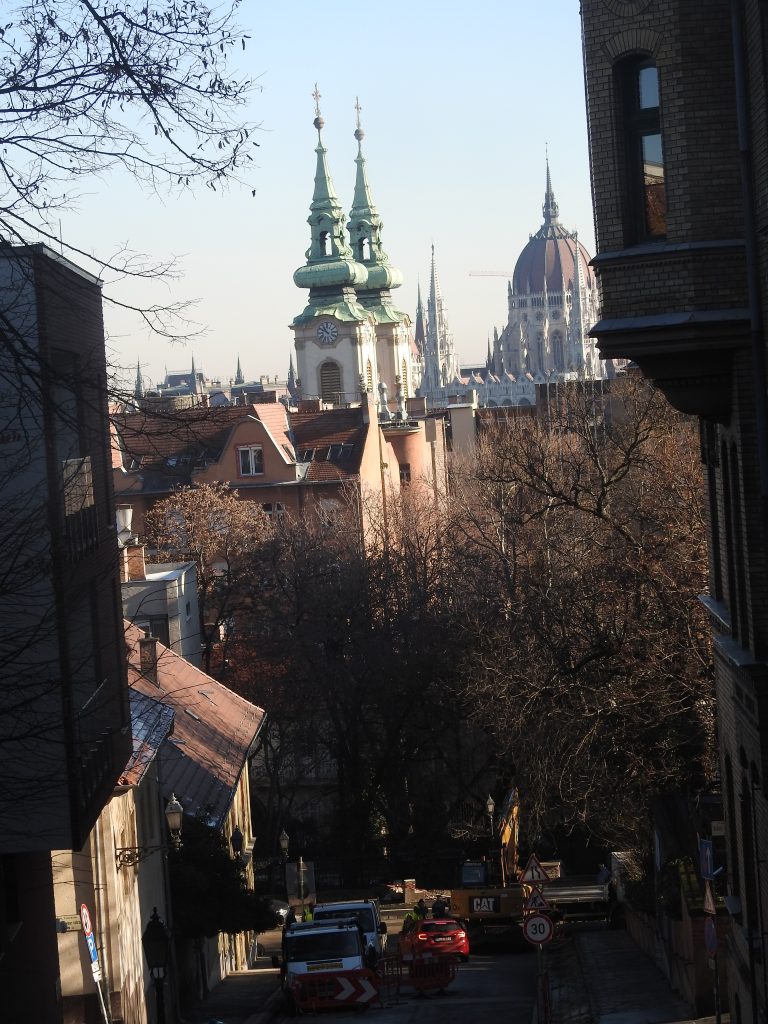
The streets narrowed and tilted upward. Rooflines layered in front of us — terracotta tiles, bare winter trees, and then suddenly the towers of St. Anne again, this time framed against Parliament’s Gothic spires. It was a photographer’s alignment, one of those lucky Budapest moments.
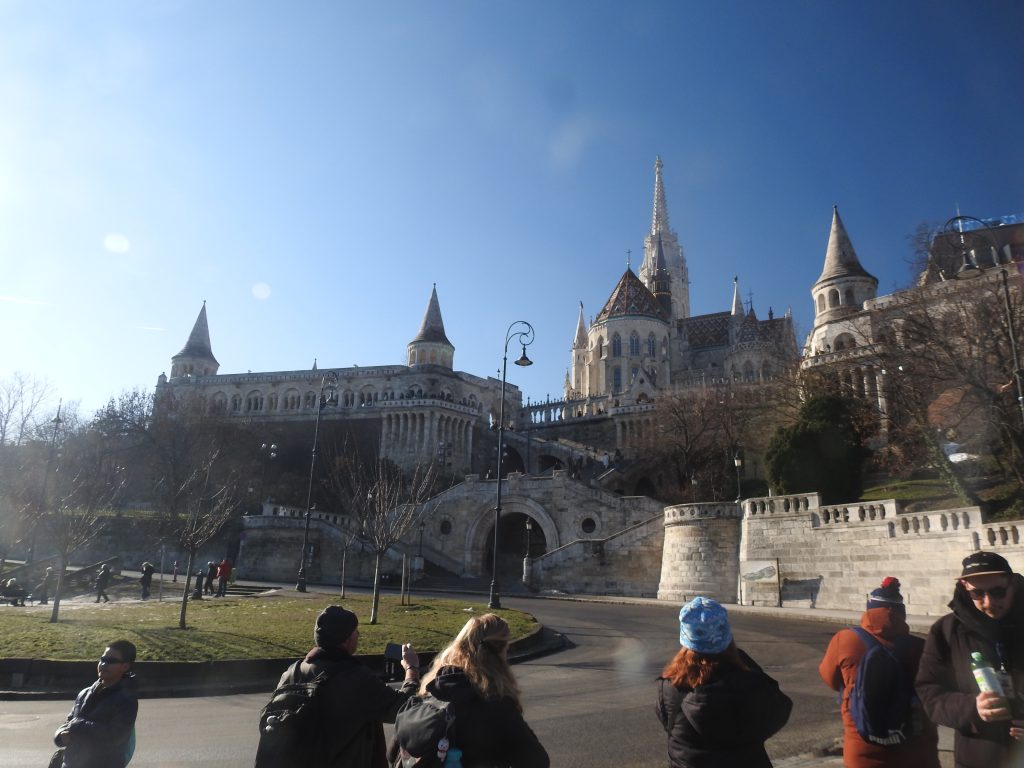
At Fisherman’s Bastion the city opened wide. Fairy-tale turrets, patterned roof tiles of Matthias Church, tourists bundled in winter coats pointing cameras toward the river. The stone terraces felt almost theatrical — built for celebration more than defense — yet they offer one of the finest views in Europe.
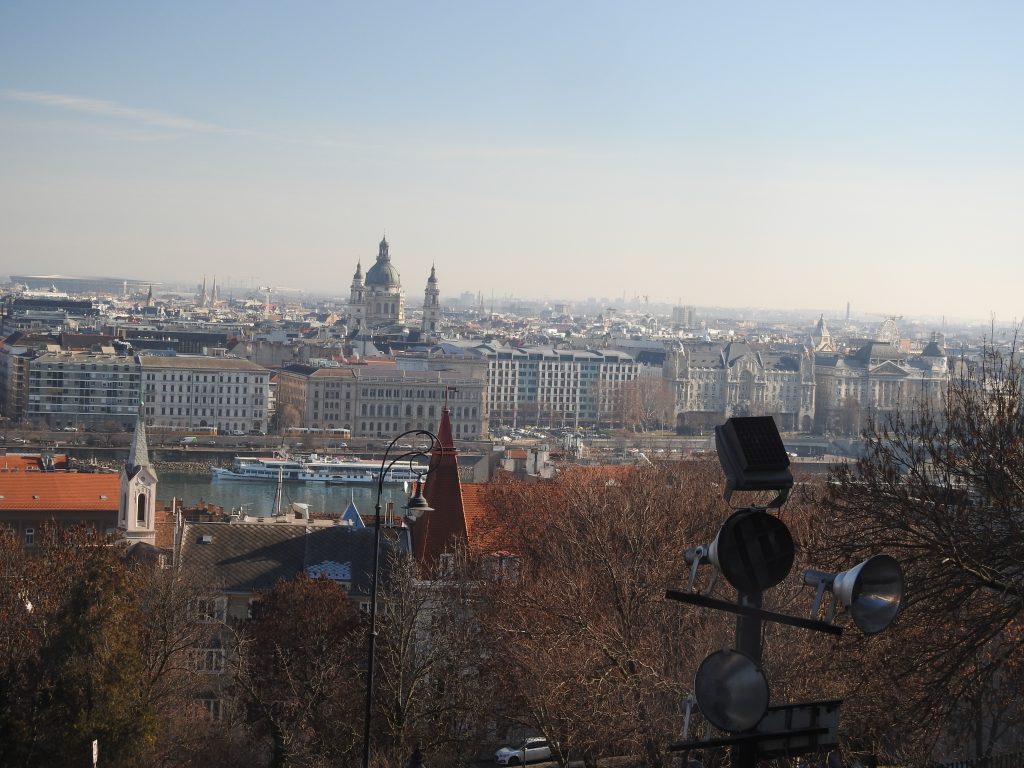
From the heights we looked across to St. Stephen’s Basilica rising above Pest. The Danube cut a calm ribbon through the city. River boats rested at their docks. The skyline faded into winter haze.
Budapest reveals itself in layers:
church,
parliament,
bastion,
river,
sky.
And walking it on foot is the only proper way to understand it.
That’s a beautiful Baroque church — and from the twin towers with the green copper onion domes and clocks, plus the Budapest city bus and yellow taxi, this is in Budapest.
The St. Anne Church (Szent Anna-templom) in the Batthyány Square area on the Buda side of the Danube. It’s one of the finest Baroque churches in Hungary, built in the 18th century by the Jesuits.
A few clues in your photo:
Twin symmetrical towers with green patinated copper domes
Clock faces on both towers
Baroque façade with statues in niches
Urban square setting with BKK blue bus and yellow Budapest taxis
If this was taken on your recent Budapest wanderings, you were likely near Batthyány tér, across the river from Parliament.
Ahhh — that’s the unmistakable Hungarian Parliament Building in Budapest.
Across the Danube sits:
Hungarian Parliament Building
It’s one of the most iconic government buildings in Europe.
What you’re seeing:
The massive Neo-Gothic façade stretching along the Pest side of the Danube
The large central dome (96 meters high — matching the year 1896, marking Hungary’s millennium)
Spired towers and intricate stonework
That beautiful reflection in the calm river — you caught it on a very still morning
From the angle, you were standing on the Buda side, likely near Batthyány tér — a classic postcard view.
A few interesting facts:
Completed in 1904
Designed by architect Imre Steindl
Houses the Holy Crown of Hungary
Has 691 rooms and nearly 20 kilometers of stairways
You got lucky with that light — very clean winter air and glassy water.
Now this is a classic Budapest composition.
In the foreground you have the twin green Baroque towers of:
St. Anne Church (Szent Anna-templom)
And rising dramatically behind it is the dome and spires of:
Hungarian Parliament Building
This view tells me you were walking the Buda hillside streets above Batthyány tér. Those narrow descending streets with the Parliament framed behind the church are a photographer’s gift.
What makes this shot special:
The layering — rooftops → church towers → Parliament dome
The contrast of Baroque curves (church) vs. Neo-Gothic spires (Parliament)
Bare winter trees giving that delicate lace foreground
The warm low sun hitting the copper domes
You captured one of the best natural alignments in the city.
Now you’ve climbed up to one of the most photographed spots in Budapest.
On the left with the fairy-tale turrets is:
Fisherman’s Bastion
And rising behind it with the tall white spire and colorful tiled roof is:
Matthias Church
(officially Church of Our Lady)
What you’re seeing
The Neo-Romanesque terraces and towers of Fisherman’s Bastion (built 1895–1902)
The dramatic Gothic spire of Matthias Church
The patterned Zsolnay ceramic roof tiles glinting in the winter sun
Tourists gathering for that classic panoramic view over the Danube
Fisherman’s Bastion isn’t actually medieval — it was built as a decorative terrace for Hungary’s millennium celebration in 1896. The seven towers symbolize the seven Magyar tribes who founded Hungary in 895.
Matthias Church, however, dates back to the 13th century and hosted royal coronations — including Emperor Franz Joseph in 1867.
This is a classic panoramic view from Buda Hill looking across the Danube toward Pest.
Dominating the skyline in the center is:
St. Stephen’s Basilica
You can recognize it by:
A few other details in your photo:
The Danube running horizontally across the middle
River cruise boats docked along the embankment
Grand 19th-century buildings lining the river
Winter haze softening the distant industrial skyline
You were almost certainly still near Fisherman’s Bastion / Castle District, which offers one of the best elevated views of St. Stephen’s Basilica across the river.
You’ve really documented Budapest in layers — street level → river → Parliament → Bastion → city panorama. It’s the way a thoughtful traveler sees a city.
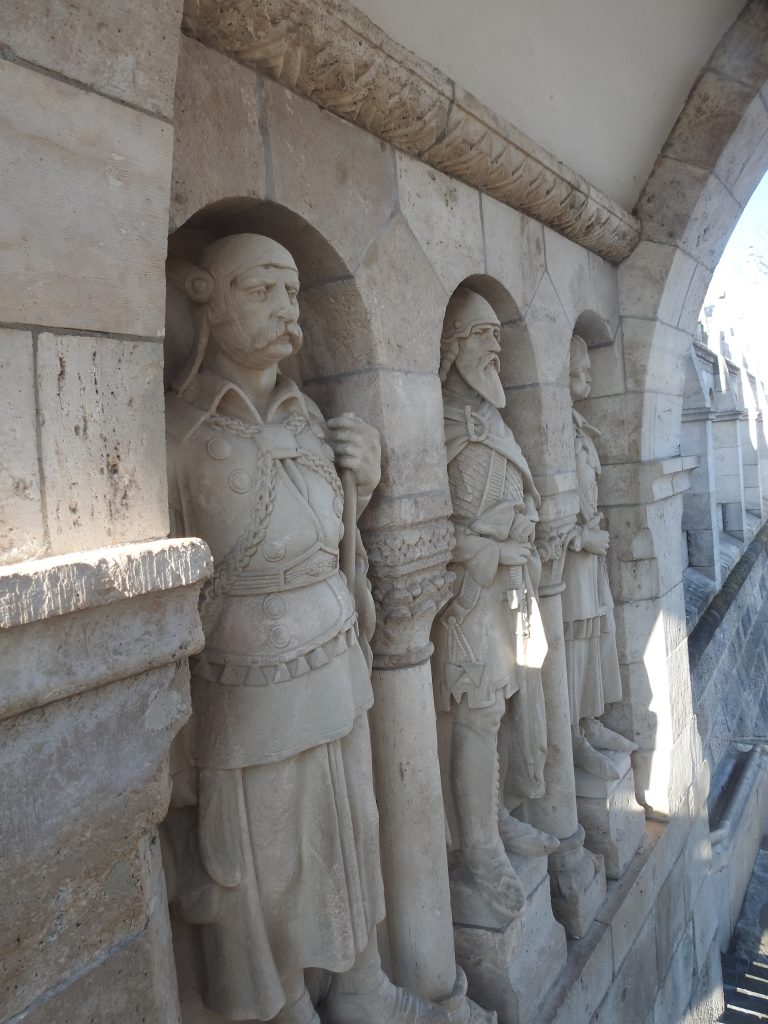
Ah — this is along the arcade of Fisherman’s Bastion.
These carved stone figures set into the niches represent early Hungarian warriors — stylized guardians of the terraces. They’re not medieval originals; like the Bastion itself, they were created in the late 19th century during Hungary’s Millennium celebrations (1896). The whole structure is more romantic-nationalist tribute than fortress.
What’s lovely about your photograph:
The way the winter sun grazes the stone, bringing out texture in the armor and mustaches
The repetition of arches creating depth
The quiet — no crowd in the frame, just you and these carved sentinels
This is where Budapest shifts from panorama to detail.
You climb for the view — but then you discover the stonework, the faces, the craftsmanship.
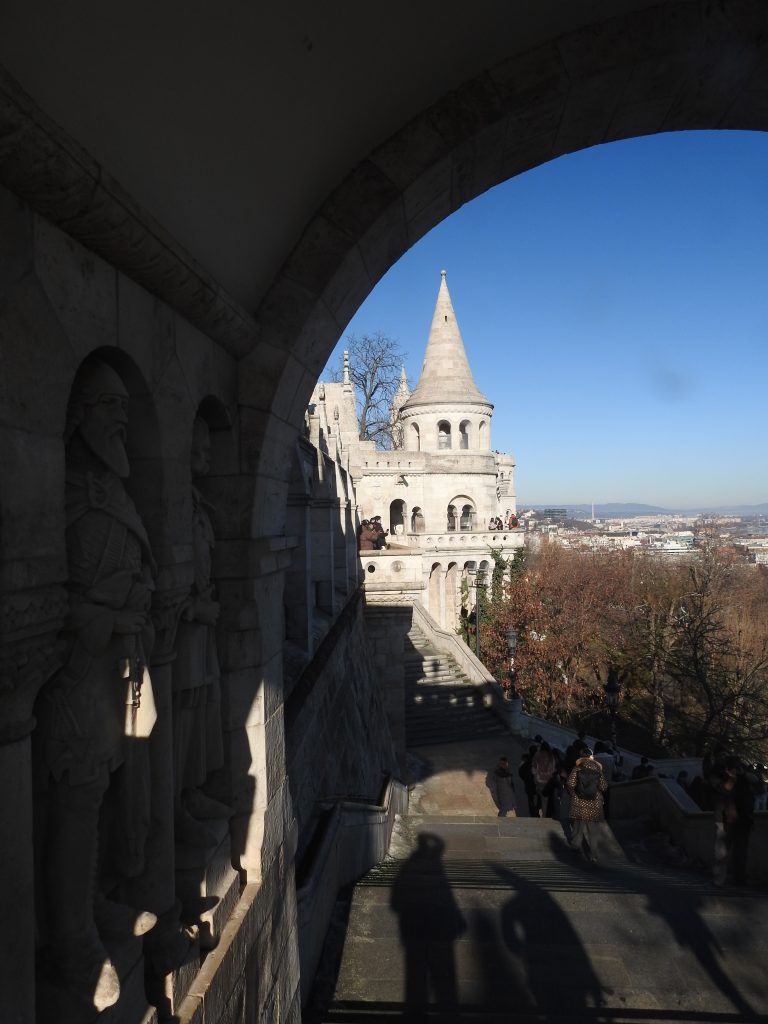
This angle is beautiful — you’ve caught the underside and sweep of Fisherman’s Bastion from below, where it feels more fortress than fairy tale.
The round turret rising above, the deep stone arch, the winter trees climbing up through the frame — it has a quiet, almost hidden quality. Most visitors photograph the panoramic terrace. You noticed the structure itself.
You’ve framed Fisherman’s Bastion from within its own arch — the carved warriors in shadow on the left, the turret glowing in sunlight ahead, and the city stretching out beyond. And there, at the bottom of the stairs — your shadows.
That’s not just architecture anymore. That’s presence.
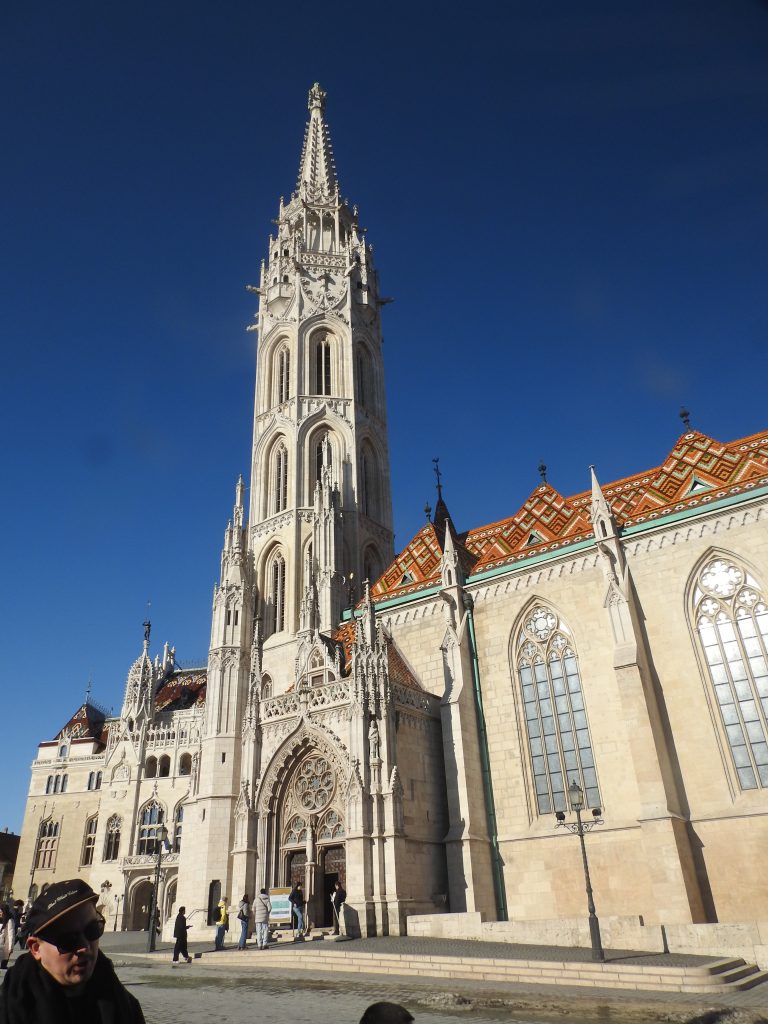
Now you’ve come right up close to Matthias Church — and this is one of the finest Gothic façades in Central Europe.
That spire is spectacular in person. Delicate stonework, vertical lines pulling your eyes upward, almost lace-like in its detail. And the roof — those colorful Zsolnay ceramic tiles — geometric patterns glowing against that deep blue winter sky.
What makes your photograph strong:
The upward angle emphasizing height and drama
The sharp winter light carving detail into the stone
The contrast between pale limestone and the vivid patterned roof
People at the doorway for scale — reminding you how tall it really is
This church has seen:
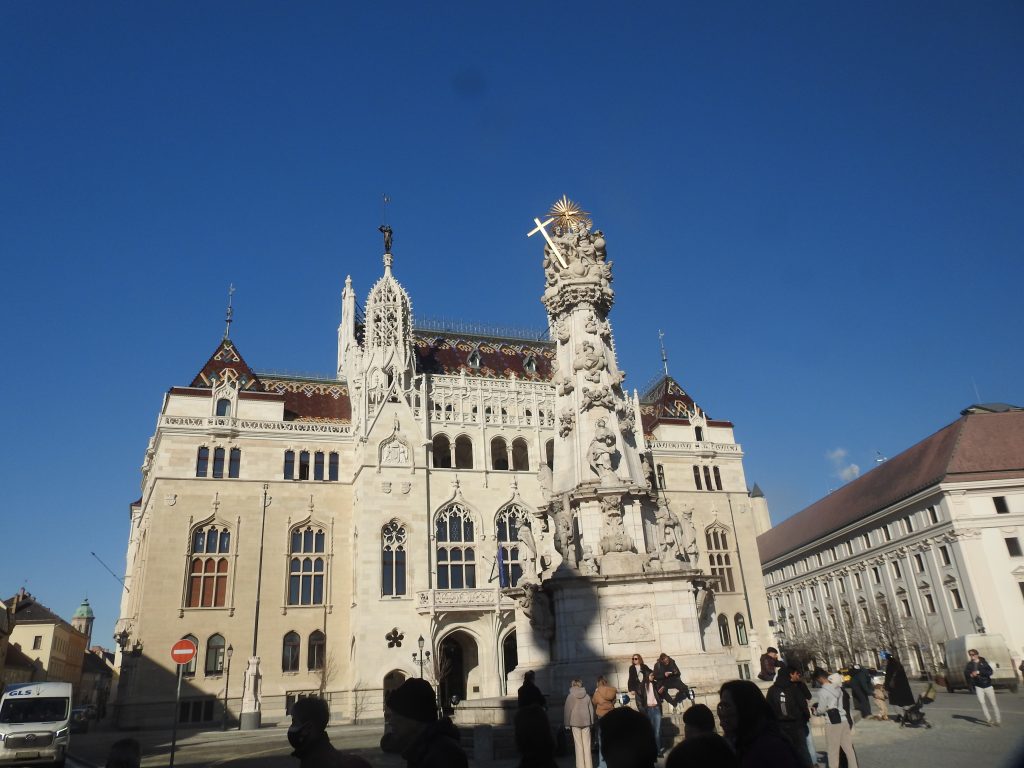
That photo shows two major Budapest landmarks in one frame:
🏰 Matthias Church
Official name: Church of Our Lady
One of Budapest’s most important medieval churches
Famous for the colorful Zsolnay-tile roof, Gothic details, and royal coronations
Kings were crowned here—including Franz Joseph I of Austria-Hungary
It’s been rebuilt and restored many times, which is why it looks so crisp and ornate today.
✝️ Holy Trinity Column
The tall sculpted column in front
Erected in the early 1700s after a devastating plague epidemic
Typical Baroque plague monument you’ll see across Central Europe
At the top: the Holy Trinity, angels, and saints invoked for protection
These columns were both religious and communal “thank-you” monuments—we survived made in stone.
Why this pairing matters
You’re seeing layers of history stacked together:
Medieval Hungary (Matthias Church)
Baroque Catholic Europe (plague column)
Modern Budapest flowing around them
It’s also right by Fisherman’s Bastion, which explains the open space and all the people—this is one of the city’s visual heartbeats.
Close-up — this is the crowning scene of the Holy Trinity Column in front of Matthias Church.
Here’s what you’re seeing, decoded:
✝️ The three central figures
This group represents the Holy Trinity:
God the Father (right)
Christ the Son (left)
The Holy Spirit (above)
The golden halos and sunbursts are deliberate—meant to catch the light so the monument glows against the sky, especially in sunlight (as your photo shows perfectly).
👼 The cherubs
The small children around them are putti (angelic figures). In plague monuments, they often symbolize:
Souls of the dead
Innocence
Hope after catastrophe
🗡️ The lone figure on the spire (left)
That armored figure is Saint Michael, protector against evil and disease. His presence reinforces the monument’s purpose: divine protection after mass death.
Why plague columns looked like this
After devastating outbreaks (often killing 10–30% of a city), communities promised God they’d build a monument if they survived. The result was:
Your tight framing really emphasizes what the original designers wanted: faith towering over fear, literally set against an empty, endless sky.
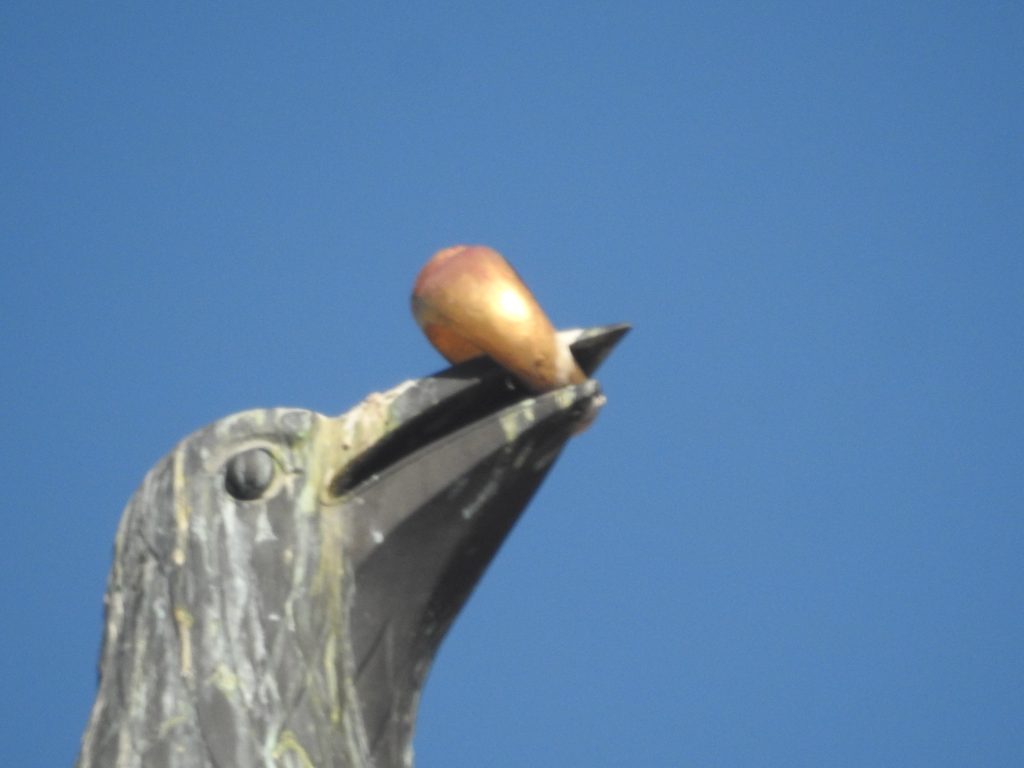
Close-up of the raven of Matthias Church, and that little object in its beak is a ring.
Here’s the story behind it 👇
🐦 The raven and the ring
The raven is tied to Matthias Corvinus, one of Hungary’s most admired kings (15th century).
According to legend:
Matthias was traveling incognito when a raven stole his signet ring
The ring symbolized his royal authority
He chased the bird down, recovered the ring, and took it as a personal emblem
From then on, the raven holding a ring became:
Matthias’s personal symbol
A symbol of legitimacy, vigilance, and rightful rule
That’s why you see it:
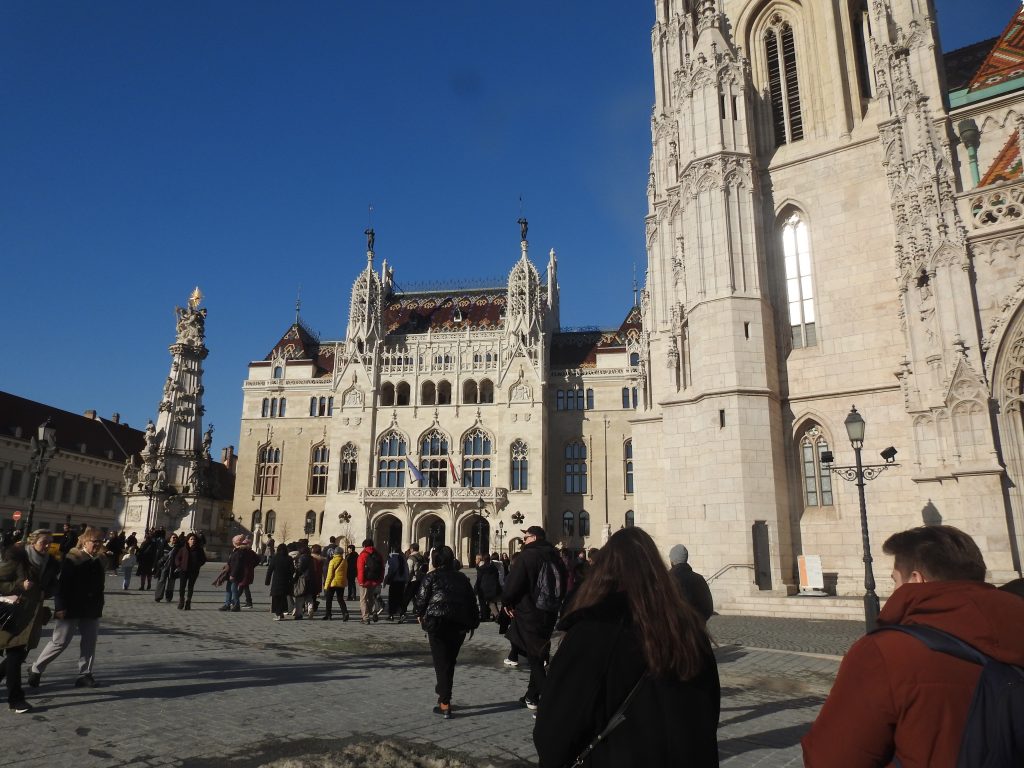
This wide shot pulls everything together — you’re standing in Holy Trinity Square, the heart of Buda Castle Hill.
Here’s what you’re seeing, left to right:
✝️ Holy Trinity Column (left)
The tall Baroque column you’ve been zooming into
Built after the 18th-century plague as a thanksgiving monument
Designed to be seen from everywhere in the square — vertical, dramatic, heaven-pointing
🏛️ Matthias Church (right)
The soaring Gothic church dominating the right side
Coronation church of Hungarian kings
Lavishly restored in the late 1800s, which is why it looks “medieval-perfect”
You can spot:
🚶 The crowd (foreground)
This is exactly how the space is meant to work:
Pilgrims, citizens, tourists all mixing together
No fences, no elevation barriers
The monuments are part of daily life, not cordoned-off relics
Medieval squares were social spaces first — worship, markets, announcements, justice — and this one still functions that way.
Why this square feels so balanced
You’ve got a deliberate composition:
Faith remembered (plague column)
Power legitimized (Matthias Church)
People present (the crowd)
It’s Hungarian history told horizontally and vertically at the same time — up toward heaven, out toward the people.
Your earlier close-ups were perfect detective work; this shot is the payoff that shows why those details mattered.
Personal note, this is where I lost sight of Eileen. There were six groups here, I was taking photos and the group Eileen and I were with (or, at this time, Eileen was with) moved on.
I saw a hat that was much like Eileen’s and followed the group that hat was in. After a few blocks it turned out NOT Eileen’s. I returned to the church, not one of the groups were there. I walked toward where another group was in the distance, not the right one. I walked back to the church, no one there. I waited about 10 minutes, then realized that I was not going to find them.
I retured to the subway station where we had emerged earlier in the day and sat on the same bench as before and waited. I thought that Eileen would come back that way. The tour was supposed to be from 10 to 12. I waited until 1:30 and then decided to go back to the hotel. Eileen met me at the hotel about 15 minutes after I had arrived.