The Trump Administration Just Declared All Foreign Exports Unfair
By the administration’s logic, Iowa is hurting Arizona by producing so much corn. This is a very silly way to think about economic policy.
During his first term in the White House, President Donald Trump reportedly scribbled the phrase TRADE IS BAD into the margins of a speech he was preparing to give to other world leaders.
That remains the most concise illustration of Trump’s economic views when it comes to the free exchange of goods. And if you wanted to see what that phrase would look like when translated into an official government policy, look no further than the announcement made by U.S. Trade Representative Jamieson Greer on Wednesday, as he outlined the administration’s plans for more tariffs targeting imports from 16 of America’s largest trading partners.
“Across numerous sectors, many U.S. trading partners are producing more goods than they can consume domestically,” Greer said in a statement. “This overproduction displaces existing U.S. domestic production” and harms American manufacturing as a result.
Does it? Let’s think about this for a moment.
At the most basic level, this is no different from saying “trade is bad.” Greer is suggesting that the mere fact of other countries selling products into America should be considered an “unfair” trade practice that could trigger tariffs.
Such excess production is fundamental to trade at every level. A baker will make more loaves of bread than she can eat because she can sell the rest to earn money that can be used to buy clothes, shoes, other types of food, and so on.
For the same reason, a farmer has an incentive to grow more food than his own family can consume.
The farmer’s excess production is what allows the baker to have fresh fruits and vegetables, while the baker’s excess production allows the farmer to have bread without making it himself. To take it a step further, the farmer’s production also boosts the baker’s output, as she can now make apple pies with what she buys from the farmer. Trade is not a zero-sum game.
More simply: The whole point of having exports is so you can buy imports.
The global economy is more complex, but that fundamental principle remains the same. Half of all imports to the U.S. are raw materials and intermediate parts (the apples) that we use to manufacture finished goods (the apple pies). In other words, it is the excess production of lumber, copper, and aluminum in other parts of the world that allows us to make more finished goods here.
But, in Greer’s view, the farmer’s excess production is displacing the baker’s vegetable garden and apple trees. In Greer’s world, the baker would be better off if she had to grow her own apples to put in the pies she’s making, rather than trading with the farmer who has a surplus of apples. He should only grow as many apples as he can eat! Doing anything else is unfair.
Or think about this in terms of American states, if you prefer that analogy to global trade.
Is Iowa’s surplus corn production displacing the potential corn industry in Arizona and harming Arizonans? Of course not. Residents of Arizona are obviously better off because they can import loads of Midwestern corn rather than trying to grow their own in the middle of a desert. If we banned cross-state trade, would there suddenly be a thriving wild salmon industry in Missouri? No. This is a very silly way to think about an economy.
Indeed, the world that the Trump administration is envisioning—one where every nation produces exactly the right amount of every commodity and item that it needs to consume—is impossible as a practical matter because not every country has access to all raw materials in the proper amounts. There is no wild salmon in Missouri.
It would also be a much poorer world.
What if every farmer produced only enough food to feed himself and his immediate family? What if every shopkeeper stocked only enough goods to supply her own personal needs? What if Alaska refused to ship salmon to the rest of the country, or Iowa refused to export corn? That’s not a world I want to live in.
Trade, in fact, is good.
Trump’s failure on every front sending GOP into a death spiral
March 12, 2026 | 08:04AM ET
I spent the first hour of my day, reading story after story essentially saying that Donald Trump “miscalculated” in his catastrophically stupid war in Iran, which would seem to make the big damn assumption that this utter and complete moron “calculated” ANYTHING in the first place.
In fact, The New York Times headline had it this way atop their meandering story: How Trump and His Advisers Miscalculated Iran’s Response to War
That’ll be about enough of this damned nonsense.
This war never made any sense to anybody with a brain in their head, because here was what we knew for sure in its lead-up, and what we still know right now: Trump is a dangerous and impetuous idiot, who is capable of anything including attacking his own country, which is why his attack on Iran shouldn’t surprise a soul.
If I had to guess what was behind this insanity, I’d venture that in the last month or so, somebody inside the White House with a semi-cool head, and most likely his Chief of Staff Susie Wiles, was able to finally chase him off the golf course for 45 minutes, and force-fed him some unsavory polling numbers to go along with all those Big Macs that pointed to a looming disaster in November, if he didn’t change course but quick, and do something about them.
Trump heard that as a great chance to go bomb another country, so he invited his boss, Bibi Netanyahu and his 22,000 pages of war plans to share an unhappy meal, while they discussed how to deploy their human oil slick, Pete Hegseth, to carry out their favorite war crimes.
But that’s just me speculating about why we are in Iran right now when even Trump and his wreck of an administration can’t seem to tell us for sure. They change their story by the hour, and our service members and their families are paying a terrible price for it.
This was a totally preventable manmade disaster in the most volatile region in the world that is intensifying by the minute.
The dead and wounded are mounting, and that is our horrifying reality right now.
The most gruesome look at where we really are came from this eye-opening blast from Connecticut Sen. Chris Murphy on Bluesky Tuesday night. This sets the terrible scene right now better than I could ever hope to.
So essentially we are just bombing the bejesus out of the place and hoping victory will somehow rise out of the rubble. Calling these so-called plans “incoherent and incomplete” is about as nice as you can put it, but I do appreciate this senator’s direct approach to telling America the truth, because truth is the one thing you will never, ever get from the most notorious liar in American history.
We are in a very, very dangerous place right now, because America’s No. 1 convicted felon has managed to stick a gun to his own head and hold himself up. It really didn’t have to be this way, but anybody who has been paying even the slightest amount of attention the past decade or so knew this is exactly what would happen.
Trump actually entered his second term in decent shape, had the House and Senate falling at his fat little feet, and the political winds at his hunched back. In just 14 months, he’s incinerated all that goodwill, and his Republican House and Senate is starting to take on water.
Trump is failing everywhere, and I am telling you right now there is panic in the Grand Ol’ Party as we steam toward the midterms.
If the elections were to happen tomorrow, the Republican Party would most likely lose the House by 30-to-50 seats. Even the Senate would swing to Democrats with victories in just four of these flippable states: Alaska, Maine, North Carolina, Ohio, Texas, and Montana.
Trump would be no less dangerous — and maybe more so — but at least we could gum up his dirty works, and stare the rest of the world in the face and not be completely laughed at.
A new NPR/PBS News/Marist poll is out today with some stunning numbers.
Consider that Trump’s two strong points entering his second term were the economy and immigration. Now take a look at this:
-35% of Americans approve of how Trump is handling the economy, while 58% disapprove.
-40% of Americans approve of how Trump is handling immigration, while 57% disapprove.
These are devastating numbers for Republicans, but it gets worse, because perhaps the most important tell for what voters will do when they hit the voting booth is how they are feeling about both parties at the time, so get a load of this:
-53% of registered voters said they would support the Democratic candidate on the ballot in their district, compared to 44% who said they would support the Republican.
Generally any party garnering a number above +5% is jumping for joy. This +9% spread has no doubt triggered a tsunami warning for Republicans, and jibe with recent election results in which Democrats have been hammering Republicans in one election after another.
Here’s are some other random numbers from that poll:
-Trump’s job approval rating among Americans is 38%, while 57% disapprove of the job the president is doing, and 5% are unsure.
-Americans are nearly twice as likely to strongly disapprove (50%) of the job he is doing than to strongly approve (26%).
-55% of Americans say the state of the union is not very strong or not strong at all. 45% think the union is very strong or strong.
-More than six in ten Americans (61%) also report that the nation is headed in the wrong direction. 38% say the U.S. is moving in the right direction.
This points to a president and a party that is failing at historic levels. It is every bit as bad as most of us thought it would be after throwing our hands up in disgust at a country that is capable of literally anything except electing a woman to lead our country.
Which leads to our cold, hard reality right now. To hash that out, I’ll return to a piece I typed just two weeks after his election two Novembers ago. It is still the most read thing I have ever published. Here is the lede of that offering:
“I considered waiting to publish this dire warning about what will be coming in the wake of the America-attacking Trump’s inauguration in two months, because too many good people are being asked to process too many terrible things right now.
This simply had to be put to paper, though, because I would be remiss if I didn’t urgently warn you that Trump’s takeover of our military is at the top of his dirty to-do list, and at the tip of his toxic spear in his quest to murder our Democracy.
Once you understand that Trump will use his presidency and whatever is left of his miserable life to settle scores and return the favors of the crooked dictators, and slobbery weaklings in his political party, who helped put him back in office, you can better prepare for the hell that’s most assuredly coming.”
I actually considered not reminding you again of this today, but because you pay attention, you fully know what is at stake right now, and what this madman is capable of doing.
Since returning to our White House, Trump has misplayed every card on his table, and is now turning that table upside down, and treating it like so many bottles of ketchup.
He is cornered, failing, and lashing out.
Because he is incapable of calculating anything clearly, as we discussed up front, he will do what he does best and scream and moan. His problems will be everybody else’s problems. He is capable of anything, because he is an incapable president.
With that backdrop, here is how I ended that piece 16 months ago, and how I will end this one today:
“Throughout history, supposedly good men have been talked into doing heinous things because of blinding misjudgment, weakness, or rocket-fueled ambition.
Trump is counting on this weakness to exploit our military for his rotten gains because NOTHING Trump does with our military will be to protect the citizens of the United States of America. EVERYTHING Trump does with our military will be to protect himself from the citizens of the United States of America.
This is not a story of hope, my friends, but words of warning.
Like it or not, and as tired as we are, we must be vigilant and NEVER accept this as anything approaching normal in this country.
A repulsive coward who never had the guts to serve will do everything he can to get our armed forces to serve only him.
WE must be the resistance.”
(D. Earl Stephens )
March 12, 2026
We got more lies on Tuesday morning from the Pentagon press briefing. They’re now up to 17 different rationalizations for the attack on Iran, none of which makes sense.
To paraphrase Rod Serling, consider what happened in Minab, Iran.
A Tomahawk cruise missile, an American weapon, a weapon that Iran doesn’t own and can’t fire, struck a girls’ elementary school. One hundred and seventy-five people are dead, most of them little girls who showed up that morning to learn to read.
And Donald Trump stood in front of cameras and said Iran did it. He lied. About dead children. Without blinking. And his crew backed him up, even knowing it was a lie.
And now the corporate media will spend two days on this and then move on to whatever shiny object the White House throws next. That isn’t an aberration: it’s the GOP’s entire strategy. This is who they are and have been since Reagan pioneered the scam: a PR machine front for an iron-fisted oligarchy.
I’ve been studying authoritarian movements for 40 years, including in my book The Hidden History of American Oligarchy. I’ve written about how Hitler rose to power, how Mussolini consolidated his grip on Italy, how the Confederates took over the American South, how strongmen from Budapest to Brasília have used the same playbook again and again.
And the first page of that fascist and neofascist playbook is always the same: “Destroy the concept of shared truth.”
Not any particular truth. Not “this lie” or “that lie.” The concept of truth itself. Make people so exhausted, so confused, so beaten down by the constant barrage of contradictions, lies, and naked bulls— that they give up trying to figure out what’s real. Make cynicism feel like wisdom and encourage your “influencers” to make it cool. Make “nobody knows anything” feel like a reasonable way to understand what’s happening.
Because once you’ve done that, once you’ve convinced enough people that truth is just whatever you say no matter how outrageous or transparently false it is, you can do pretty much anything.
- You can bomb a school full of little girls and blame the victims.
- You can try to rig an election and, when you lose, call it stolen from you.
- You can watch a million Americans die and say the virus is just going to disappear.
- You can claim that tax cuts for billionaires will help average working-class people.
- You can say that increasing poisons in the air and on our crops will Make America Healthy Again.
- You can argue that destroying unions will increase working people’s standard of living.
- You can claim that taking people’s healthcare away “encourages individual initiative” and “independence.”
Trump didn’t invent this. But my G-d, has he ever perfected it.
Trump also didn’t build this lie machine all by himself. Most of it was built for him, over a period of 50 years, with billions of dollars, by morbidly rich people who never appear on television and never have to answer for any of it.
In 1971, a corporate lawyer named Lewis Powell wrote a memo to the U.S. Chamber of Commerce that became the blueprint for the takeover of America by the richest men in the country. Powell told the business community that they were losing America, that universities, the press, and the courts were all turning against “free enterprise,” and that if corporations didn’t fight back systematically and aggressively, capitalism itself was at risk.
What followed was one of the most consequential 50-year projects in American political history, every bit as nation-changing and dangerous as the Confederate movement of the 1840s.
- Think tanks were funded to produce “alternative” academic research that would always reach the “right” conclusions.
- Conservative media was built from the ground up, from 1,500 AM talk radio stations to Fox “News” to the rightwing takeover of social media, all to create an information ecosystem where Republican voters would never have to encounter an uncomfortable fact.
- Public schools and Civics classes were defunded and attacked, because an educated citizenry asks too many questions.
- Local newspapers, the institutions that actually hold local power accountable, were starved out of existence.
Charles and David Koch alone spent hundreds of millions of dollars seeding distrust in climate science, in government, in the very idea that collective action could solve collective problems. And they were just the tip of a massive iceberg.
This wasn’t an accident; it was a strategy.
And that strategy had one ultimate goal: to create a population of Americans so skeptical of institutions, so distrustful of expertise, so certain that everyone is lying all the time, that they’d be willing to believe anything.
Donald Trump didn’t create those people. They were created for him by these cynical billionaires.
And that means that removing Trump from power won’t dismantle the machine. Unless it’s defeated along with Trump, it’ll just produce another Trump, a smarter one, one who doesn’t make his lies and corruption quite so obvious.
The numbers around this project are staggering. Thirty thousand naked lies or misleading statements Donald Trump made during his first term alone. The Washington Post counted them: over 30,000.
That’s a man who woke up every single morning with the intention of deceiving the American people. That isn’t occasional dishonesty or spin: it’s a psychopathy — pathological lying — deployed as a governing strategy.
And it worked for Trump, just like it worked for Mussolini, Hitler, Putin, and Orbán before him.
- He told people that Barack Obama, a man who released his birth certificate, a man whose Hawaiian birth was verified by state officials, a man who graduated from Harvard Law, was secretly a Kenyan. Millions of people believed it then and millions still do to this day.
- He told people three million illegal ballots were cast against him in 2016 and that he won in 2020. While repeated investigations by reporters, federal agencies, and even courts (including the Supreme Court) found no evidence, he keeps saying it anyway.
- He told people Covid would disappear. “One day, like a miracle, it’ll just go away.” Over a half-million Americans are in the ground because of the lies Trump told during those early critical months when action could’ve saved lives.
- And then he told us all the biggest lie of all, the lie that almost ended the American experiment with democracy. When he lost in 2020 — lost fairly, lost decisively, lost in a contest that his own Attorney General, his own Homeland Security officials, his own judges said was legitimate — Donald Trump told his followers the election had been stolen.
Sixty-plus lawsuits, thrown out by every court that heard them. Even his own people told him the fraud claims weren’t true.
Nonetheless, he lied about it anyway. Louder. On repeat. For months.
And on January 6th, 2021, his mob stormed the United States Capitol, our Capitol, the symbol of 250 years of democratic governance, because this twisted man had spent months pouring gasoline on their rage and then lit the match at a rally a few blocks away.
People died. Police officers were beaten and four of them died. Members of Congress hid under their desks. And Donald Trump giddily watched it on television and did nothing for hours.
That’s who’s running the United States of America right now.
His supporters will tell you, as they always tell you, “that was then.” Move on. Stop living in the past. But here’s the thing: he never stopped.
- Back in power, he’s now claiming inflation was at record levels when he took office. It wasn’t.
- He’s claiming gas prices have dropped below two dollars in some states. They haven’t.
- He says climate change is a hoax. It’s not.
- He’s reviving the zombie lie that undocumented immigrants vote in American elections, a claim that multiple rigorous studies (including by the Heritage Foundation) have demolished but Republicans keep reciting, because it serves the GOP’s purpose of making Americans distrust their own elections.
- He’s pushing discredited claims linking vaccines to autism. He’s the President of the United States and he’s telling parents not to trust medicines that have saved millions of lives, based on a sham study that was retracted decades ago because the author fabricated the data.
- He’s claiming America pays for nearly the entire NATO alliance. We don’t. We pay a significant share, but 29 other nations contribute. This isn’t a matter of interpretation; it’s arithmetic.
These aren’t gaffes or misstatements. They’re deliberate lies. Each one chips away at some aspect of American life and governance, at trust in elections, trust in science, trust in institutions, trust in the basic idea that we can all look at the same facts and reach the same conclusions.
That’s the goal of these billionaires who fund the GOP and put Trump into office. And their buddy, Vladimir Putin, whose bots so heavily populate our social media. It’s always been their goal. And it was their goal long before Donald Trump came down that escalator.
And then there are Trump’s toadies and lickspittles, the hangers-on. Let’s not let the enablers off the hook, because this machine doesn’t even remotely run on Trump alone.
Pete Hegseth, an alleged alcoholic wife-beater whose own mother called him “an abuser of women” who, she wrote, “belittles, lies, cheats, sleeps around, and uses women for his own power and ego,” was handed the most powerful military in human history despite having no meaningful qualifications for the job. He was confirmed by Republicans in the Senate in what future historians will call one of the greatest acts of institutional cowardice in American history.
This is the man who stood in front of cameras after Minab and said Iran was the only side targeting civilians. One hundred and sixty dead children. Footage of an American Tomahawk missile. And Pete Hegseth looked America in the eye and lied.
Hegseth, Vance, Noem, Bondi, Miller, Vought, et al, aren’t confused or mistaken. They absolutely know what they’re doing and what lies they’re telling. And they’re counting on enough of us being too tired, too overwhelmed, too beaten down by 50 years of relentless Republican dishonesty to push back.
Don’t be.
Democracy isn’t a building. It’s not a flag or even a Constitution, as important as that document is. Democracy is a shared agreement, an agreement that we’ll resolve our differences through votes and not violence, that we’ll be governed by facts and not whoever yells the loudest, that when we disagree about what happened we can at least look at the evidence together.
That agreement didn’t just happen into existence; it took over three centuries to build. It was, as I write in The Hidden History of American Democracy, built on the Enlightenment and Native American idea that reason matters, that evidence is meaningful, that human beings are capable of governing themselves when they’re told the truth and well-informed.
This 50-year project I’m describing has been a direct assault on that very idea of self-governance. Defund the schools. Kill the local press. Teach people that experts are “elitists,” science is opinion, and government is always the enemy. Then stand back and watch what happens to a democracy that’s been hollowed out from the inside.
Donald Trump is what happens. CBS is what happens. An unprovoked war against Iran is what happens.
Our nation’s Founders and the Framers of the Constitution understood this. They knew that a free press and an educated citizenry aren’t luxuries: they’re the load-bearing walls of the republic. Knock them out and the whole thing comes down.
We’ve been watching someone kick at them for 50 years. Trump is just the most recent, least sophisticated, and grossest wrecking ball they finally decided to throw at us.
And 160 children in Minab are dead, and the men responsible are pointing their fingers at the country they bombed and saying, “Iran did it.”
Trump is basically inviting Iranian partisans to attack America with the ferocity and style of 9/11, hoping it’ll provoke a “rally around the president” moment like Bush got and the Reichstag Fire did.
As fascism expert Timothy Snyder writes:
“A purpose of the war on Iran might well be to provoke a terrorist attack inside the United States. This would provide Donald Trump with a pretext to try to cancel or ‘federalize’ the coming Congressional elections.”
This is what it looks like when a democracy is in genuine danger.
The rightwing lie machine was built to make you feel like nothing you do matters. Like it’s all just too big. Like you’re way too small. Like the liars always win, so, “Why bother?”
That’s both the first and the last lie they need you to believe.
Don’t
CAUGHT AGAIN
When President Donald Trump and his allies targeted pro-Palestinian activists for deportation, civil libertarians were quick to sound the alarm. Trump, they stressed, had every right to criticize their views, but targeting them for deportation because of those views was anti-First Amendment. Now, a federal judge appointed by President Ronald Reagan, Judge William G. Young, is taking the Trump administration to task. In a ruling handed down on Wednesday, March 11, Young ruled that targeting pro-Palestinian activists for deportation because of their views “was unconstitutional, abhorrent to a society that cherishes free speech.” Young wrote, “As this Court recognizes, the entire theory of this administration is that of a unitary executive with no agency independence where every single employee within the Article II executive dances to the tune of the President…. This conduct must never happen again.”Cue ‘1984’
Inside Trump’s new plan to round up homeless veterans
March 12, 2026 | 07:11AM ET
President Donald Trump’s new proposal for addressing widespread veteran homelessness involves forcibly institutionalizing hundreds or even thousands of them — and this is raising concerns about civil liberties.
“Our new partnership with the Justice Department reflects our ongoing commitment to ensuring that every veteran receives timely, appropriate care,” explained Secretary of Veterans Affairs (VA) Doug Collins in a public statement. The VA says that they will initiate legal guardianships for veterans who are either homeless or “at risk of homelessness,” thereby empowering the federal government to involuntarily commit them to care facilities.
“Critics say the policy shift raises significant civil liberties concerns, noting that in earlier generations, people with severe mental illness were routinely stripped of their legal rights and confined to state hospitals,” reported The New York Times.
Representative Mark Takano, the top Democrat on the House Committee on Veterans’ Affairs, said that “the Trump-Vance administration is pursuing policies that would push hundreds, if not thousands, of veterans into institutions and court-ordered guardianships.”
Takano added, “Guardianship should always be a last resort, after all less restrictive options have been exhausted, to ensure veterans’ rights are respected.”
By contrast, Michael Figlioli, the director of the National Veterans Service for the Veterans of Foreign Wars, said “that some of our nation’s most vulnerable veterans must be approached through a public health and social services framework” and argued that if the program is carried out thoughtfully, guardianships could offer more “structured support” for vulnerable veterans. At the same time, he said that there would need to be due diligence taken to account for “veterans’ privacy, potential implementation gaps and the need for sufficient resources.”
As the Times reported, “There are about 33,000 homeless veterans in the United States, about 14,000 of whom live on the streets. Veterans make up around 5 percent of the unsheltered homeless population.”
Prior to this policy change, Trump has often disappointed veterans. He in March on a promise to establish a National Center for Warrior Independence, and his sweeping cuts to the federal workforce led to 62,000 veterans losing their jobs.
“The Trump Administration has radically slashed the federal civilian workforce, sidestepping Congress and causing disruptions, slowdowns, and fragility in a range of critical public services that people and communities depend on,” wrote the Center on Budget and Policy Priorities earlier in March. “Veterans have been affected by these cuts both as members of the federal workforce and as recipients of federal health care and other benefits available to them based on their service.”
Trump has also been accused of showing disrespect toward veterans, such as earlier in March when he ignored protocol and left his hat on while greeting the remains of six soldiers killed in his Iran war.
“This fool has ABSOLUTELY no sense of dignity or appreciation for the moment,” Michael Steele, Republican National Committee chair from 2009 to 2011, wrote on X. “It is called the Dignified Transfer for a reason. Take your damn hat off!!”
Douglas Heye, a former communications director for the Republican National Committee, said that there is a partisan double standard.
“I know what Republicans would have said if Obama had done this — I would have written the statement,” Heye posted on X. “Shameful.”
A , including Trump’s former chief of staff and retired Marine Corps. General John F. Kelly, have said that Trump privately referred to soldiers as “suckers” and “losers” because he could not understand them fighting for things other than self-interest.
How far out of touch is tRump?
President Trump argued the U.S. benefits when oil prices go up on Thursday amid growing concerns over the impact of Washington’s operation in Iran on energy costs. |
Have money? Build up your military when a bully attacks.
Iran is planning a massive arms deal — Buying over 40 Chinese Chengdu J-10C fighter jets to boost its air power.
Iran may expand its missile arsenal from 2,500 to as many as 10,000 by 2028, according to new estimates. ~ The Jerusalem Post.
The Iranian President “We will abandon our nuclear program on the condition that Israel gives up its nuclear weapons.”
India has discussed the supply of S-400 air defense systems and upgrades to Su-30 fighter jets with Russia.
Senator Richard Blumenthal
Senator Richard Blumenthal walked out of a classified briefing on the escalating conflict with Iran looking visibly shaken and he didn’t hold back when speaking to reporters afterward.
According to Blumenthal, the briefing left him more frustrated than any he has attended during his 15 years in the Senate.
“I come out of this briefing as dissatisfied and frankly as angry as I’ve been after any briefing in my time in the Senate,” he said. “Instead of clarity, I’m left with more questions than answers especially about the cost of this war. Those questions still haven’t been answered, and I intend to keep demanding answers because the American people deserve them.”
Concerns about the financial cost are already mounting. A report from The Washington Post indicated that the United States spent roughly $5.6 billion on munitions in just the first two days of the conflict. For many critics, that figure highlights a troubling contradiction: the same leaders who frequently claim there isn’t enough funding for healthcare, education, or social services appear willing to spend billions on a war almost overnight.
Blumenthal also raised alarms about the potential human cost particularly the possibility of American troops being sent into Iran.
“What worries me most is the risk to American lives if this escalates into deploying our sons and daughters on the ground in Iran,” he said. “Right now, it seems we may be moving down a path where U.S. troops could be sent in to achieve whatever objectives are being considered.”
He also pointed to a broader geopolitical risk. Intelligence discussed in the briefing, he suggested, indicated the possibility of outside powers becoming more deeply involved.
“There is the deeply troubling possibility of active Russian support for Iran,” Blumenthal warned. “It appears Russia may already be providing intelligence and possibly other forms of assistance. There are also concerns that China could be offering support as well.”
For Blumenthal, the lack of transparency surrounding the conflict is unacceptable.
“The American people deserve to know far more than what this administration has told them so far about the financial cost, the risks to our service members, and the possibility of this conflict expanding into something far larger,” he said. “This is a war that was chosen by the president, not by the American people, and it could have enormous consequences.”
The senator’s reference to a “war of choice” reflects a growing debate in Washington. Critics argue that the administration moved forward with military action without clearly explaining its strategic objectives or seeking explicit authorization from Congress something many lawmakers believe is required under the Constitution.
Beyond the legal and political questions, analysts also warn about the practical realities of a potential ground conflict with Iran. The country has a population of roughly 93 million people, a vast territory that is significantly larger than Iraq, and extremely rugged terrain dominated by mountains. Military experts frequently caution that any large-scale ground invasion would be extraordinarily difficult and costly.
As tensions continue to rise, lawmakers like Blumenthal are calling for greater transparency and oversight arguing that before the United States moves any further down the path of war, the public deserves clear answers about the strategy, the risks, and the true cost.
“Whatever you do, don’t ask President Donald Trump”
Minimally competent leaders would have considered at least five obvious questions before launching the nation into war. PresidentNo. 1: What’s the Objective?
It’s not surprising that more than half of all Americans oppose Trump’s War. From the outset, his administration has offered numerous and contradictory justifications for it. February 28: Trump cited 47 years of grievances, a desire to destroy Iran’s missiles, and a message that the Iranian people should “seize the moment” because now was their chance to “be brave, be bold, be heroic, and take back your country.” But he also said that the attack was a campaign to “eliminate the imminent nuclear threat,” although Trump had boasted in June that the United States had already accomplished that goal. The next day, Pentagon officials told congressional staff members that no intelligence supported the notion that Iran was planning to attack the US first. The same day, Trump told the Washington Post, “All I want is freedom for the people.” United Nations Ambassador Mike Walz claimed to the UN Security Council that the US was invoking the right of self-defense in response to Iran’s imminent threat. But the next day, Pentagon officials told congressional staff members that no intelligence supported the notion that Iran was planning to attack the US first. March 2: Secretary of Defense Pete Hegseth told the press that the objective was retaliation for decades of Iranian behavior, destruction of their missiles, and providing an opportunity for Iranians to “take advantage of this incredible opportunity.” But only hours later, Secretary of State Marco Rubio offered a new justification for the war: Israel was going to attack Iran and, if that happened, Iran would then attack US interests in the region. He made it sound as if Israel’s Prime Minister Benjamin Netanyahu had maneuvered Trump into a corner. The next day, Trump contradicted Rubio, saying: “It was my opinion that they [Iran] were going to attack first. They were going to attack if we didn’t do it.” Rebutting any impression that Netanyahu had manipulated him, Trump added, “If anything, I might have forced Israel’s hand.” Rubio complained that his earlier remarks had been taken out of context and the operation “had to happen anyway.” March 6: Trump posted on social media that only “unconditional surrender” would end the war.No. 2: How Long Will It Last?
March 1: Trump told the New York Times that the operation could take “four to five weeks.” He didn’t mention the Pentagon’s concerns that the war could further deplete reserves that military strategists have said are critical for scenarios such as a conflict over Taiwan or Russian incursions into Europe. March 2: Trump said that the war could go on longer than four to five weeks. March 4: Hegseth said that the Iran war is “far from over” and has “only just begun.” March 6: Trump told the New York Post that he hadn’t ruled out putting “boots on the ground, if necessary.”No. 3: Who Will Lead Iran After US Strikes Kill Its Supreme Leader?
March 1: Trump told the New York Times that he had “three very good choices” for who could lead Iran. March 3: Trump admitted: “Most of the people we had in mind are dead… Now we have another group. They may be dead also, based on reports. So I guess you have a third wave coming. Pretty soon we’re not going to know anybody.” Asked about the worst-case scenario for the war, Trump said, “I guess the worst case would be we do this and somebody takes over who’s as bad as the previous person.” More than a dozen Mideast countries are now embroiled in Trump’s war, including Israel, Saudi Arabia, UAE, Qatar, Kuwait, Bahrain, Oman, Jordan, Iraq, Syria, Lebanon, and Yemen. March 5: Trump told Axios, “I have to be involved in the appointment [of Iran Supreme Leader Ayatollah Khamenei’s successor], like with Delcy in Venezuela”—referring to Vice President Delcy Rodriguez, who remained in charge of President Nicolás Maduro’s corrupt and repressive regime after the US abducted him. Trump said that Khamenei’s son—rumored to be a leading candidate as successor—is “unacceptable to me” and “a light weight.” The same day, he told NBC News, “We have some people who I think would do a good job.” March 7: The Washington Post reported that a classified National Intelligence Committee study issued prior to the war found that even if the US launched a large-scale assault on Iran, it likely would not oust the Islamic republic’s entrenched military and clerical establishment. March 9: Iran chose Khamenei’s son, a cleric expected to continue his father’s hard-line policies, as the country’s Supreme Leader.No. 4: How Would a US-Iran War Affect the Mideast?
Before US bombs began to fall, thousands of American citizens were in the war zone. But ahead of the strikes, the State Department didn’t issue official alerts advising Americans that the risk of travel in the region had increased. Yael Lempert, who helped organize the evacuation of Americans in Libya in 2011 observed, “It is stunning there were no orders for authorized departure for nonessential US government employees and family members in almost all the affected diplomatic missions in the region—nor public recommendations to American citizens to depart—until days into the war.” After attacks and counterattacks closed airspace and airports throughout the region, on Wednesday, March 4—four days into the war—the State Department finally began evacuations by charter flight. The following day, the New York Times reported:Until midweek, the State Department had mainly provided stranded travelers with basic information about security conditions and commercial travel options via a telephone hotline and text messages. Before Wednesday, desperate people calling the hotline got an automated message that said the US government could not help get them out of the region.
No. 5: Could the War Lead to Humanitarian, Economic, or Geopolitical Crises?
Only a week into the war, the UN humanitarian chief warned, “This is a moment of grave, grave peril.” Iran is a country of 90 million people. US-Israel bombing has already displaced more than 100,000 of them. Israel’s companion attack on Lebanon has displaced more than 300,000 residents. Asked to rate his Iran war performance on a scale of one to 10, Trump gave himself a “15.” More than a dozen Mideast countries are now embroiled in Trump’s war, including Israel, Saudi Arabia, UAE, Qatar, Kuwait, Bahrain, Oman, Jordan, Iraq, Syria, Lebanon, and Yemen. The ripple effects span the globe as oil prices spike and Iran disrupts tanker traffic in the Strait of Hormuz—through which one-fifth of the world’s oil flows. During his state of the union message, Trump boasted that the price of gasoline was down to $2,00 per gallon in some states. Last week, the national average price in the US was $3.41 per gallon. Ominously, on March 6 the Washington Post reported that Russia is providing intelligence assistance to the Iranian military attacking US targets. But Hegseth is “not concerned about that.” Asked to rate his Iran war performance on a scale of one to 10, Trump gave himself a “15.” Introspection rarely accompanies incompetence.
A “war of whim”
Iran has an evil regime and a 47-year record of hostility toward the United States. But it was hard to argue, even before the current bombing, that the Islamic Republic constituted a major threat to the U.S. (as opposed to Israel). Iran’s nuclear program may not have been “totally obliterated” by American air strikes in June, as Trump claimed, but it was definitely set back. There was no “imminent” threat from Iran to justify the war Trump launched on Feb. 28 out of the blue — and the cost of waging it (financed with deficit spending at a time when the national debt is already close to $39 trillion) is likely to hamper U.S. efforts to compete with much more significant adversaries, notably Iran’s allies Russia and China.
Russia is already benefitting from the Iran war. The rise in oil prices (near $100) a barrel on Sunday from $73 a barrel on the eve of war) and Trump’s decision to relax sanctions on India for buying Russian oil will help bankroll the Russian war machine. The U.S. is also rapidly burning through limited stockpiles of missiles, especially air-defense interceptors, that are badly needed in Ukraine. President Volodymyr Zelensky has said more Patriot missiles were expended in just three days of fighting with Iran than have been used by Ukraine since 2022.
Imagine how much Ukrainian energy infrastructure — and how many Ukrainian civilians — might have survived the winter if Trump had sent more Patriots to Ukraine rather than to what one journalist dubbed a “war of whim” with Iran.
Trump
His poll numbers right now are worse than Bush’s were in the summer of 2001; worse in many regards than any president in polling history. His approval ratings on literally every topic — from immigration to ICE to taxes to inflation to healthcare, etc., etc. — are underwater and sinking.
Further, there are allegations that the FBI is sitting on evidence related to claims Trump raped at least one and possibly two 13-year-old girls. His family is openly monetizing the presidency, with his nepo sons and son-in-law cutting real estate deals and cryptocurrency schemes with the governments of Saudi Arabia and the UAE while Trump pushes — against the advice of our intelligence agencies — to send advanced AI chips to those same countries.
The corruption is so brazen it barely qualifies as corruption anymore. Trump and his lickspittles have pulled off what was previously unimaginable: the reinvention of government as a machine to generate profit for the ruling family — much like Saddam Hussein had done in Iraq and Vladimir Putin has done in — all right out in plain sight.
Meanwhile, Trump’s ICE agents are terrorizing communities across the country, beating and intimidating American citizens, deporting legal residents without due process, and violating the Fourth and Fifth Amendments so routinely that constitutional scholars have stopped being shocked and started being terrified. Reports of ICE-related deaths of American citizens like Renee Good and Alex Pretti in Minneapolis are piling up as the Trump regime refuses to cooperate in state-level murder investigations.
On top of all these crises, the electoral landscape for November is looking catastrophic for Republicans. Trump and the GOP are staring down a potential wipeout in the 2026 midterms, which is why red-state legislatures are gerrymandering with abandon, why Trump is floating proposals to nationalize <elections, ban mail-in voting, and station ICE agents outside polling places in minority neighborhoods.
These are not the actions of a confident political party that believes it’s doing what’s best for average Americans. They are, instead, the actions of people who know they’re on the verge of losing power and facing accountability, and are therefore willing to destroy our very democracy to hold onto power.
So, Trump desperately needed something to change the subject. And right on cue, he launched an unprovoked military attack on Iran, apparently at the urging of Benjamin Netanyahu, who has his own desperate need to remain in power to keep himself out of prison for his own bribery and corruption scandals.
The bombing of Iran gave Trump a few days of wall-to-wall war coverage, pushing every other scandal (including Epstein) below the fold. It was a classic wag-the-dog maneuver, but so far it’s worked well enough to dominate the news cycle.
But here is where the rhyme with 2001 turns frighteningly dark.
Kash Patel, Trump’s FBI director, has fired or reassigned almost the entire FBI team responsible for tracking Iranian threats inside the United States. The specialists who spent years building intelligence networks to monitor Iranian-linked operatives on American soil have been purged from the agency, fired unceremoniously.
At the same time, Trump has let funding for the Department of Homeland Security lapse, leaving critical counterterrorism functions in limbo as Republicans in Congress refuse — at his insistence — to act. He’s systematically dismantled the very apparatus that exists to prevent a terrorist attack on the continental US or our assets around the world.
Ask yourself why. Why would a president who just bombed Iran simultaneously gut the very intelligence infrastructure built by previous administrations to detect and prevent Iranian retaliation? Why would you poke a hornet’s nest and then fire the guy with the EpiPen?
Unless you wanted to get stung.
The logic is almost too ugly to contemplate, but it tracks perfectly with recent history. Bush needed 9/11 and got it, and it saved his presidency. Trump needs something equally dramatic to reset his collapsing political fortunes.
A spectacular Iranian-sponsored attack on American soil, or even a major domestic attack by a radicalized actor inspired by the chaos Trump himself has created, would instantly transform him into a Bush-like “wartime president.”
It would push the bribery, the rapes, the constitutional violations, the ICE killings, and the election rigging off the front page overnight. It would give him emergency powers he has already shown he’s more than willing to abuse. It would give Republicans a reason to “rally around the flag” and postpone the reckoning that November 2026 currently promises.
This is not some wacky conspiracy theory: it’s simply pattern recognition. When a president provokes a hostile nation, then fires the people whose job it is to protect us from that nation’s retaliation, the conclusion is either staggering incompetence or something far more sinister.
We can’t afford to wait and find out which one it is.
Jared Kushner has some explaining to do
Did Jared set a trap?
Thom Hartmann March 08, 2026
Jared Kushner grew up sleeping in Benjamin Netanyahu’s bed.
That isn’t a metaphor or hyperbole. Netanyahu, during his visits to New York over the decades, was close enough to the Kushner family that, as the New York Times reported, . Jared Kushner didn’t grow up watching Netanyahu on the news the way the rest of us did. He grew up knowing the man as something close to a family institution.
And that man, who has said publicly that he has “yearned” to destroy Iran’s military and political leadership “for 40 years,” is the same man whose government may have been coordinating directly with Kushner in the days before the most consequential American military action since the invasion of Iraq or the Vietnam War.
We need to ask the question that official Washington is too timid, too compromised, or too captured by the moment’s war fever to ask: “Was Jared Kushner sitting across from Iranian negotiators in good faith? Or was he trying to get the Iranian leadership to meet together so Netanyahu could kill them all in one single decapitating strike?”
Here’s what we know. The third round of nuclear talks between the U.S. and Iran wrapped up in Geneva on Feb. 26th and 27th. The Omani foreign minister, who’d been mediating the talks for months, told CBS News on the eve of the bombing that a deal was “within our reach” and that Iran had fully given in to American demands and agreed it would never produce nuclear material for a bomb, or an ICBM capable of striking the United States.
A fourth round had already been scheduled for Vienna the following week to work through the technical details following final discussions in Tehran. The Iranian foreign minister told reporters his team was ready to stay and keep talking for as long as it took.
And then, less than 48 hours after those talks in Switzerland concluded, the bombs began to fall.
On the morning of Feb. 28th, Iran’s Supreme National Security Council was gathered together in their offices for meetings. That body, the one that manages Iran’s nuclear dossier and makes the regime’s most consequential decisions, is exactly where you would expect the Iranian leadership to be sitting after a round of talks with America that their own foreign minister was calling “historic.”
They were almost certainly deliberating whether to accept or reject Kushner’s American proposal. And Wall Street Journal, American and Israeli intelligence had verified that senior Iranian leaders would be gathered at three locations that could be struck simultaneously. How they knew that is, as the Journal carefully noted, still unknown.
In other words, Iran’s entire decision-making apparatus was assembled in one place most likely because they were in the middle of an active negotiation with Jared Kushner. The talks had created a predictable, intelligenceable window.
Diplomats who were part of the earlier rounds of talks now tell reporters that the Iranian side has come to believe they’d been misled, and that Tehran now views the Witkoff-Kushner negotiations as, in their words, “a ruse designed to keep Iran from expecting and preparing for the surprise strikes.”
That’s not the assessment of Iranian state media spinning a narrative after a military defeat; it’s the conclusion of people who were in the room, speaking to American journalists, on the record.
Now layer on top of that what we know about who Witkoff was meeting with in the days before they sat down with the Iranians. He flew to Israel and was briefed directly by Netanyahu and senior Israeli defense officials and then, with Kushner, flew to Oman and Geneva and sat across the table from the Iranian negotiators.
The man who briefed Kushner’s partner (Witkoff) before those talks — Netanyahu — is the same man who said on the night the bombs fell that “this coalition of forces allows us to do what I have yearned to do for 40 years.” He wasn’t even remotely subdued or reluctant about the possibility of the Middle East going up in flames, perhaps even igniting World War III. He was, instead, triumphant that he finally got an American president to do something he’d been unsuccessfully pushing for decades.
We also know that the Trump regime’s explanations for why the attacks happened when they did have collapsed into open contradiction. Secretary of State Marco Rubio initially the US struck because Israel was going to attack anyway and Iran would have retaliated against American forces. then went on television and flipped the scenario upside-down, saying he might’ve “forced Israel’s hand.”
The two most senior officials in the administration told two diametrically opposite stories within 48 hours of each other, and neither story explains why the diplomacy that the Omani mediator called substantively successful — that essentially got America everything we said we wanted — was abandoned without the final round.
None of this proves that Kushner was running a deliberate double-cross operation designed to concentrate Iranian leadership in a killable location. What it does prove, though, is that the question is entirely legitimate and demands an answer under oath.
This is not the first time in American history that such a question has had to be asked, or that it damaged America’s reputation on the world stage. In October of 1972, Henry Kissinger stood before the cameras and told the world that “peace is at hand” in Vietnam. The Paris negotiations, he assured everyone, were on the verge of ending the war.
But it was a lie: two months later, Nixon ordered Operation Linebacker II, the most intensive bombing campaign of the entire war, dropping more tonnage on North Vietnam in twelve days than had been dropped in all of 1969 and 1970 combined.
The Paris Peace Accords were signed in January 1973 on terms that serious historians have long argued were not meaningfully different from what had been on the table long before the bombing. Kissinger won the Nobel Peace Prize for those negotiations. His North Vietnamese counterpart, Le Duc Tho, however, refused to accept his share of the prize, saying that peace had not actually been achieved and the Vietnamese had been deceived because the negotiations were a sham. And he was right: the war dragged on for two more years and was ended by Jerry Ford with the fall of Saigon.
The question that has haunted the world since those 1973 negotiations is the same question hanging over Kushner’s Geneva talks today: were the talks ever meant to succeed on their own terms, or were they simply a setup to destroy the Iranian leadership even if they gave us everything we wanted?
There’s also the Ronald Reagan precedent. His campaign was credibly accused of running a back-channel to Iran to delay the release of American hostages held in Tehran so that Jimmy Carter couldn’t get a pre-election boost from securing their freedom. It took decades for anything close to a full picture to emerge, but now we know that the Reagan campaign successfully committed that treason just to get him into the White House in 1980.
We don’t have decades this time. A war is under way and Americans are already dying. The leadership of a modern, developed country of ninety million people has been decapitated. And every foreign ministry on Earth is watching and drawing conclusions about whether they’ll ever again trust American diplomacy.
If the Iranians were right that they were “negotiated” into a kill box, no government facing an existential American ultimatum will ever be able to assume our good faith again.
The damage this administration is doing to American credibility isn’t abstract or temporary: when a country uses the negotiating table as a targeting opportunity, it poisons the well for every administration that comes after it.
North Korea is watching. Iran’s neighbors are watching. China is watching. The next time an American president sends an envoy somewhere with a genuine offer of peace, why would anyone believe it? Le Duc Tho knew the answer to that question when Kissinger betrayed his Vietnamese negotiating partners in 1973. The world is apparently relearning it now.
Congress has the constitutional power and the institutional obligation to call Kushner and Witkoff before investigative committees and ask them directly: What did you know about Israeli targeting plans during the Geneva talks? When did you know it? What were you instructed to accomplish or delay? Did you communicate with Netanyahu’s government during the negotiations themselves?
The man at the center of this diplomacy grew up treating Benjamin Netanyahu like a member of the family. That’s not a reason to assume guilt, but it sure as hell is a reason to demand answers, loudly, now.
U.S. Tomahawk Hit Naval Base Beside Iranian School, Video Shows
The evidence contradicts President Trump’s claim that Iran was responsible for a strike at the school that killed 175 people, most of them children.
A newly released video adds to the evidence that an American missile likely hit an Iranian elementary school where 175 people, many of them children, were reported killed.The video, uploaded on Sunday by Iran’s semiofficial Mehr News Agency and verified by The New York Times, shows a Tomahawk cruise missile striking a naval base beside the school in the town of Minab on Feb. 28. The U.S. military is the only force involved in the conflict that uses Tomahawk missiles.


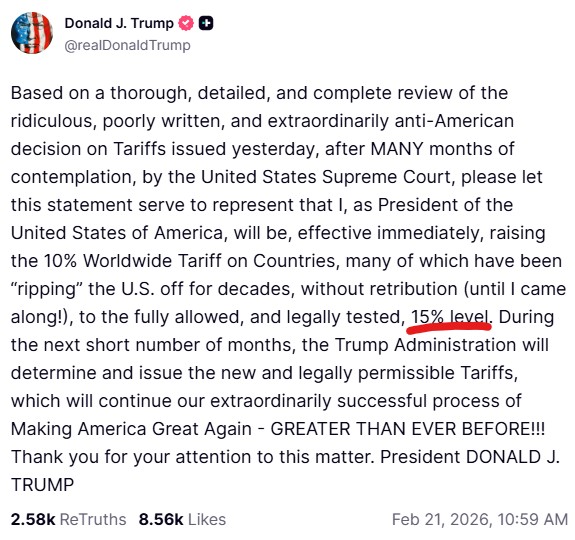


 Donald J. Trump@realDonaldTrump