
Adding fluoride to the water supply, a practice experts have lauded as one of the greatest public health achievements of the 20th century.
The discovery of fluoride’s oral health benefits traces to 1901, when a dentist in Colorado Springs noticed his patients had brown stained teeth that were oddly resistant to decay and cavities. It turns out they were drinking water from a spring with elevated levels of the naturally occurring fluoride mineral, which in large amounts can stain teeth.
Bacteria breaking down food produces acids that degrade the teeth, and fluoride works to replenish the lost minerals and strengthen the enamel.
Grand Rapids, Michigan, in 1945 became the first city in the world to fluoridate its drinking water, and long-term research showed the cavity rate plunged in children born after the mineral was added. By 1980, half of Americans drank fluoridated water after the practice rapidly gained steam — along with the conspiracy theories.
Jump to 2024:
Robert F. Kennedy Jr., a longtime vaccine skeptic whom President-elect Donald Trump has chosen to be his Health and Human Services secretary, wants communities across the nation to follow Lebanon’s lead and no longer add fluoride to the water.. Days before the election, Kennedy said the Trump administration on Inauguration Day would advise water districts to remove fluoride, which he referred to on X as “an industrial waste associated with arthritis, bone fractures, bone cancer, IQ loss, neurodevelopmental disorders, and thyroid disease.” Despite medical organizations characterizing Kennedy’s assertions as unfounded, Trump quickly supported the idea in an NBC interview.
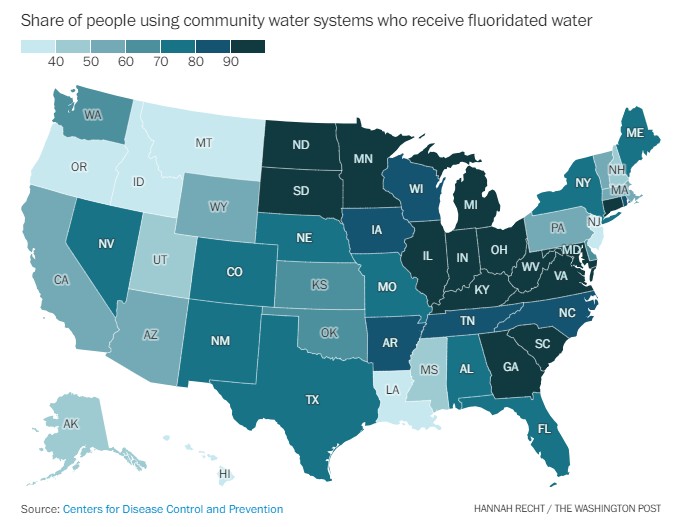
The newfound national attention on fluoride injects the intense partisan passions of a Trump presidency into an issue that historically has been hyperlocal. Most Americans drink fluoridated water to strengthen their teeth. A Florida city commission voted last week to remove fluoride, with one commissioner citing Kennedy’s comments.
St. Petersburg
In 1955 St. Petersburg had added fluoride to its water. In 1957 they stopped it to get a review from the Federal Government. After the review, the city again added the fluoride in 1959. It appears that subsequently it was stopped again.
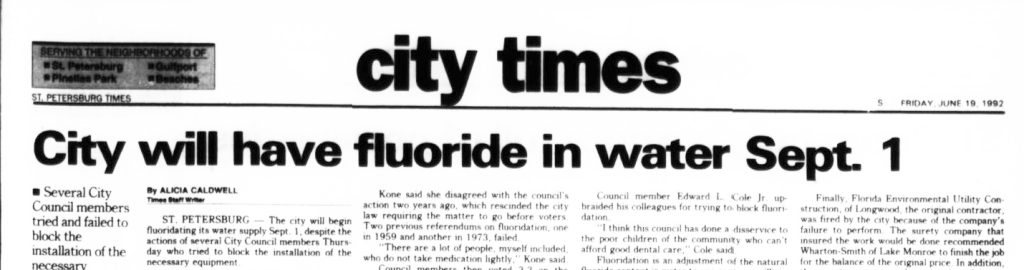
I worked for the City of St. Petersburg, Florida from 5/16/1989 11/15/1996 . The City decided to again add fluoride to the water in 1992. The amount was .04 ppm, or 0.000004%. Kind of a small amount. The headline in the June 19, 1992 City Times proclaimed that “City will have fluoride in water Sept.1”
I was the manager of Engineering Construction at the time, and was in charge of the contract to have the fluoride system installed.. The contract had gone out to bid and a contractor employed. In July the contractor called me and said “The specified pump to pump the fluoride is only made in France and it is not available. The company assured me that they will be able to manufacture it and get it to me in November.”
I did not think to go to the newspaper and tell them that there would be no fluoride in the water in September.
September 1 through the next two weeks the City was inundated with calls and letters about how the fluoride had made the water taste bad, it corroded water pipes, it made water heaters leak, and all kinds of ailments were caused by that horrible chemical.
No fluoride pump was in place, and no fluoride had been introduced into the water. All the hullabaloo was in people’s imagination.
Finally, in December we injected the tiny amount of fluoride into the water. The City did not receive one phone call or letter.
Some communities that have removed fluoride from municipal water supplies have noted a rise in tooth decay. In Canada, children in Calgary, where fluoridation was stopped in 2011, had more decay than neighboring kids in Edmonton, where fluoride stayed in water. Similar trends of more dental decay have turned up in Israel, which stopped fluoridating water in 2014, and in Juneau, Alaska, where fluoridation was stopped in 2007.
Cavities can lead to pain, trouble talking and eating, social and psychological harm. Untreated tooth decay, in kids and adults, can cause death. Fluoridated water is backed by medical organizations including the World Health Organization, the American Academy of Pediatrics and the American Dental Association.
“I think fluoride is on its way out,” Kennedy said in an NBC News interview hours after Trump secured victory. “I think the faster that it goes out, the better.” He said he would not compel water districts to remove the mineral but rather, advise them of their legal obligation to their constituents.
Dentists will again have lots of work filling unnecessary cavities. 123 years of progress dismissed by a crackpot.